










According to research conducted by the Center for Disease Control and Prevention one in three Americans age 65 and older fall. Recent findings by experts at the University of Tel Aviv, Israel, found that Ritalin improves cognitive impairments in seniors, which may greatly contribute to a decrease in falls.

The findings may be a step into the treatment of falls within the senior population, but Prof. Jeffrey M. Hausdorff, of Sackler School of Medicine at Tel Aviv University isn’t counting chickens before they hatch. “While the notion of treating fall risk with a pill is an intriguing concept it is not likely to be a silver bullet solution, and it is still too early to recommend Ritalin on a wide scale basis,” he said.

In 2005, the CDC analyzed 16,000 deaths in the elderly population in which unintentional falls were the fundamental cause of death making it among the top ten leading causes of death in senior citizens, a statistic that holds true today.

By the age of 18 years, two in every five South African schoolboys report being forced to have sex, mostly by female perpetrators. A new study, reported in International Journal for Equity in Health, reveals the shocking truth about endemic sexual abuse of male children that has been suspected but until now only poorly documented.

Some 28% of victims said a non-family member or teacher was the perpetrator. Another 28% had been forced by a fellow student, while 20% had been abused by a teacher and 18% by an adult family member.

Until 2007, forced sex with males in South Africa did not count as rape but as ‘indecent assault’, a much less serious offense.

In Optimizing The University - Why We Need a New Educational Model for a New Century I discussed some of the issues facing post-secondary science education.

In particular, that piece focused on how changing student demographics, modern faculty responsibilities and the new knowledge gained from advanced assessment techniques showed us that we need to fix fundamental aspects of science education if students are to receive the high quality education that is becoming increasingly important to individual and societal success.


Regular readers know that I have long predicted the current price of oil and that we are now moving through Peak Oil These subjects were included in my “Forecast for 2008”

To quote from that January 9, 2008 column:

“In 2008, gas will, for a period of time reach $4 on the national level. A year ago I predicted that oil would rise above $80. Three months ago I predicted that the price would rise to $100 and that the trading range for oil will be $80 – 125 a barrel for the next year…but there could be several situations that could drive the price above $125.”

Tired of your bulky microscope? Researchers at the California Institute of Technology have developed a super-compact high-resolution microscope, small enough to fit on a finger tip.

This "microscopic microscope" operates without lenses but has the magnifying power of a top-quality optical microscope, can be used in the field to analyze blood samples for malaria or check water supplies for giardia and other pathogens, and can be mass-produced for around $10.

"The whole thing is truly compact--it could be put in a cell phone--and it can use just sunlight for illumination, which makes it very appealing for Third-World applications," says Changhuei Yang, assistant professor of electrical engineering and bioengineering at Caltech, who developed the device, dubbed an optofluidic microscope, along with his colleagues at Caltech.

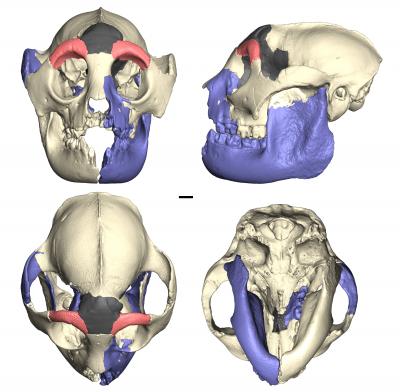
Penn State researchers have used computed tomography (CT) technology to virtually glue newly-discovered skull fragments of a rare extinct lemur back into its partial skull, which was discovered over a century ago. Alan Walker, Evan Pugh Professor of Anthropology and Biology at Penn State, and Research Associate in Anthropology Timothy Ryan, led the research.

The different fragments of this lemur's skull are separated by thousands of miles, with the partial skull in Vienna and the pieces of frontal bone in the United States. The result of the digital manipulation is a nearly complete skull of Hadropithecus stenognathus, which is one of only two known skulls for this species.

A fish-heavy diet has gotten another endorsement, this one saying that a lifetime of eating tuna, sardines, salmon and other fish appears to protect Japanese men against clogged arteries, despite other cardiovascular risk factors.

The research, published in the August 5, 2008, issue of Journal of the American College of Cardiology (JACC), suggests that the protection comes from omega-3 fatty acids found in abundance in oily fish. In the first international study of its kind, researchers found that compared to middle-aged white men or Japanese-American men living in the United States, Japanese men living in Japan had twice the blood levels of omega-3 fatty acids—a finding that was independently linked to low levels of atherosclerosis.

If you're a pessimist, the primate known as the "Kipunji'"discovered just three years ago, is already bordering on extinction.

If you're more of an optimist, you may think that its small numbers are why it was never discovered until recently so 1,117 of them are nothing to be alarmed about.

The Wildlife Conservation Society is in the alarm business so they're saying that the first-ever census of the forest-dwelling primate showing 1,117 individuals, according to a study released in the July issue of the journal Oryx, is worrisome.

A recent study published by the International Journal of Eating Disorders says that university undergraduate women who actively participate in sports and exercise-related activities tend to have higher rates of attitudes and behaviors related to eating disorders compared to those who do not regularly exercise.

The researchers concluded that women who have higher anxiety about their sport or exercise-related performance were even more likely to experience eating disorder symptoms and body dissatisfaction. This study is one of the first to document that women who participate in high levels of athletic competition and have sports anxiety are more likely to experience eating disorder symptoms.

A snapshot of New Zealand's climate 40 million years ago reveals a greenhouse Earth, with warmer seas and little or no ice in Antarctica, according to research published this week in the journal Geology.

The study suggests that Antarctica at that time was yet to develop extensive ice sheets. Back then, New Zealand was about 1100 km further south, at the same latitude as the southern tip of South America – so was closer to Antarctica – but the researchers found that the water temperature was 23-25°C at the sea surface and 11-13°C at the bottom.


