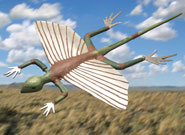
Archaeopteryx is famous as the world's oldest bird, but reptiles were flying about some 50 million years earlier than that (225 million years ago), even before large dinosaurs roamed the Earth.

A new study of extinct reptiles called kuehneosaurs, by scientists from the University of Bristol, England, shows that these early flyers used extraordinary extensions of their ribs to form large gliding surfaces on the side of the body. The results were published today in Palaeontology.

Kuehneosaurs, up to 70 centimetres (two feet) long, were first found in the 1950s in an ancient cave system near Bristol. Their lateral 'wings' were always assumed to be some form of flying adaptation, but their aerodynamic capability had never been studied before.

Genomic imprinting is a mechanism that regulates gene expression in the developing fetus and plays a major role in regulating its growth. Research published in Nature Genetics by a team of international scientists has established an identical mechanism of genetic imprinting which evolved 150 million years ago.

"This paper shows that we share a common genetic imprinting mechanism which has been active for about 150 million years despite the differences in reproductive strategies between marsupials and humans," said Professor Geoffrey Shaw of the Department of Zoology at the University of Melbourne, a coauthor on the paper.

Penn State researchers say they can produce greener, less expensive hydrogen for fuel using water, solar energy and nanotube diodes that use the entire spectrum of the sun's energy.

Currently, the steam reforming of natural gas produces most of our hydrogen. As a fuel source, this produces two problems. The process uses natural gas and so does not reduce reliance on fossil fuels; and, because one byproduct is carbon dioxide, the process contributes to the carbon dioxide in the atmosphere, the carbon footprint.

Craig A. Grimes, professor of electrical engineering, says their process splits water into its two components, hydrogen and oxygen, and collects the products separately using commonly available titanium and copper. Splitting water for hydrogen production is an old and proven method, but in its conventional form, it requires previously generated electricity. Photolysis of water solar splitting of water has also been explored, but is not a commercial method yet.

A group of scientists has used deep ocean-floor drilling and experiments to show that volcanic rocks off the West Coast and elsewhere might be used to securely imprison huge amounts of globe-warming carbon dioxide captured from power plants or other sources. In particular, they say that natural chemical reactions under 78,000 square kilometers (30,000 square miles) of ocean floor off California, Oregon, Washington and British Columbia could lock in as much as 150 years of U.S. CO2 production.

Interest in so-called carbon sequestration is growing worldwide. However, no large-scale projects are yet off the ground, and other geological settings could be problematic. For instance, the petroleum industry has been pumping CO2 into voids left by old oil wells on a small scale, but some fear that these might eventually leak, putting gas back into the air and possibly endangering people nearby.

Have you ever been puzzled by a statement like this: “Rotating a spin-1/2 particle by 360° does not bring it back to the same quantum state, but to the state with the opposite quantum phase; this is detectable, in principle, with interference experiments. To return the particle to its exact original state, one needs a 720° rotation.” (Wikipedia). Last week I zoomed back to 1820 and introduced Ørsted and his famous experiment, and left you with a promise of going mathematical tomb raiding. Tomb Raider was first released in 1996 for the Sega Saturn, and other platforms followed. The lore has it that this was the first mass market video game to be programmed using quaternions. Prior to that, rotations had been represented by Euler Angles or similar. Imagine you are flying an aeroplane. You are going in direction A, heading up or down at angle B, and your wings are tilted at angle C. Euler’s achievement in introducing these to the worlds of mechanics, astronomy, etc., in the mid-18th century was a landmark in itself. But they do come with mathematical problems when you are flying and tumbling at the speed of Lara Croft, one of which is that in certain orientations you can get a bad case of gimbal lock. Step in quaternions: the mathematical tomb raider who brought these to the worlds of video gaming and flight simulation appears to be Ken Shoemake, of the University of Pennsylvania, with a seminal paper in the journal Computer Graphics, 1985. But whom exactly did he, so to speak, “excavate”?

Remnants of the bacterium that causes stomach ulcers, Helicobacter pylori, (H. pylori) have been discovered in gastric tissue from North American mummies.

A study of human remains believed to predate Columbus' discovery of the New World has shown for the first time that H. pylori infection occurred in native populations, according to research published in BMC Microbiology.

As well as stomach ulcers, H. pylori causes gastritis, duodenitis, and cancer. It is a helix-shaped bacteria that is believed to be transmitted by the ingestion of food or water contaminated with faecal matter.

Nine out of ten regular food items aimed specifically at children have a poor nutritional content – because of high levels of sugar, fat or sodium - according to a detailed study of 367 products published in the July issue of the UK-based journal Obesity Reviews.

Just under 70 per cent of the products studied - which specifically excluded confectionery, soft drinks and bakery items - derived a high proportion of calories from sugar. Approximately one in five (23 per cent) had high fat levels and 17 per cent had high sodium levels. Despite this, 62 per cent of the foods with poor nutritional quality (PNQ) made positive claims about their nutritional value on the front of the packet.

"Children's foods can now be found in virtually every section of the supermarket and are available for every eating experience" says Professor Charlene Elliott from the University of Calgary, Canada, and a Trustee of the Canadian Council of Food and Nutrition.

Listen to science instead of Tiger Woods on golf? Sheer madness.

But golfers who heed the advice of instructors to keep their heads perfectly still while putting may be hampering their game, according to a study in the July issue of the Journal of Motor Behavior that examined coordination patterns.

Tim Lee, professor of kinesiology at McMaster University and a golfer himself, says the findings run contrary to conventional wisdom, or at least conventional golf wisdom.
 

The putting stroke is used more frequently than any other during a round of golf, regardless of skill. In 2007, putts represented 41.3 per cent of total strokes taken by members of the PGA tour, and 40 percent for members of the LPGA.

Israelis and Palestinians working together? Indeed, when it comes to combating tuberculosis.

Tuberculosis - or TB - is a deadly infectious bacterial disease that usually attacks the lungs. Acknowledged as a disease of crowds, it is transmitted from human to human living in close contact.

Dating back thousands of years, tuberculosis was well known in antiquity. However, according to Spigelman, it is still the biggest killer even today. One-third of the world's current population has been infected by tuberculosis, resulting, in recent years, in approximately three million deaths per year.

Plant sterols have been touted as an effective way to lower cholesterol and reduce the risk of heart disease. However, a research study in the July JLR has uncovered that these compounds do have their own risks, as they can accumulate in heart valves and lead to stenosis.

Aortic valve stenosis (AS) results from cholesterol accumulation in the valve between the left ventricle and aorta; this impedes the flow of blood and puts extra pressure on the heart. About 2% of individuals over 65 (and over 5% of those over 85) have AS, and as the population ages, it is becoming an increasing problem.

Plant sterols can block the absorption of dietary cholesterol into the body, and as such high vegetable diets and/or plant sterol supplements are often used to alleviate high cholesterol. However, although plant sterols themselves are poorly absorbed, they can enter the body, so Satu Helske and colleagues examined whether plant sterols can also accumulate in aortic valves.