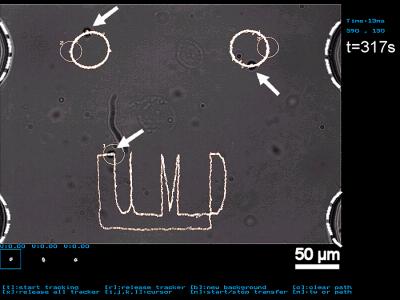









Current biochemical detectors are slow and produce an unacceptable number of false readings because they are easily fooled by subtle differences between deadly pathogens and harmless substances. They simply cannot fully monitor or interpret the different ways these substances interact with biological systems.

To solve this problem, three faculty researchers in the University of Maryland's A. James Clark School of Engineeringare are learning how to incorporate real cells into tiny micro-systems to detect chemical and biological pathogens.

They are collaborating across engineering disciplines to make advanced "cell-based sensors-on-a-chip" technology possible. Pamela Abshire, electrical and computer engineering (ECE) and Institute for Systems Research (ISR); Benjamin Shapiro, aerospace engineering and ISR; and Elisabeth Smela, mechanical engineering and ECE; are working on new sensors that take advantage of the sensory capabilities of biological cells.

Fallow agricultural land and steppe-formation processes are evidently capable of having a much greater effect on global air quality than was previously assumed, according to researchers who examined a dust cloud that formed over parched fields in southern Ukraine and led to extremely high concentrations of particulate matter in Central Europe.

Over two-thirds of the land area in the Ukraine consists of fields and meadows. The soil on 220,000 square kilometres is regarded as being under threat. Since the 1930s wind erosion in what was then the Soviet Union has increased considerably as a result of collectivisation in agriculture and the resultant large field areas.

In particular, this has affected the regions north of the Caucasus, the lower reaches of the Don river and eastern and southern Ukraine. It is possible that the process is also accelerated by climate change. In particular, previously unaffected semi-arid regions are continuing to dry out.

A gut hormone that causes people to eat more does so by making food appear more desirable, suggests a new report in the May issue of Cell Metabolism. In a brain imaging study of individuals, the researchers found that reward centers respond more strongly to pictures of food in subjects who had received an infusion of the hormone known as ghrelin.

The findings suggest that the two drives for feeding — metabolic signals and pleasure signals — are actually intertwined.

More and more U.S. college students are smoking tobacco using hookahs, a kind of water pipe, and it’s becoming a growing public health issue, according to a new study led by a Virginia Commonwealth University researcher.

In a hookah, tobacco is heated by charcoal, and the resulting smoke is passed through a water-filled chamber, cooling the smoke before it reaches the smoker. Some waterpipe users perceive this method of smoking tobacco as less harmful and addictive than cigarette smoking.

Principal investigator Thomas Eissenberg, Ph.D., associate professor in the VCU Department of Psychology, notes that current and prospective waterpipe tobacco smokers should be made aware that waterpipe tobacco smoking is not as benign as they might think. Waterpipe and cigarette smoke contains some of the same toxins -- disease-causing tar and carbon monoxide, as well as dependence-producing nicotine. Additionally, the exposure to these toxins through waterpipe smoking may be greater due to longer periods of use.

It has long been known that type 2 diabetes is linked to obesity, particularly fat inside the belly. Now, researchers at the Joslin Diabetes Center have found that fat from other areas of the body can actually reduce insulin resistance and improve insulin sensitivity.

In a study published in the May issue of Cell Metabolism, a team lead by C. Ronald Kahn, M.D. found that subcutaneous fat -- fat found below the skin, usually in the hips and thighs -- is associated with reduced insulin levels and improved insulin sensitivity.

A new revision of clinical guidelines to help doctors manage patients with depression has challenged the rationale behind the UK government’s policy of rolling out of cognitive behavioural therapy (CBT) for milder depression.

According to a comprehensive review of treatments for depression, there is a lack of evidence for CBT being more helpful than other forms of psychological support in mild depression or for its efficacy in severe depression. There is also good evidence for antidepressants being effective in depression, with benefit increasing the more severe the depression. This is contrary to recent reports that antidepressants don’t work except in the most severe depression.

Dr Ian Anderson, Senior Lecturer and Honorary Consultant Psychiatrist, Neuroscience and Psychiatry Unit, University of Manchester, UK, says the cost effectiveness of CBT should be thoroughly investigated before it is adopted more widely because it is likely to be offered to people with milder depression where the evidence is poorest.

Gambling activity is widespread among U.S. adolescents and young adults ages 14 through 21, according to a study conducted by researchers at the University at Buffalo’s Research Institute on Addictions (RIA).

Results of the first national survey of its kind show problem gambling -- described as gambling with three or more negative consequences (for example, gambling more than you intended or stealing money to gamble) in the past year -- occurring at a rate of 2.1 percent among youth 14 to 21. That ppercentage projects to approximately 750,000 young problem gamblers nationwide.

In addition, 11 percent of the youth surveyed gambled twice per week or more, a rate that describes frequent gambling. Sixty-eight percent of the youth interviewed reported that they had gambled at least once in the past year.

With over half of U.S. children ages 3-6 in child care centers, growing concern over childhood obesity has led physicians to focus on whether children are getting enough physical activity and a new study of outdoor physical activity at child care centers, conducted by researchers at Cincinnati Children’s Hospital Medical Center, has identified some surprising reasons why the kids may be staying inside.

“It’s things we never expected, from flip flops, mulch near the playground, children who come to child care without a coat on chilly days, to teachers talking or texting on cell phones while they were supposed to be supervising the children,” according to Kristen Copeland, M.D., lead author of the study.

Beads known to geologists as carbon cenospheres were formed from liquefied carbon deep in the earth when an asteroid struck some 65 million years ago, according to a new theory.

The carbon cenospheres were deposited next to a thin layer of the element iridium -- an element more likely to be found in Solar System asteroids than in the Earth's crust. The iridium-laden dust is believed to be the shattered remains of the 200-km-wide asteroid's impact. Like the iridium layer, the carbon cenospheres are apparently common. They've been found in Canada, Spain, Denmark and New Zealand.

But the cenospheres' origin presented a double mystery. Cenospheres had been known to geologists only as a sign of modern times -- they form during the intense combustion of coal and crude oil. Equally baffling, there were no power plants burning coal or crude oil 65 million years ago, and natural burial processes affecting organic matter from even older ages -- such as coals from the 300-million-year-old Carboniferous Period -- had simply not been cooked long or hot enough.

Over the past decades competition for fossil fuels and the concern that they are generating large quantities of contaminating gases have given rise to a growing scientific interest in the development of alternative energies.

Most current research is focused on hydrogen cells, the biggest advantages being that they do not generate contaminant gases and have water vapor as the only waste product. However, hydrogen is very expensive, both in production and distribution. It has to be kept and stored under conditions of very high pressure (more than 800 bars).

This is why hydrogen is dangerous and even more so when stored in vehicles travelling at high speed – a small crack in the storage container could have fatal consequences.

