










Socrates (470-399 BC) may have lived centuries ago but the methods connected with him never go out of date.

Socratic methods(1) have developed independently in various countries. They all describe similar methodological steps - an opening question is answered by all participants and followed by cooperative, critical analysis. Finally, the new ideas are connected to the everyday life experience of the participants.

This formal structure helps participants to try new, bold ideas that they might otherwise not have tested. By cooperating when examining the ideas they also seem to learn a way to address problems on their own without teacher intervention.

The majority of people prefer to start counting on their left hand, regardless of whether they are left- or right-handed, found a recent set of experiments.

In a subsequent odd-even task, the left-starters had more consistent spatial-numerical associations than the right-starters.

Simple numerical tasks, such as classifying digits as odd or even by pressing left or right buttons reveal that we like to associate small numbers with left space.

Where does this preference come from?


Credit: Storyblocks

Designer labels aren't just cool to pretentious New York women - they're also the dream of nuclear physicists.

Designer isotopes, the relatively new power scientists have to make specific rare isotopes to solve scientific problems and open doors to new technologies, will compete with nanotechnology for big breakthroughs, according to Bradley Sherrill, a University Distinguished Professor of physics and associate director for research at the National Superconducting Cyclotron Laboratory at Michigan State University.

Isotopes are the different versions of an element. Their nuclei have different numbers of neutrons, and thus give them different properties. Rare isotopes don’t always exist in nature – they must be coaxed out with high-energy collisions created by special machines, like those in MSU’s Coupled Cyclotron facility. As technology advances, newer equipment is needed.

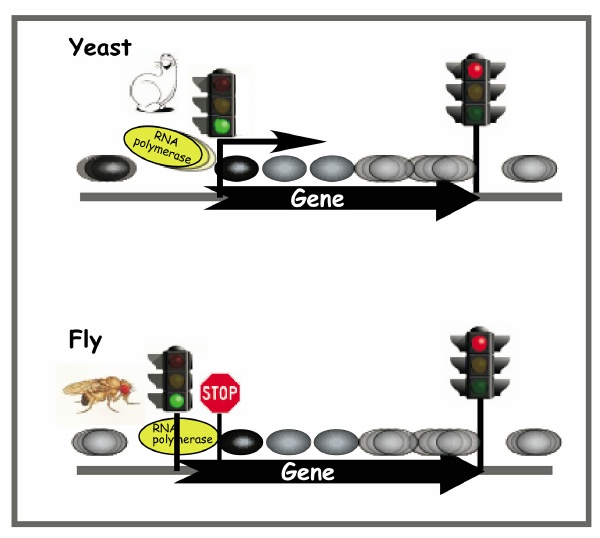
A team of scientists has provided, for the first time, a detailed map of how the building blocks of chromosomes, the cellular structures that contain genes, are organized in the fruit fly Drosophila melanogaster. The work identifies a critical stop sign for transcription, the first step in gene expression, and has implications for understanding how the AIDS virus regulates its genes.

The scientists found that nucleosomes--chromosomal building blocks made up of proteins around which DNA is coiled--occur at precise locations along genes that are actively undergoing transcription. They also showed that RNA polymerase--the enzyme that reads genes as the first step in making proteins--is stopped at the first nucleosome, where it remains idle until it is directed to continue moving forward.

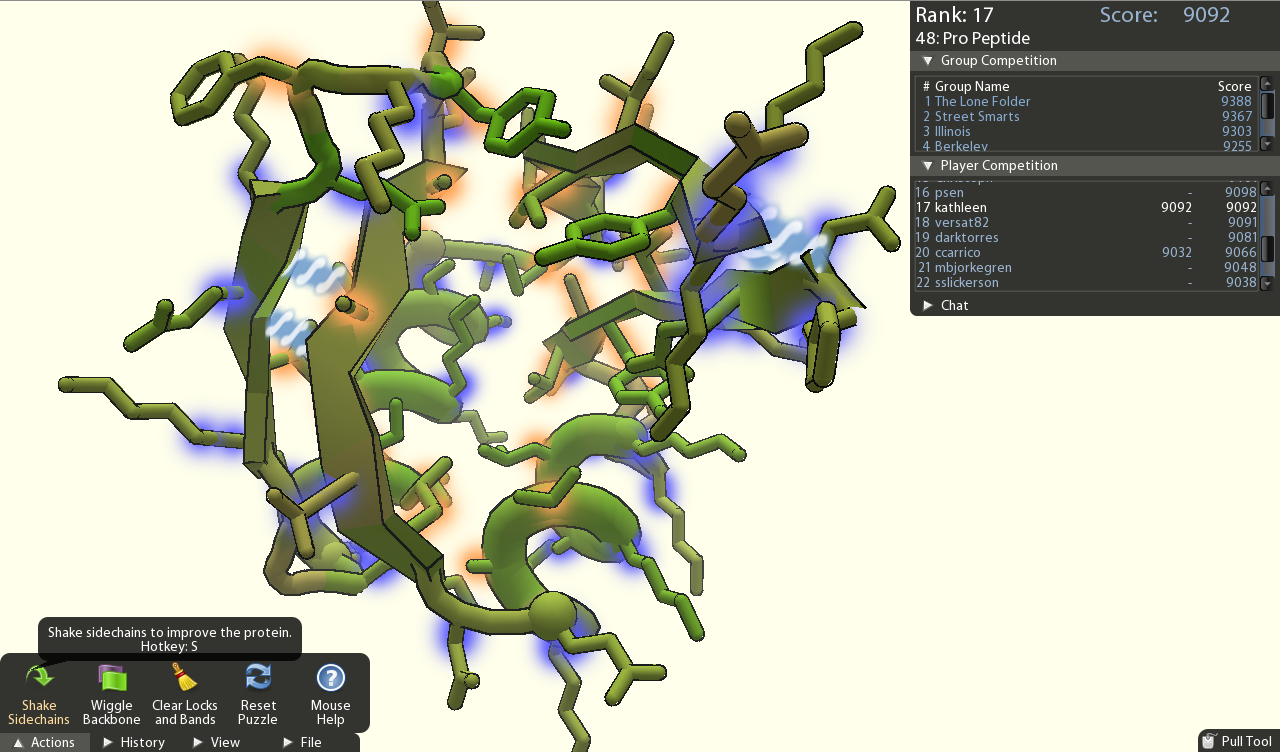
Like video games? Want to also solve puzzles for science?

A new game, named Foldit, turns protein folding into a competitive sport. Introductory levels teach the rules, which are the same laws of physics by which protein strands curl and twist into three-dimensional shapes – key for biological mysteries ranging from Alzheimer's to vaccines.

After about 20 minutes of training, people feel like they're playing a video game but are actually mouse-clicking in the name of medical science.

Investigations continue into the cause of a mysterious illness that has resulted in the deaths of thousands of bats since March 2008. At more than 25 caves and mines in the northeastern U.S, bats exhibiting a condition now referred to as “white-nosed syndrome” have been dying.

The U.S. Geological Survey (USGS) recently issued a Wildlife Health Bulletin, advising wildlife and conservation officials throughout the U.S. to be on the lookout for the condition known as “white-nose syndrome” and to report suspected cases of the disease.

USGS wildlife disease specialist Dr. Kimberli Miller advises that "anyone finding sick or dead bats should avoid handling them and should contact their state wildlife conservation agency or the nearest U.S. Fish & Wildlife Service field office to report their observation.”

Neuroscientists at Johns Hopkins have discovered that mice lacking an enzyme that contributes to Alzheimer disease exhibit a number of schizophrenia-like behaviors. The finding raises the possibility that this enzyme may participate in the development of schizophrenia and related psychiatric disorders and therefore may provide a new target for developing therapies.

The BACE1 enzyme, for beta-site amyloid precursor protein cleaving enzyme, generates the amyloid proteins that lead to Alzheimer’s disease. The research team years ago suspected that removing BACE1 might prevent Alzheimer.

“We knew at the time that in addition to amyloid precursor protein, BACE1 interacts with other proteins but we didn’t know how those interactions might affect behavior,” says Alena Savonenko, M.D., Ph.D., an assistant professor in neuropathology at Hopkins.

Researchers at the OU Cancer Institute have identified a new gene that causes cancer, according to an article in Oncogene.

The gene and its protein, both called RBM3, are vital for cell division in normal cells. In cancers, low oxygen levels in the tumors cause the amount of this protein to go up dramatically. This causes cancer cells to divide uncontrollably, leading to increased tumor formation.

Researchers used new powerful technology to genetically “silence” the protein and reduce the level of RBM3 in cancerous cells. The approach stopped cancer from growing and led to cell death. The new technique has been tested successfully on several types of cancers – breast, pancreas, colon, lung, ovarian and prostate.

Chile’s Chaiten Volcano is shown spewing ash and smoke (centre left of image) into the air for hundreds of km over Argentina’s Patagonia Plateau in this Envisat image acquired on 5 May 2008.

The 1000 m-high volcano had been dormant for thousands of years before erupting on 2 May, causing the evacuation of thousands. Chaiten Volcano is located in southern Chile 10 km northeast of the town of Chaiten on the Gulf of Corcovado.

Envisat’s Medium Resolution Imaging Spectrometer (MERIS) instrument processed this image at a resolution of 1200 m.

Distiller’s grains are a by-product of ethanol processing that can be used for animal feed. There’s been some skepticism about using distiller’s grains in Texas but one scientist says the type of grain used makes all the difference.

Dr. Jim MacDonald, AgriLife Research beef nutritionist at Amarillo, said, “I believe we can do it successfully, provided we have distiller’s grains that are equivalent in quality to those used in the North Plains states.”

Two years ago, MacDonald began investigating the dramatically different animal performance responses observed in the Northern Plains and Southern Plains, and to determine how to successfully incorporate distiller’s grains into this region’s finishing rations.

