Can a machine taste coffee? Scientists have been working on it for decades. Researchers in Switzerland published a study on their coffee-tasting machine is scheduled for the March 1 issue of Analytical Chemistry.
For the food industry, “electronic tasters” could prove useful as quality control devices to monitor food production and processing. Christian Lindinger and colleagues at Nestlé Research pointed out that coffee scientists have long been searching for instrumental approaches to complement and eventually replace human sensory profiling.
However, the multisensory experience from drinking a cup of coffee makes it a particular challenge for flavor scientists trying to replicate these sensations on a machine. More than 1,000 substances may contribute to the complex aroma of coffee.
Move over, compact discs, DVDs, and hard drives. Researchers in Japan report progress toward developing a new protein-based memory device that could provide an alternative to conventional magnetic and optical storage systems, which are quickly approaching their memory storage capacities. Their study is scheduled for the March 4 issue Langmuir.
Just as nature chose proteins as the memory storage medium of the brain, scientists have spent years exploring the possibility of similarly using proteins and other biological materials to build memory-based devices with the potential for processing information faster and providing greater storage capacity than existing materials. Although a few protein-based memory materials have shown promise in experimental studies, developing such materials for practical use remains a challenge.
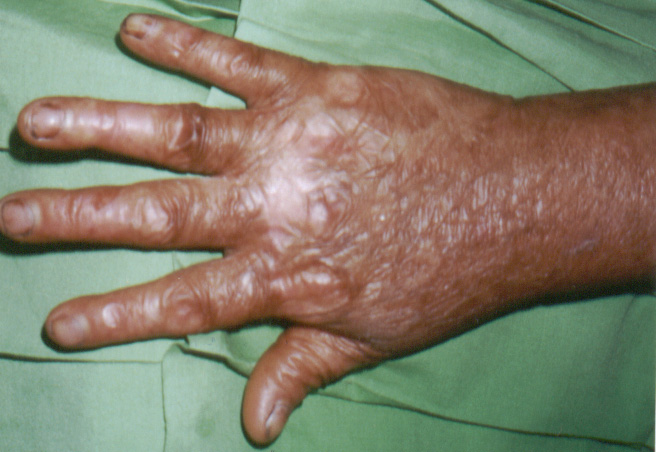
A case is reported of a 28 year old man referring the appearance of swollen blisters due to insignificant trauma since birth. Later he noticed progressive changes of the skin as teleangectasies, atrophic spots, sensivity to sun, dystrohic fingermails and webbing between fingers.The patient was hospitalized several times for an appropriate diagnosis and asked for the permission to undergo an operation of plastic surgery in Paris to correct webbing of the hands.
The rare association of two congenital diseases, epidermolysis bullosa dystrophica and poikiloderma, leads to the diagnosis of a Kindler syndrome.
Incontinentia pigmenti is a rare genodermatosis also called Bloch-Sulzberger syndrome or Bloch-Siemens, that shows early at birth or in the neonatal period.In its classical form,the cutaneous symptomatology develops through three steps.
1st step, with evidence of injuries, of erythematic-vescicular-blistered kind and one wave after another, linearly positioned and involving upper body and limbs;haematic hypereosinophilia is also present.
2nd step, that pops up between the second and the sixty life-week with papulo-lichenoid injuries,hyperkeratosic and warty, looking as elongatad striae in the distal limbs section ( knee, foot-and hand back ).
3rd step, when at third-sixth month of life dark pigmented spots appear at the upper body level, positioned like a vortex, a whirl or spurts.
The first descriptions of the disease are found again in the Textbook of Dermatology, published in 1874, "On disease of the skin, including exanthemata" London - New Sydenham Society, Hebra F.-Kaposi M.
The term "Xeroderma Pigmentosum" was coined from the hungarian dermatologist Moritz Kaposi wanting in such a way to indicate a characterized disease picture from pigmented and dry skin.
Hereditary disease, trasmitted with recessive autosomical modality, the XP is characterized from extreme photosensivity that causes strict and premature damages to level of the cutis and of the eyes. Its incidence is of 1:250000 in Europe and USA, while in Japan the relationship is of 1:40000.
German physician Otto Werner (1879-1936) described the clinical picture of this syndrome in 1904, in four sisters, defining the skin thin, tight, scleroderma-like, that mimics premature aging, with bilateral cataracts associated.
Also known by the term "Progeria" - 'prematurely old' Greek derivation, due to the fact that usually presents wrinkling and aging of face. Progeria occurs in two forms: Progeria of childhood, described by Jonathan Hutchinson (1886) and Hastings Gilford (1897), diagnosed in the first or second year of life and Progeria adultorum commonly indicated as Werner Syndrome.
Jonathan Hutchinson (1828-1913) described “A case of congenital absence of hair with atrophic condition of the skin and its appendages”. Lancet, London, 1: 923, 1886.
At the same time wrote “Congenital absence of hair and mammary glands with atrophic condition of the skin and its appendages in a boy whose mother had been almost wholly bald from alopecia areata from the age of six”. Transactions of the Medico-Chirurgical Society of Edinburgh, 69: 473-477, 1886.
Subsequently Hastings Gilford (1861-1941) wrote “On a condition of mixed premature and immature development”. Medico-Chirurgical Transactions, London, 80: 17-45, 1897 and coined the term Progeria from greek “Prematurely old”. In the year 1904 published “Progeria: a form of senilism”. Practitioner, London, 73: 188-217.
In the last post I suggested that the U.S. learn from Europe in the use of high speed trains as a core component of a national transportation system. Trains are more energy efficient than cars, give off far less greenhouse emissions than airplanes, rarely get cancelled or delayed due to ‘weather’ or ‘flow control’ and depart and arrive near the central city. Given that America is much larger than any country currently utilizing high speed trains, it can only be a part of the transportation mix. What might the composite national transportation profile look like in 2015?
Physical attractiveness is important in choosing whom to date. Good looking people are not only popular targets for romantic pursuits, they themselves also tend to flock together with more attractive others. Does this mean then that more attractive versus less attractive people wear a different pair of lens when evaluating others’ attractiveness?
Columbia University marketing professor, Leonard Lee, and colleagues, George Loewenstein (Carnegie Mellon University), Dan Ariely (MIT) and James Hong and Jim Young (HOTorNOT.com), decided to test this theory in the realm of an online dating site. The site HOTorNOT.com allows members to rate others on their level of physical attractiveness.
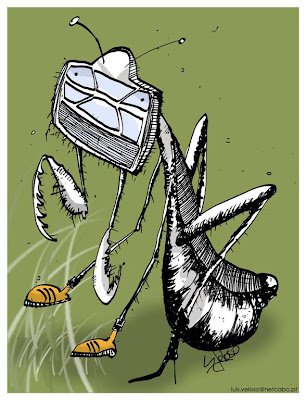 (Publicado no jornal O Primeiro de Janeiro a 24/01/2008)
A formação paleontológica desperta frequentemente as questões que abordo.
Não foi o caso desta vez.
Estava eu em frente ao espelho, a preparar-me para a árdua e sisífica tarefa que pesa na vida de qualquer homem, o barbear, quando olhando existencialmente para as lâminas de corte me ocorreu o seguinte: “Mas estes tipos não param de aumentar o número de lâminas? Não haverá limite?”








.jpg)

