MELBOURNE, Australia, April 22 /PRNewswire/ --
Researchers in The Netherlands have achieved outstanding success in blocking the lifecycle of the mosquitoes which transmit malaria.
The trials were conducted by Tullu Bukhari and Bart Knols, mosquito researchers at Wageningen University, on a silicone-based liquid which spreads instantly across standing water. The liquid forms a very thin surface film, impacting on mosquitoes at every stage of their lifecycle.
The research, which will soon be published in the American Journal of Tropical Medicine and Hygiene, has shown excellent efficacy of the product against the most important Asian and African malaria vectors.
LAS VEGAS, April 22 /PRNewswire/ --
FC2 Blog has recently released the Russian version (http://blog.fc2.com/ru/ ) of their blog because of its popularity amongst Russian users. FC2, Inc. ( http://blog.fc2.com/ ) is a large scale web services company who primarily provides services in Japan. FC2 Blog was firstly launched in Japan in October 2004, and as of March 2008 there are over 400,000 active users with over 4.3 billion page views.
(Logo: http://www.prnasia.com/sa/2009/04/20/200904201701.jpg )
Researchers writing in Nature magazine say the fossil skeleton of a newly discovered carnivorous animal,
Puijila darwini, is a "missing link" in the evolution of the group that today includes seals, sea lions, and the walrus.
Modern seals, sea lions, and walruses all have flippers—limb adaptations for swimming in water. These adaptations evolved over time, as some terrestrial animals moved to a semi-aquatic lifestyle. Until now, the morphological evidence for this transition from land to water was weak.
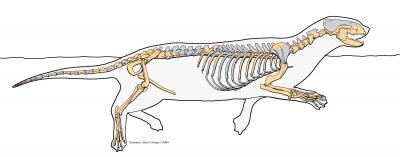 Skeletal illustration of Puijila darwini. Credit: Mark A. Klingler/Carnegie Museum of Natural History
Using information from a suite of telescopes, astronomers have discovered a mysterious, giant object that existed at a time when the universe was only about 800 million years old. Objects such as this one are dubbed extended Lyman-Alpha blobs; they are huge bodies of gas that may be precursors to galaxies. This blob was named Himiko for a legendary, mysterious Japanese queen. It stretches for 55 thousand light years, a record for that early point in time. That length is comparable to the radius of the Milky Way's disk.
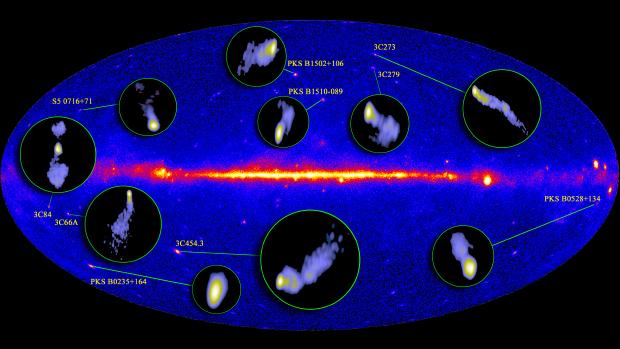
An international team of astronomers has used the world's biggest radio telescope to look deep into the brightest galaxies that NASA's Fermi Gamma-ray Space Telescope can see. The study solidifies the link between an active galaxy's gamma-ray emissions and its powerful radio-emitting jets.
"Now we know for sure that the fastest, most compact, and brightest jets we see with radio telescopes are the ones that are able to kick light up to the highest energies," said Yuri Kovalev, a team member at the Max Planck Institute for Radio Astronomy in Bonn, Germany.
Take that, Taliban. Western decadence, in the form of caring about beauty and nature, has infested your fundamentalist madness and it's here to stay.
We are talking about Band-i-Amir national park in Afghanistan, which opens today.
The United States Agency for International Development (USAID) provided key funding that led to the park's creation, including support of the Wildlife Conservation Society (WCS) to conduct preliminary wildlife surveys, identify and delineate the park's boundaries, and work with local communities and the provincial government. WCS also developed the park's management plan, helped the government hire and train local rangers, and provided assistance to the Afghan Government to design the laws enabling the park to be created.
Los Alamos National Laboratory researchers have discovered a potential chink in the armor of fibers that make the cell walls of certain inedible plant materials so tough. The insight ultimately could lead to a cost-effective and energy-efficient strategy for turning biomass into alternative fuels.
In separate papers published today in Biophysical Journal and recently in an issue of Biomacromolecules, Los Alamos researchers identify potential weaknesses among sheets of cellulose molecules comprising lignocellulosic biomass, the inedible fibrous material derived from plant cell walls. The material is a potentially abundant source of sugar that can be used to brew batches of methanol or butanol, which show potential as biofuels.
Researchers know that animals which seem identical can actually belong to completely different species. But if it's worms used in laboratory testing, that could be important news in research.
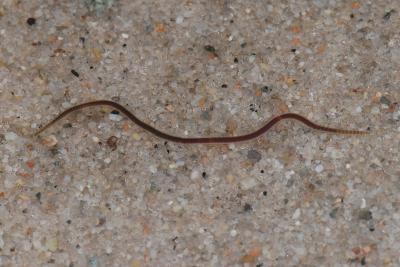
Researchers at the University of Gothenburg, Sweden, say they have used DNA analyses to discover that one of our most common segmented worms, Lumbriculus variegatus, is actually two types of worm. Along with some obvious issues in research it also affirms that the variety of species on the earth could be considerably larger than we thought. "We could be talking about a large number of species that have existed undiscovered because they resemble other known species," says Professor Christer Erséus.
WHAT: New research from Baylor College of Medicine indicates a positive effect of chewing gum on academic performance in teenagers. The study examined whether chewing Wrigley sugar-free gum can lead to better academic performance in a "real life" classroom setting. Major findings include:
- The researchers found that students who chewed gum showed an increase in standardized math test scores and their final grades were better compared to those who didn't chew gum.
A new study reveals that asteroid surfaces age and redden much faster than previously thought — in less than a million years, the blink of an eye for an asteroid. The solar wind is the likely culprit in very rapid space weathering, they say, and this knowledge will help astronomers relate the appearance of an asteroid to its actual history and identify any after effects of a catastrophic impact with another asteroid.