




Using a virtual pendulum and its real-world counterpart, scientists at the University of Illinois have created the first mixed reality state in a physical system. Through bi-directional instantaneous coupling, each pendulum “sensed” the other, their motions became correlated, and the two began swinging as one.

“In a mixed reality state there is no clear boundary between the real system and the virtual system,” said U. of I. physicist Alfred Hubler. “The line blurs between what’s real and what isn’t.”

In the experiment, Hubler and graduate student Vadas Gintautas connected a mechanical pendulum to a virtual one that moved under time-tested equations of motion. The researchers sent data about the real pendulum to the virtual one, and sent information about the virtual pendulum to a motor that influenced motion of the real pendulum.

Video games such as Second Life give users the freedom to create characters in the digital domain that look and seem more human than ever before but while they can have your hair or your hazel eyes, it's still just a pretty face.

A group of researchers from Rensselaer Polytechnic Institute is working to change that.

They are engineering characters with the capacity to have beliefs and to reason about the beliefs of others. The characters will be able to predict and manipulate the behavior of even human players, with whom they interact in the real world, according to the team.

New research suggests that humans are not as fooled as they seem when viewing visual illusions.

Ben-Gurion University of the Negev Psychologist Tzvi Ganel, writing in the March issue of Psychological Science, says we process images in two very distinct ways. He and his colleagues presented research participants with the “Ponzo” illusion, an image common in psychological research that makes two objects that are similar in length appear drastically different. They then hooked participants’ index finger and thumb to computerized position tracking equipment and asked them to grasp the objects with their fingers.

NEW YORK, March 10 /PRNewswire/ --

Chairman and CEO of QTRAX Allan Klepfisz announced today that Beggars Group has signed a digital distribution licensing agreement with QTRAX, the free and legal ad-supported peer-to-peer music network.

ANDOVER, Massachusetts and BANBURY, England, March 10 /PRNewswire/ --

IBA Health Group company iSOFT has today signed an agreement with US-based Sentillion to become its first healthcare channel partner in Europe for its single sign-on (SSO), context management, and user provisioning solutions.

The move coincides with the launch of Sentillion's UK Channel Partner Program and enables iSOFT to become the first partner to offer its customers the market-leading Vergence(R) SSO/context management suite and Sentillion's next-generation SSO solution, expreSSO(TM), which are all developed exclusively for healthcare.

NEW YORK, March 10 /PRNewswire/ --

- Company's Business Transaction Management Software is the First Solution to Provide IT with True Business Visibility into Virtualized Environments

OpTier(TM), the leader in Business Transaction Management (BTM), today announced that its CoreFirst software is the first product to extend transaction visibility to virtual environments to help IT meet dynamically changing business needs. CoreFirst provides organizations with the insight and stability required to manage mission-critical applications running in production within virtualized environments.

PARIS, March 10 /PRNewswire/ --

- ReachView Enhances Alcatel-Lucent's Service Assurance Capabilities

Alcatel-Lucent (Euronext Paris and NYSE: ALU), announced today that it has signed an agreement to acquire ReachView Technologies, one of the largest service assurance consulting and integration firms in North America. Upon completion this acquisition will enhance Alcatel-Lucent's current professional services consulting practice, specifically, OSS/BSS and software integration, enabling the company to deliver advanced service assurance solutions to carriers and industry and public sector customers.

SAN DIEGO, March 10 /PRNewswire/ --

PreCYdent, a start-up based in San Diego and Milan, Italy announced today that it has created a new legal research technology that is many times more effective at finding relevant case law than the decades-old Westlaw and LexisNexis. The search engine's alpha version is available at http://www.precydent.com and is free to users.

(Logo: http://www.newscom.com/cgi-bin/prnh/20080303/LAM012LOGO)

"Our technology mines the information in legal citations," said co-founder and CEO Tom Smith, who is a professor at the University of San Diego Law School. "It makes searching for law as easy as searching the Web, which means anyone can do it."

McFluoride

McFluoride

Mar 10 2008 | comment(s)

"I’ll take a burger and fries, hold the fluoride.” Fluoride? Serious scientists, who look, find fluoride in the darnedest places. Researchers from the University of Indiana School of Dentistry report in the scientific journal “Community Dentistry and Oral Epidemiology” that McDonald’s French fries deliver more than guilty pleasure. Your teeth bite into 0.13 milligrams fluoride along with that small portion of McDonald’s fries that goes upward to 0.38 mg in the supersize. So why do we need to know that? Because of fluoridation, where water engineers purposely add fluoride to water supplies to reduce tooth decay, and the billion dollar fluoride products industry, many Americans are fluoride over-dosed.

Cells are coded with several programs for self-destruction. Many cells die peacefully. Others cause a ruckus on their way out.

Some programmed cell death pathways simply and quietly remove unwanted cells, noted a team of University of Washington (UW) researchers who study the mechanisms of cell destruction.

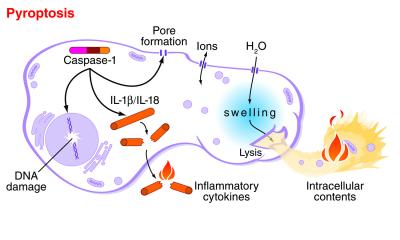
Then there is the alarm-ringing death of a potentially dangerous cell, such as a cell infected with Salmonella, they added. These dying cells spill chemical signals and get a protective response. The resulting inflammation, which the body launches in self-defense, can at times backfire and damage vital tissues.


This schematic shows the cell death pathway called pyroptosis, Greek for going down in flames. When activated by a toxin or an infection, the enzyme caspase-1 initiates several reactions inside of the cell, some of which lead to DNA damage, others to the release of chemical distress signals called cytokines, and others to the formation in the cell membrane of tiny pores that let water flood in until the cell swells, bursts and spills its contents. Credit: Image by David W. Ehlert and Brad Cookson, University of Washington.

