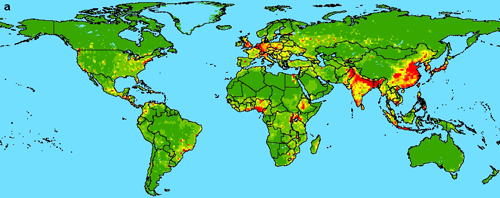






Deadly emerging diseases have risen steeply across the world and an international research team has provided the first scientific evidence mapping the outbreaks’ main sources.

They say:

New diseases originating from wild animals in poor nations are the greatest threat to humans and;

Expansion of humans into shrinking pockets of biodiversity and resulting contacts with wildlife are the reason.

Meanwhile, richer nations are nursing other outbreaks, including multidrug-resistant pathogen strains, through overuse of antibiotics, centralized food processing and other technologies.


Zoonotic pathogens passed from wildlife to people, from lowest occurrence (green) to highest (red).

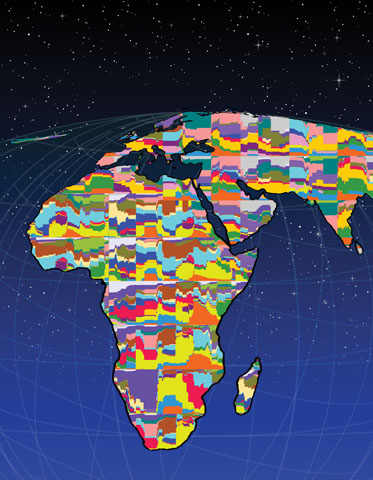
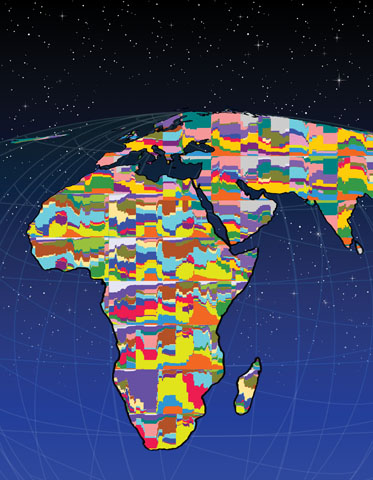
University of Michigan scientists and their colleagues at the National Institute on Aging have produced the largest and most detailed worldwide study of human genetic variation, a treasure trove offering new insights into early migrations out of Africa and across the globe.

Like astronomers who build ever-larger telescopes to peer deeper into space, population geneticists like Noah Rosenberg are using the latest genetic tools to probe DNA molecules in unprecedented detail, uncovering new clues to humanity's origins.

The latest study characterizes more than 500,000 DNA markers in the human genome and examines variations across 29 populations on five continents.


A schematic of worldwide human genetic vari

A team of researchers has discovered the remains in Madagascar of what may be the largest frog ever to exist.

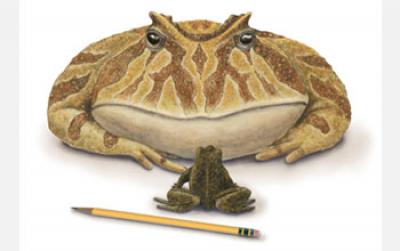
The 16-inch, 10-pound ancient frog, scientifically named Beelzebufo, or devil frog, links a group of frogs that lived 65 to 70 million years ago with frogs living today in South America.

Discovery of the voracious predatory fossil frog is significant in that it may provide direct evidence of a one-time land connection between Madagascar, the largest island off Africa's southeast coast, and South America.


Beelzebufo. This ain't your daddy's giant devil frog. Credit: SUNY-Stony Brook

A straight line may be the shortest distance between two points, but it isn’t necessarily the fastest or easiest path to follow.

That’s particularly true when terrain is not level, and now researchers have developed a mathematical model showing that a zigzag course provides the most efficient way for humans to go up or down steep slopes.

Human migration from Africa to Europe more than 30,000 years ago is still visible in the genes of Europeans today - and because the numbers were small, the harmful variations were magnified as time passed.

A study in the Feb. 21 issue of Nature compared more than 10,000 sequenced genes from 15 African-Americans and 20 European-Americans. The results suggest that European populations have proportionately more harmful variations, though it is unclear what effects these variations actually may have on the overall health of Europeans.

Computer simulations suggest that the first Europeans comprised small and less diverse populations. That would have allowed mildly harmful genetic variations within those populations to become more frequent over time, the researchers report.

ROCKVILLE, Maryland, February 20 /PRNewswire/ --

- CJ Acquires Cur Stock for Rights to Spinal Cells in Future

LONDON, February 20 /PRNewswire/ --

- Breakthroughs in Secure Information Sharing on the Agenda

At this year's Defence IT 08 conference, members of the Transglobal Secure Collaboration Program (TSCP) will discuss issue and opportunities in secure information sharing in mission-critical environments, with an emphasis on how the obstacles are being overcome.

The session, moderated by John Taylor, Director General Information at the Ministry of Defence, will offer attendees a first-hand look at how organizations like BAE SYSTEMS, Rolls-Royce, the U.K. Ministry of Defence and the U.S. Department of Defense are working together on initiatives such as secure e-mail, identity federation, online collaboration and digital rights management.

PARIS, February 20 /PRNewswire/ --

- The Electrical and HVAC Engineering Group is Following a Robust Acquisitions Policy.

SPIE crossed a significant threshold in 2007 in its ambition to become the European leader in its sector by making two major acquisitions, Controlec in the Netherlands and Matthew Hall in the United Kingdom, as well as nine other companies in France, with total sales exceeding EUR600 million.

Strengthening SPIE's European presence

In Northern Europe, the acquisitions of Matthew Hall in the United Kingdom, Controlec in the Netherlands and Anca-Tech in the Benelux countries opens up new prospects for SPIE and has increased the share of sales generated outside France from 28% to 42%.

CHICAGO, February 20 /PRNewswire/ --

- New SAQ available in TrustKeeper(R) compliance management portal

Trustwave, the leading provider of information security and compliance management solutions for businesses and organizations throughout the world, has upgraded TrustKeeper with the new Self-assessment Questionnaire (SAQ) Version 1.1, issued by the Payment Card Industry Security Standards Council (PCI SSC) earlier this month. TrustKeeper, a Web-based, real-time compliance management tool used for compliance validation with the Payment Card Industry Data Security Standard (PCI DSS) by thousands of merchants and service providers throughout the world, is the first compliance management solution to support the new SAQ version 1.1.

You may not be aware of it - they might not be aware of it, but the people in your work environment might be slowing you down.

New research by University of Calgary, Faculty of Kinesiology researcher Dr. Tim Welsh says that regardless of their intentions, having an individual working on a different task - within your field of vision - could be enough to slow down your performance.

“Imagine a situation like a complex assembly line,” said Welsh If you are doing a particular task and the person across from you is doing a different task, you’ll be slowed down regardless of their performance.”
