







Wind energy is one of the fastest growing sectors of the energy industry, but not without environmental consequences. Nocturnally active birds and bats have become prey to turbines, yet little guidance could be found for assessing impacts of wind energy on this group until now. A new article published in the latest issue of The Journal of Wildlife Management gives guidance about the methods and metrics of this subject.

Songbirds are by far the most abundant flying vertebrates in most terrestrial ecosystems and until recently have been the most frequently reported fatalities at utility-scale wind facilities in the United States.

Only recently it was hard to imagine a game in which people compete only with their minds. Today, you can play it. At the end of this year Mindmower, the first biological Internet game, goes into beta testing.

Players fight against each other not with joysticks, but with their minds.

A device connected to the fingers, deciphers the player’s physiological parameters and sends them to the server. Your thoughts have a key influence on your avatar and the course of the whole game.

Anyone who has thrown a backyard barbecue knows that hot dogs are inexplicably packaged in different numbers than buns — eight hot dogs per pack versus 10 hot dog buns. Put in ecological terms, this means that weenie roasts are “hot-dog limited” — the extra buns are worthless without hot dogs to fill them.

Such limiting factors are a cornerstone of natural ecology, where phosphorus or nitrogen limits plant production in most ecosystems. According to the customary model, the relative importance of these two key nutrients varies by ecosystem; but a group of researchers led by Arizona State University professor James Elser has found that this view might need to be updated.

Researchers at UCSF and the University of Toronto have identified a potential new way of fighting against HIV infection that relies on the remnants of ancient viruses, human endogenous retroviruses (HERV), which have become part of the genome of every human cell.

Mounting evidence suggests that HIV infection could enable HERV expression by disrupting the normal controls that keep HERV in check.

In some HIV-infected individuals, infection fighting T cells are able to target HERV expressing cells.

The recreational use of cocaine has rapidly increased in many European countries over the past few years. One cause of this is the fall in the price of the drug on the street from 100 Euros for one gram (about 5 lines) in 2000 to 50 Euros in the Netherlands today. One line of cocaine is, thus, now as cheap as a tablet of ecstasy. This means cocaine is no longer considered an “elite” drug but is affordable for all, especially for recreational use.

A new study suggests that a holistic approach is needed in assessing the potential environmental and health effects of toxic effluent from industry. The study is published in the International Journal of Environment and Pollution.

Studies of industrial effluent toxicity usually focus on a single contaminant, such as an environmental or marine pollutant, a potential carcinogen, or a toxic heavy metal. However, according to Tatjana Tišler of the National Institute of Chemistry, in Ljubljana, and Jana Zagorc-Koncan of the University of Ljubljana, Slovenia, toxicity tests of effluent using bacteria generally underestimate the total toxicity.

Effluents from industrial or municipal sources may contain hundreds to thousands of chemicals, but only a few are responsible for aquatic toxicity.

The HIV-1 virus is one of the most difficult targets for therapy because it hijacks the cells of our immune system and particularly because the virus mutates rapidly, making it drug resistant. Up to 20% of HIV-infected patients host virus that is drug resistant.

The current "Highly active antiretroviral treatment" (HAART therapy) against HIV uses a combination of several different drugs, which increases the probability of simultaneous development of resistance against different drugs. A team of Slovenian undergraduate students from the University of Ljubljana together with their mentors from the National institute of chemistry of Slovenia (NIC) has developed a new strategy of antiviral defense that is not breached by viral mutations.

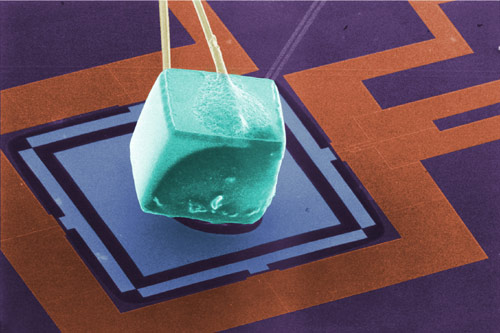
A Finnish group of researchers at the Low Temperature Laboratory of Helsinki University of Technology (TKK) have developed and fabricated a nanoscale heat transistor, and simultaneously the smallest refrigerator ever made.

The device, nanofabricated with the help of electron beam lithography, functions at extremely low temperatures of less than one degree above absolute zero. The possibility to control the electrons going through the device one by one in the metal-superconductor structure enables its use as a heat transistor.


For your six pack of atoms. Credit: N. Miller, A. Clark/NIST

The big world of classical physics mostly seems sensible: waves are waves and particles are particles, and the moon rises whether anyone watches or not. The tiny quantum world is different: particles are waves (and vice versa), and quantum systems remain in a state of multiple possibilities until they are measured -- which amounts to an intrusion by an observer from the big world -- and forced to choose: the exact position or momentum of an electron, say.

On what scale do the quantum world and the classical world begin to cross into each other? How big does an "observer" have to be? It's a long-argued question of fundamental scientific interest and practical importance as well, with significant implications for attempts to build solid-state quantum computers.

People who have a mother with Alzheimer’s disease appear to be at higher risk for getting the disease than those individuals whose fathers are afflicted, according to a new study by NYU School of Medicine researchers.

The study is published in this week’s online edition of the Proceedings of the National Academy of Sciences. It is the first to compare brain metabolism among cognitively normal people who have a father, a mother, or no relatives with Alzheimer’s disease, and to show that only individuals with an affected mother have reduced brain metabolism in the same brain regions as Alzheimer’s patients.

Over the last two decades a number of studies have shown that people with the disease have significant reductions in brain energy metabolism in certain regions of the brain.

