



I realize that the audience for this blog tends to be more broad based than on UsefulChem but once in a while I'll throw in an organic chemistry puzzle to see if there are any organic chemists out there lurking.

Ever since we isolated our Ugi products, we've been trying to cyclize them to the diketopiperazines. As described by Hulme, we are trying to effect an intramolecular transamidation catalyzed by trifluoroacetic acid (TFA).

The Hubble Space Telescope (HST) has produced some of the most famous still images in astronomy (e.g., the pillars of creation in the Eagle Nebula). The latest images from HST are movies of Saturn and its moons. Astronomers wrote software that multiplies the relatively small number of images taken by Hubble for each event into the much larger number needed to make a movie. The original images covered several hours of observing time, and the videos range in length from 15 to 30 seconds, so time is compressed in the videos and the motions of Saturn and its moons are speeded up.

Two of the videos show Saturn with the rings edge-on either to Earth or to the sun.

Marie Godfrey has left a comment on one of my posts recently, and asked me whether I’d like to write about her blog and the Genetic Alliance non-profit organization. They both try to make genetics more readable and understandable for laymen and people with genetic conditions. So first, let’s take a deeper look at GeneForum and the Genetizen blog:

Advances in genetics and biotechnology are impacting society in provocative ways. The Genetizen is written by a select group of scientists, bioethicists, and healthcare professionals who provide you with expert analysis and commentary on many important issues.

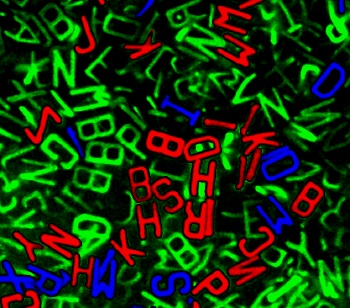
UCLA scientists have designed and mass-produced billions of fluorescent microscale particles in the shapes of all 26 letters of the alphabet in an “alphabet soup” displaying “exquisite fidelity of the shapes.”

The letters are made of solid polymeric materials dispersed in a liquid solution. The research will be published March 29 in the Journal of Physical Chemistry C, where it will be illustrated on the cover. The scientists anticipate that their “LithoParticles” will have significant technological and scientific uses.

“We can even choose the font style; if we wanted Times New Roman, we could produce that,” said study co-author Thomas G.

After years of results that repeatedly dogged him, University of Oregon geologist Douglas R. Toomey decided to follow the trail of data surfacing from the Pacific Ocean. In doing so, he and his collaborators may have altered long-held assumptions involving plate tectonics on the ocean floor.

Reporting in the March 22 issue of Nature, Toomey and co-authors from four other institutions propose that, one, the flow in the Earth's mantle is rotated beneath the East Pacific Rise, causing the plate boundary to change orientation with time. Secondly, they argue that deep-sea hydrothermal vents frequently form above volcanoes where upwelling of the mantle and spreading of the plates are aligned.

The inventors of self-healing plastic have come up with another invention: a new way of doing chemistry.

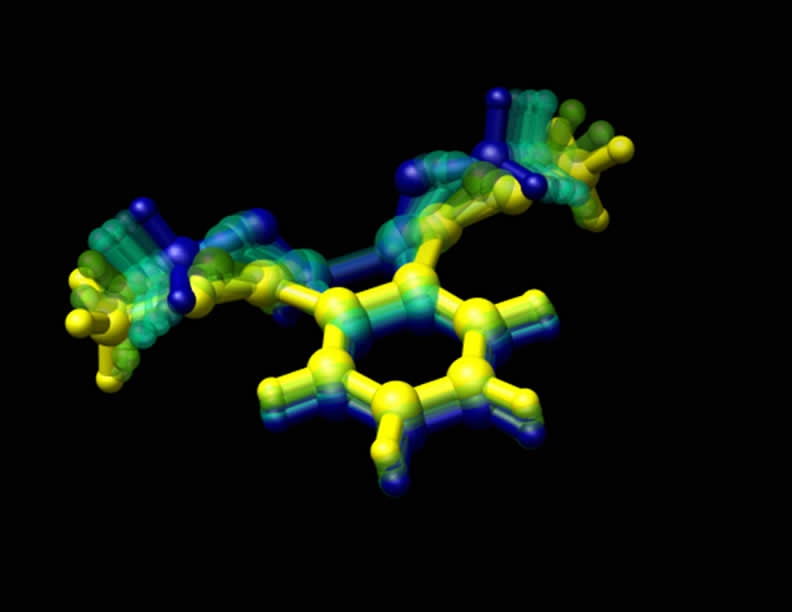
Researchers at the University of Illinois at Urbana-Champaign have found a novel way to manipulate matter and drive chemical reactions along a desired direction. The new technique utilizes mechanical force to alter the course of chemical reactions and yield products not obtainable through conventional conditions.


An overlay of images at successive stages of force-induced chemical change. The blue image is the start of the reaction. The yellow image represents the end of the reaction. Graphic by Ashley Levato

Research funded by Metallica?

Gifted students who feel the pressure of their ability could be using Heavy Metal music to get rid of negative emotions.

This is the conclusion of Stuart Cadwallader and Professor Jim Campbell of The National Academy for Gifted and Talented Youth at the University of Warwick. They will discuss their findings at the British Psychological Society’s Annual Conference at the University of York on Wednesday 21 March 2007.

Current methods used to sniff out dangerous airborne pathogens may wrongly suggest that there is no threat to health when, in reality, there may be.

But researchers have found a better method for collecting and analyzing these germs that could give a more accurate assessment of their actual threat. For example, the findings may make it easier to detect airborne pathogens in low concentrations.

Scientists from NOAA’s Earth System Research Laboratory (ESRL) announced today a new tool to monitor changes in atmospheric carbon dioxide and other greenhouse gases by region and source. The tool, called CarbonTracker, will enable its users to evaluate the effectiveness of their efforts to reduce or store carbon emissions.

The online data framework distinguishes between changes in the natural carbon cycle and those occurring in human-produced fossil fuel emissions. It also provides verification for scientists using computer models to project future climate change. Potential users include corporations, cities, states and nations assessing their efforts to reduce or store fossil fuel emissions around the world.

Engineers at Purdue University have designed and tested a "structural health monitoring" system to detect flaws that could hinder the performance of new types of military missiles made of composite materials instead of metal.

Missiles are sometimes damaged when struck by rocks and debris kicked up by helicopter rotors or when mishandled during shipping or maintenance.

Unlike missiles made of metallic alloys, which often show external signs of damage such as cracks or dents, damage in the new "filament wound" composite materials may not reveal telltale signs, said Douglas Adams, an associate professor of mechanical engineering.


Douglas Adams, an associate professor of

