




Despite big ambitions, most life sciences organizations are stuck navigating outdated systems that make collaboration harder and breakthroughs slower.
The result? Slowdowns, missed insights, and costly rework.
These obstacles affect productivity in both wet and dry lab environments, with the most pressing challenges spanning a few critical categories:

Image: Storyblocks
● Complexity in Disease-Focused Research (Multimodal Approaches): Increasingly researchers addressing complex diseases rely on multiple therapeutic modalities (e.g. small molecules, biologics, gene therapy, and cell therapy).(1) Each requires different groups and skill sets, with varying needs. This makes it difficult to create a single platform that can effectively support all approaches.
● Lack of Comprehensive Scientific Traceability and Data Connectivity: Scientists need more than just data—they must also track the evolution of scientific thinking, hypotheses, and iterative analyses. They need a “digital thread” that begins by connecting all data sources that can be used in R&D and continues throughout the research process. Existing systems often fail to capture these critical aspects, leaving gaps in the lineage of experiments, workflows, and conclusions. Procedural steps are often disconnected from sample data, materials, and instrument results in LIMS, making it difficult to reconstruct the full scientific process. This fragmentation hinders reproducibility, complicates regulatory compliance, and limits AI-driven insights. As a result, scientists are left piecing together information outside their workflows. That leads to uninformed decision-making rather than efficient, insight-driven research.
● Disconnected Wet Lab and Dry Lab Workflows: Fragmented workflows between wet and dry labs cause significant inefficiencies, especially during data handoffs. Manual processes such as spreadsheets and email introduce delays, data loss, and reproducibility challenges. Without seamless integration between experimental and computational systems, dry lab teams often receive incomplete or poorly annotated data, leading to time-consuming reformatting. This disconnect hinders collaboration between biologists, chemists, and computational scientists, impeding the sharing of insights and slowing discovery.
● Critical Need for a Data-First Approach to AI in Life Sciences: Gartner predicts that by 2027, non-technology-related reasons, such as misaligned processes, will cause 40% of AI project failures in life sciences.(2) AI and machine-learning depend on high-quality, structured, and inter-operable data. Yet many organizations struggle with poor data hygiene, inconsistent ontologies, and fragmented datasets, making it hard to train and validate effective AI models. To enable AI-driven insights, life sciences organizations need tools that support automated data harmonization, lineage tracking, and seamless integration across experimental and computational workflows—they need a digital thread.
What is a Digital Thread?
A digital thread is a connected chain of data that stretches across the entire process involved in developing new therapeutics, from early research and development to full scale production. It connects traditionally siloed functions—like design, development, testing, manufacturing, and maintenance—into a single, cohesive data flow. It's the digital backbone that ensures traceability and consistency of data from end to end. That means companies can innovate faster, accelerate market introduction of new therapies and most importantly, be able to improve people’s lives.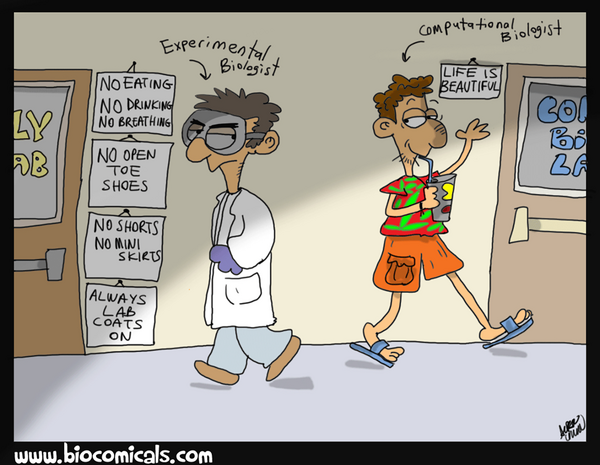
Credit: Dr. Alper Uzun, Biocomicals, all rights reserved by Dr. Azun
Until recently, building a true digital thread was incredibly difficult because life sciences data has long been fragmented across incompatible systems, formats, and organizational silos. Research, development,and manufacturing each relied on separate tools that didn’t communicate easily, making it nearly impossible to achieve end-to-end visibility or traceability. Legacy infrastructure, manual hand-offs, and strict regulatory requirements further slowed integration efforts. Only with recent advances in cloud computing, data standards, and inter-operable platforms has it become feasible to connect these stages seamlessly and realize the full potential of a digital thread.
Scientists Deserve Better—What Should They Expect?
Instead of wholesale replacement of their existing investments, teams are likely to embrace a gradual, integrated path forward to next-generation technologies, allowing customers to adopt new capabilities beyond an ELN or LIMS at their own pace. To transition without disrupting current workflows, the goal should be clear integration points between traditional systems and any new technology. This ensures continuity while unlocking new levels of efficiency and intelligence over time. What will those next generation solutions look like?
1. Adaptive Workflows That Mirror Real Science
Adaptive workflow systems represent a significant departure from rigid, process-centric approaches. Instead of imposing a linear, step-by-step structure, teams will be able to dynamically assign and adjust tasks as the needs of the research evolve. This action-centric approach aligns with how research actually progresses in real-world settings.
Flexible task assignment will allow teams to string tasks together in any order, as long as input validation criteria are met, enabling researchers to stay agile and respond to new insights and shifting priorities. Data capture is contextualized, with tasks aligned to research goals so data reflects changes, optimizations, and alterations across different modalities (e.g.,protein therapeutics, gene therapy). Low-code app-building will enable real-time adaptation as insights or challenges arise, supporting iterative work-like experimental design or assay development. Finally, seamless integration across modalities will create a flexible, multimodal framework where teams can collaborate and share insights without bottlenecks.
2. End-to-End Traceability for Every Molecule
Legacy systems often fail to handle the complexity of modern biologic formats like multispecific antibodies (MsAbs), leading to imprecise data representation and fragmented workflows. These systems struggle with tracking molecular structures, creating gaps in traceability, which can cause miscommunication, delays, and costly errors. Future systems will provide accurate molecular registration and full lifecycle traceability. Each molecule—whether in design, production, or testing—will be assigned a unique ID,ensuring seamless tracking across every stage of the biologic discovery process. This comprehensive traceability will help teams to maintain data integrity from the initial design phase throughout production.
3. Multimodal Self-Service Agility
Researchers must be able to easily configure workflows, tasks, data models, and governance settings to suit evolving research needs—without heavy IT resources or outside consultants required. Building new workflows or adjusting existing ones should be simple and fast, seamlessly adapting to research projects. This self-service approach lets scientists and researchers modify processes mid-experiment without disruption, ensuring workflows are as dynamic as the discoveries. With next generation systems, they will be able to design personalized interfaces with drag-and-drop functionality for charts,dashboards, and scientific visualizations, enhancing usability and decision support.
Critically, domain-specific AI will accurately predict scientific outcomes. From auto-gating in flow cytometry to other advanced predictions,researchers will be able to natively combine data across scientific disciplines to predict and simulate complex outcomes, optimizing processes like antibody efficacy and developability.
4. Seamless Integration with Industry-Leading Scientific Software& Tools
And finally scientists already have a suite of core tools and applications they're familiar with. Any next generation system must be able to maximize that existing value with seamless integration. Research teams need the flexibility to continue using the technologies they know and trust, while benefiting from a unified, automated platform. The end goal is compatibility across diverse IT ecosystems to minimize fragmentation and foster a seamless flow of data across all the tools scientists use.
As we look ahead to 2026 and beyond, scientific organizations can protect their existing investments while unlocking new levels of efficiency, collaboration, and discovery—at their own pace and on their own terms.
(1) “New Drug Modalities 2023.” BCG, 30 June 2023
(2) Predicts 2025: CIOs Prepare for AI to Reshape Life Sciences, Gartner, 21 January 2025


Comments