Banner
Here's Where Your Backyard Was 300 Million Years Ago

We may use terms like "grounded" and terra firma to mean stability and consistency but geology...

Convergent Evolution Cheat Sheet Now 120 Million Years Old

One tenet of natural selection is a random walk of genes but nature may be more predictable than...

Synchrotron Could Shed Light On Exotic Dark Photons

There are many hypothetical particles proposed to explain dark matter and one idea to explore how...

The Pain Scale Is Broken But This May Fix It

Chronic pain is reported by over 20 percent of the global population but there is no scientific...

User picture.
News StaffRSS Feed of this column.

News Releases From All Over The World, Right To You... Read More »

Blogroll
Patients who have tried to commit suicide with medication are prescribed more medication after the attempt, not less, according to an analysis of patients who were admitted to three Norwegian hospitals after deliberate self-poisoning. 

The psychologists behind the work collected information about the patients' medication from The Norwegian prescription database in order to compare the medication load in the year before and after the poisoning episode and say they were surprised to discover that the patients' medication load, which was high in the first place, increased even more after their attempt to poison themselves. This was equally true for medication against both mental and somatic illness.
Norwegian women who choose to have children often say goodbye to their careers. Men, on the other hand, tarry on. Norway has, since the 1800s, come a long way towards a more egalitarian society, but when a child enters the relationship between a woman and a man the consequences for the woman are different to those for the man, according to the thesis of Eirin Pedersen at the Department of Sociology and Human Geography at University of Oslo.
Less efficiency sounds bad, in the modern world of optimization, where everyone wants to sell you a 10-minute workout that maximizes your time.  But in the ancient world of evolution, you need to turn the tables.

Due to the boom-and-bust nature of existence prior to the last 50 years, we have evolved protection against starvation - our bodies adjust on the fly. That is why if you just go on a crash diet, you will lose some weight right away and then plateau and if you eat normally again, the weight comes back. Your body 'settles in for a long winter' and metabolic efficiency goes up.
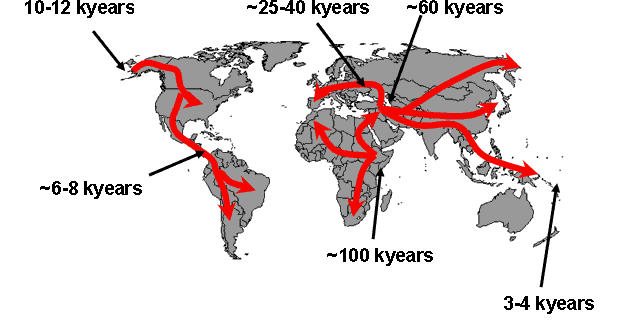
Why did the first human populations migrate out of Africa? It is the biggest debate in anthropology but no one can be sure of the answer. When it happened can at least be an informed debate and two hypotheses dominate the cultural landscape - but they both involve a common denominator that might shed light on why.

One popular belief is that human populations expanded rapidly from Africa to southern Asia via the coastlines of Arabia 50,000 or 60,000 years ago while another is that dispersal into the Arabian interior began 75,000 or even up to 130,000 years ago, but during multiple smaller phases as increased rainfall provided sufficient freshwater to support expanding populations.

Both involve climate change. 

Cells lining the intestinal tract form a critical barrier, protecting our bodies from the billions of bacteria living in the gut. Breaches in this barrier are driven largely by a single signaling molecule called tumor necrosis factor (TNF), elevated amounts of which are associated with inflammatory bowel diseases like Crohn's disease and ulcerative colitis.

Patients who increased doses of opioid medicines to manage chronic pain were more likely to experience an increase in depression, according a new paper in Pain which expands findings in a previous study of Veterans Administration (VA) patients.

Jeffrey Scherrer, Ph.D., associate professor for family and community medicine at Saint Louis University, and his colleagues studied questionnaires from 355 patients from nine practices in the Residency Research Network of Texas who reported chronic low back pain initially and at one-year and two-year follow ups. The respondents to the survey were 72.4 percent female, older than 46 (75.2 percent) and mostly of Hispanic or African-American descent (57.5 percent).