Banner
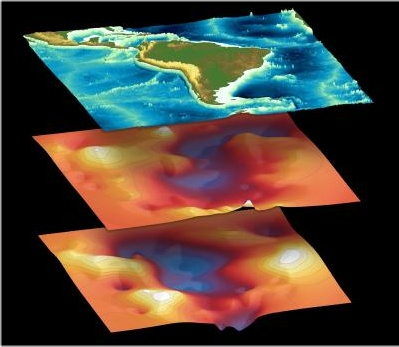
Here's Where Your Backyard Was 300 Million Years Ago

We may use terms like "grounded" and terra firma to mean stability and consistency but geology...

Convergent Evolution Cheat Sheet Now 120 Million Years Old

One tenet of natural selection is a random walk of genes but nature may be more predictable than...

Synchrotron Could Shed Light On Exotic Dark Photons

There are many hypothetical particles proposed to explain dark matter and one idea to explore how...

The Pain Scale Is Broken But This May Fix It

Chronic pain is reported by over 20 percent of the global population but there is no scientific...

User picture.
News StaffRSS Feed of this column.

News Releases From All Over The World, Right To You... Read More »

Blogroll

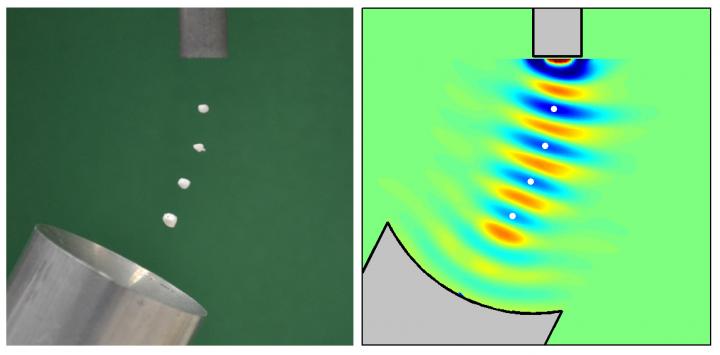
Acoustic levitation has been done in the past but it required a precise setup where the sound source and reflector were at fixed "resonant" distances. This made controlling the levitating objects difficult and isn't really proof-of-concept for anything practical.

Now a team of researchers have developed a new device that can levitate polystyrene particles by reflecting sound waves from a source above off a concave reflector below  - with more control than any instrument created before. Changing the orientation of the reflector allows the hovering particle to be moved around. 

Older men with locally advanced prostate cancer benefit by adding radiation treatment to hormone therapy versus hormone therapy alone, according to a new study which found that hormone therapy plus radiation reduced cancer deaths by nearly 50 percent in men aged 76 to 85 compared to men who only received hormone therapy.

Past studies have shown that 40 percent of men with aggressive prostate cancers are treated with hormone therapy alone, exposing a large gap in curative cancer care among "Baby Boomers" as they approach their their 70s. 

Researchers have developed a detailed explanation of how white-nose syndrome is killing bats in parts of North America - the fungus Pseudogymnoascus destructans makes bats die by increasing the amount of energy they use during winter hibernation.

Researchers from the U.S. Geological Survey and the University of Wisconsin created a model for how the disease progresses from initial infection to death in bats during hibernation. Since bats must carefully ration their energy supply during this time to survive without eating until spring, they tested the energy depletion hypothesis by measuring the amounts of energy used by infected and healthy bats hibernating under similar conditions.

Elderly patients admitted to intensive care units are about 35 percent more likely to die within five years of leaving the hospital if they develop an infection during their stay.

The upside to this finding is that preventing two of the most common health care-associated infections - bloodstream infections caused by central lines and pneumonia caused by ventilators - can increase the odds that these patients survive and reduce the cost of their care by more than $150,000, according to a study in American Journal of Infection Control. 

If you hit the ground with a hammer, it creates a micro-earthquake, but it is obviously too small to be detected. The ancient Chinese used to use a drum in the ground to listen for enemy sappers mining underneath their fortifications.

The process of hydraulic fracturing, or fracking, extracts gas and oil from shale rock by injecting a high-pressure water mixture directed at the rock to release the oil and gas trapped inside. Like any geological event, that results in micro-earthquakes much smaller than humans can feel. 

Controlled-release fertilizers are a widely used method of delivering nutrients to nursery container crops. Controlled release is just like it sounds, the fertilizers contain encapsulated solid mineral nutrients that dissolve slowly in water which are released over an extended period of time.

Controlled-release fertilizers (CRFs)
are quite popular, but growers and researchers want ways to decrease fertilizer and irrigation expenses and reduce the impact of nutrient leaching into the environment, so a new study compares CRF placement strategies.