Banner
Here's Where Your Backyard Was 300 Million Years Ago

We may use terms like "grounded" and terra firma to mean stability and consistency but geology...

Convergent Evolution Cheat Sheet Now 120 Million Years Old

One tenet of natural selection is a random walk of genes but nature may be more predictable than...

Synchrotron Could Shed Light On Exotic Dark Photons

There are many hypothetical particles proposed to explain dark matter and one idea to explore how...

The Pain Scale Is Broken But This May Fix It

Chronic pain is reported by over 20 percent of the global population but there is no scientific...

User picture.
News StaffRSS Feed of this column.

News Releases From All Over The World, Right To You... Read More »

Blogroll

Elephants are among the most intelligent non-humans, arguably on par with chimpanzees, and both African and Asian elephants are endangered. 

In 1995, 16-month old Kumari, the first Asian elephant born at the National Zoo in Washington, DC, died of a mysterious illness. In 1999, Gary Hayward of Johns Hopkins University and collaborators published their results identifying a novel herpesvirus, EEHV1 as the cause of Kumari's sudden death. They now show that severe cases like this one are caused by viruses that normally infect the species, rather than by viruses that have jumped from African elephants, which was their original hypothesis.  

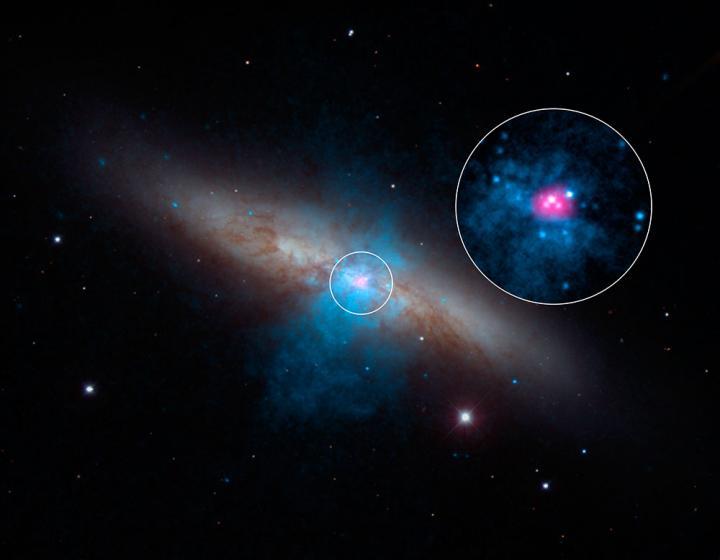
A once-in-a-century supernova, dubbed SN2014J, in a the nearby galaxy Messier 82 - the Cigar Galaxy - 12 million light-years away has been spotted; a pulsating dead star beaming with the energy of about 10 million suns. The object, previously thought to be a black hole because it is so powerful, is in fact a pulsar - the incredibly dense rotating remains of a star. 

Dom Walton, a postdoctoral scholar at Caltech who works with NuSTAR data, says that with its extreme energy, this first ultraluminous pulsar takes the top prize in the weirdness category. Pulsars are typically between one and two times the mass of the sun. This new pulsar presumably falls in that same range but shines about 100 times brighter than theory suggests something of its mass should be able to.

Despite the publicity of high-profile celebrities having their iPhones hacked and private pictures distributed across the Internet, a new paper confirms that substantial numbers of teens are sexting – sending and receiving explicit sexual images via cellphone. Though the behavior is widely studied, the potentially serious consequences of the practice led the researchers to more accurately measure how frequently teens are choosing to put themselves at risk in this fashion.

The NASA satellites, Tropical Rainfall Measuring Mission (TRMM) and Terra, have provided data on clouds, rainfall and the diameter of the eye of Super Typhoon Vongfong as it turned north in the Northwestern Pacific Ocean.

Typhoon Vongfong formed on October 2nd, 2014 in the southeast of Guam. Typhoon Phanfone, that recently pummeled Japan, formed near the same area in the western Pacific Ocean.

What could the natural diversity and beauty of plant leaves have in common with the violin, one of mankind's greatest musical inventions? More than you think.

Dan Chitwood, Ph.D., assistant member, Donald Danforth Plant Science Center in St. Louis, Missouri
spends most of his time exploring genetic and molecular mechanisms underlying diversity in plant morphology - how leaf shapes are formed and what that means for a plant to grow and thrive. He also studies how leaf shapes change as plant species evolve to adapt in different environments. Research into why a desert-adapted tomato species can survive with little water, for example, sheds light on how leaf architecture affects the efficiency of plant water use. 

Gamma rays are the highest-energy form of radioactive waves known in the universe but how they're made and where they come from have been something of a mystery. 

Using highly detailed radio telescope images, a team of astronomers have pinpointed the location where an explosion on the surface of a star, known as a nova, emitted gamma rays.  A nova occurs in a star that is part of a binary system – two stars orbiting one another. One star, known as a dense white dwarf, steals matter from the other and the interaction triggers a thermonuclear explosion that flings debris into space.

It was from this explosion from a system known as V959 Mon, located some 5,000 light years from Earth, that the researchers think the gamma rays were emitted.