Banner
Here's Where Your Backyard Was 300 Million Years Ago

We may use terms like "grounded" and terra firma to mean stability and consistency but geology...

Convergent Evolution Cheat Sheet Now 120 Million Years Old

One tenet of natural selection is a random walk of genes but nature may be more predictable than...

Synchrotron Could Shed Light On Exotic Dark Photons

There are many hypothetical particles proposed to explain dark matter and one idea to explore how...

The Pain Scale Is Broken But This May Fix It

Chronic pain is reported by over 20 percent of the global population but there is no scientific...

User picture.
News StaffRSS Feed of this column.

News Releases From All Over The World, Right To You... Read More »

Blogroll

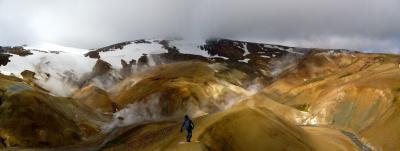
The 500 million years after Earth formed were not the hot, lava-filled Hell commonly portrayed, it may have had oceans, continents and active crustal plates - a lot like we have today.

This alternate view of Earth's first geologic eon, called the Hadean, gets support from the first detailed comparison of zircon crystals that formed more than 4 billion years ago with those formed contemporaneously in Iceland, which has been proposed as a possible geological analog for early Earth.

For the last decade, political science has been engaged in an effort to make all political behavior a function of biology, much the same way evolutionary psychologists make everything about sex. 

A new paper goes beyond suspect fMRI imaging interpretation and surveys of college students and makes the case that political leaning can be predicted by a preference for...body odor. 

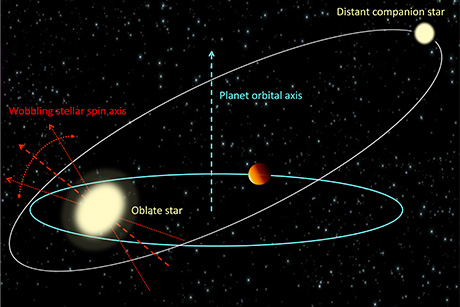
“Hot Jupiters” are the term for large, gaseous exoplanets in other solar systems and a new study finds they make their suns wobble as they make their way through their orbit.

Jupiters are a nice designation for a metric because it has a mass 1/1000th of that of the Sun

"Ontogeny recapitulates phylogeny" biologists once said - meaning that an animal's "ontogeny", its embryonic development, replays its entire evolutionary history.

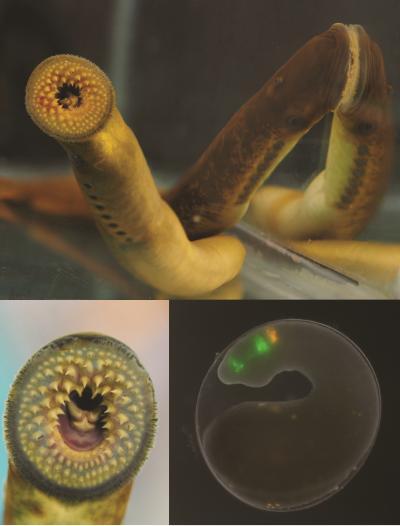
Today our understanding a more nuanced and a better way to figure out how animals evolved is to compare regulatory networks that control gene expression patterns, particularly embryonic ones, across species.  But that task can be humbling, according to Stowers Institute for Medical Research Scientific Director Robb Krumlauf, Ph.D. and colleagues, who show that the sea lamprey Petromyzon marinus, a survivor of ancient jawless vertebrates, exhibits a pattern of gene expression that is reminiscent of its jawed cousins, who evolved much, much later.

At nearly 100 feet long and weighing as much as 170 tons, the blue whale is the largest creature on the planet, and by far the heaviest living thing ever seen on Earth. So there's no way it could have anything in common with the tiniest fish larvae, which measure millimeters in length and tip the scales at a fraction of a gram, right?

Not so fast, says L. Mahadevan, Professor of Applied Mathematics, Organismic and Evolutionary Biology and of Physics at Harvard. 

Using simple hydrodynamics, Mahadevan and colleagues that a handful of principles govern how virtually every animal -- from the tiniest fish to birds to gigantic whales propel themselves though the water. 

The saying goes that we shouldn't let the perfect be the enemy of the good, so while there is no cure for muscular dystrophy, rather than solely focusing on the underlying genetic defect might not help people right now as directly targeting muscle repair. 

Muscular dystrophies are a group of muscle diseases characterized by skeletal muscle wasting and weakness. Mutations in certain proteins, most commonly the protein dystrophin, cause muscular dystrophy in humans and also in mice.