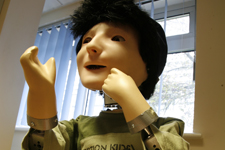
A new robot house will be launched at the University of Hertfordshire tomorrow, Wednesday 27 Mayth.
Professor Kerstin Dautenhahn and her team at the University’s School of Computer Science have taken their robots out of their laboratory and have them “living” in a house in Hatfield, so that the academics can develop them as personal companions. The academics will open the robot house to the media tomorrow, before launching it to the public in early June.
At the event, the academics will showcase the work they are doing to advance the relationship between robots and humans as part of the European project LIREC – Living with Robots and Interactive Companions. Different robots with mechanical and/or humanoid features will be shown.
U.S. Army Chemical Materials Agency (CMA) officials have announced the destruction of 60 percent of the U.S. declared stockpile under the Chemical Weapons Convention (CWC). This milestone was achieved Saturday, April 25. CMA reached the 50 percent milestone in December 2007 and is poised to destroy its two-millionth munition in the coming months.
Professor Maria da Graça Bicalho, head of the Immunogenetics and Histocompatibility Laboratory at the University of Parana, Brazil, told the annual conference of the European Society of Human Genetics that people with diverse major histocompatibility complexes (MHCs) were more likely to choose each other as mates than those whose MHCs were similar, and that this was likely to be an evolutionary strategy to ensure healthy reproduction.
Yes, opposites attract. Even genetically.
The MHC is a large genetic region situated on chromosome 6, and found in most vertebrates. It plays an important role in the immune system and also in reproductive success. Apart from being a large region, it is also an extraordinarily diverse one.
How do you reproduce when you lack the genes for reproduction? Duke University Medical Center researchers want to know also because that can tell a lot about how yeast infections occur.
In a paper published in Nature, Joseph Heitman, M.D., Ph.D., director of the Center for Microbial Pathogenesis in the Duke Department of Molecular Genetics and Microbiology and colleagues report that eight Candida species which have a sexual cycle were missing many of the genes related to reproduction found in other species.
It appears that some superbugs have evolved to develop the ability to manipulate the immune system - and that can be a good thing, say a team of researchers at The University of Western Ontario.
Some processes that reduce the lethal effects of toxins from superbugs allow humans and microbes to co-evolve, a discovery that may lead to novel alternatives to antibiotics that specifically target the toxic effects of these superbugs.
Today’s children are coming of age immersed in a world video games, instant messaging and 3-D avatars of themselves. Many have cell phones, laptops, and hand-held video games. Heck, even robot pets are being raised in virtual worlds.
What impact does this technology have on children?
The journal Children, Youth and Environments (CYE) this month published a special issue titled “Children in Technological Environments.” The issue examines the increasing prevalence of technology from various perspectives, including knowledge and education, social and moral development, culture and community, access and equity, relationship to nature, therapy and health, art and expression, and future scenarios.


 Pilot Study: Fibromyalgia Fatigue Improved By TENS Therapy
 High Meat Consumption Linked To Lower Dementia Risk
 Long Before The Inca Colonized Peru, Natives Had A Thriving Trade Network
 Mesolithic People Had Meals With More Tradition Than You Thought