Banner
Pilot Study: Fibromyalgia Fatigue Improved By TENS Therapy

Fibromyalgia is the term for a poorly-understood condition where people experience pain and fatigue...

High Meat Consumption Linked To Lower Dementia Risk

Older people who eat large amounts of meat have a lower risk of dementia and cognitive decline...

Long Before The Inca Colonized Peru, Natives Had A Thriving Trade Network

A new DNA analysis reveals that long before the Incan Empire took over Peru, animals were...

Mesolithic People Had Meals With More Tradition Than You Thought

The common imagery of prehistoric people is either rooting through dirt for grubs and picking berries...

User picture.
News StaffRSS Feed of this column.

News Releases From All Over The World, Right To You... Read More »

Blogroll
We all know how infants can act up during their terrible twos, but when these behaviors are accompanied by developmental setbacks, they could point to something more serious.

Researchers are currently learning more about regressive autistic spectrum disorder (RASD), which describes children who have been diagnosed with autism who demonstrate a history of a regression. The regression refers to a marked loss of previously acquired developmental skills such as language or social ability.
In 2006, astronomer Alice Quillen of the University of Rochester predicted that a planet of a particular size and orbit must lie within the dust of a nearby star. That planet has now been photographed by the Hubble Space Telescope, making it only the second planet ever imaged after an accurate prediction. The only other planet seen after an accurate prediction was Neptune, discovered more than 160 years ago. 

"It's remarkable," says Eugene Chiang, associate professor of astronomy at the University of California at Berkeley, and part of the team that imaged the new planet. "Alice saw the way the inner edge of the dust ring cut off sharply and recognized that a planet likely orbited just inside. The orbit we found was amazingly close to Alice's prediction." 
University of Oregon sociologist Aliya Saperstein and sociologist Andrew M. Penner of the University of California, Irvine have a new twist on race - it isn't just appearance but socioeconomic status, they say.   Their new study says that Americans who are unemployed, incarcerated or impoverished today are more likely to be classified and identified as black, by themselves or by others, regardless of how they were seen -- or self identified -- in the past.
With the aid of a straightforward experiment, researchers have provided some clues to one of biology's most complex questions: how ancient organic molecules came together to form the basis of life. 

Specifically, this study, appearing online this week in JBC, demonstrated how ancient RNA joined together to reach a biologically relevant length.
Have you ever wondered why it seems like the littlest things make people angry?   University of Minnesota marketing professor Vladas Griskevicius says he can explain in three words why people may be inclined to make a mountain out of molehill: aggression, status and sex.  He makes an unfortunate correlation-causation jump to  the colloquial term 'evolution' too, but let's forget that for a moment, because we'd never get any articles written if we stopped every time a non-biologist calls something Evolution.

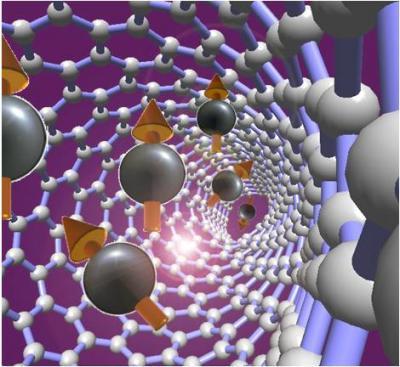
A key challenge of nanotechnology research is investigating how different materials behave at lengths of merely one-billionth of a meter. When shrunk to such tiny sizes, many everyday materials exhibit interesting and potentially beneficial new properties.

Magnetic behavior is one such phenomenon that can change significantly depending on the size of the material. However, the sheer challenge of observing the magnetic properties of nanoscale material has impeded further study of the topic.