Construction of new coal-fired power plants in the United States is in danger of coming to a standstill, partly due to the high cost of the requirement, whether existing or anticipated, to capture all emissions of carbon dioxide, an important greenhouse gas. But an MIT analysis suggests an intermediate step that could get construction moving again, allowing the nation to fend off growing electricity shortages using our most-abundant, least-expensive fuel while also reducing emissions.
Instead of capturing all of its CO2 emissions, plants could capture a significant fraction of those emissions with less costly changes in plant design and operation, the MIT analysis shows.
You wouldn't ordinarily think of soil as a non-renewable resource, but it is. Healing damage to soil takes geologic time, not human time. And increasing levels of nitrogen deposition that are associated with industry and agriculture are driving soils toward a toxic level of acidification, reducing plant growth and polluting surface waters, according to a new study published online in Nature Geoscience.
A new approach to calibrating quantum mechanical measurement has been developed with particular applications in optics and super-secure quantum communication.Scientists have used the approach to directly calibrate a detector that can sense the presence of multiple individual photons, it is revealed in research published today in Nature Physics.
Being able to sense the presence of individual photons is an important requirement for the development of future long-distance quantum communication devices and networks. One of the potential applications of this new detector is in devices for secret communications, which could allow information to be exchanged in total security guaranteed by the laws of physics, with no possibility of interception, or eavesdropping.
One of the most important developments in human civilization was the practice of
sustainable agriculture, but we were not the first - ants have been doing it for over 50 million years. Just as farming helped humans become a dominant species, it has also helped leaf-cutter ants become dominant herbivores, and one of the most successful social insects in nature. According to an article in the November issue of Microbiology Today, leaf-cutter ants have developed a system to try and keep their gardens pest-free; an impressive feat which has evaded even human agriculturalists.
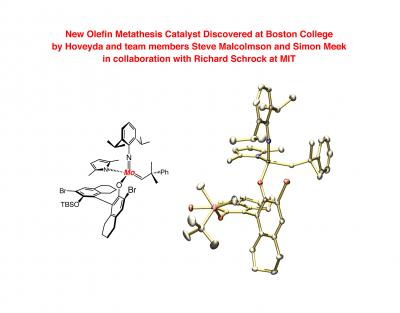
A new class of exceptionally effective catalysts that promote the powerful olefin metathesis reaction has been discovered by a team of Boston College and MIT scientists, opening up a vast new scientific platform to researchers in medicine, biology and materials.
The new catalysts can be easily prepared and possess unique features never before utilized by chemists, according to findings from a team led by Boston College Prof. Amir H. Hoveyda and MIT Prof. and Nobel laureate Richard Schrock, who shared the 2005 prize in Chemistry for early discoveries of catalytic olefin metathesis. The team's findings are reported in the current online edition of the journal Nature.
Pasteurization was invented for a good reason and raw milk is illegal in many countries because it can be contaminated with potentially harmful microbes. Contamination can also spoil the milk, making it taste bitter and turn thick and sticky. Now scientists have discovered new species of bacteria that can grow at low temperatures, spoiling raw milk even when it is refrigerated. According to research published in the November issue of the International Journal of Systematic and Evolutionary Microbiology, the microbial population of raw milk is much more complex than previously thought.


 Pilot Study: Fibromyalgia Fatigue Improved By TENS Therapy
 High Meat Consumption Linked To Lower Dementia Risk
 Long Before The Inca Colonized Peru, Natives Had A Thriving Trade Network
 Mesolithic People Had Meals With More Tradition Than You Thought