Banner
Pilot Study: Fibromyalgia Fatigue Improved By TENS Therapy

Fibromyalgia is the term for a poorly-understood condition where people experience pain and fatigue...

High Meat Consumption Linked To Lower Dementia Risk

Older people who eat large amounts of meat have a lower risk of dementia and cognitive decline...

Long Before The Inca Colonized Peru, Natives Had A Thriving Trade Network

A new DNA analysis reveals that long before the Incan Empire took over Peru, animals were...

Mesolithic People Had Meals With More Tradition Than You Thought

The common imagery of prehistoric people is either rooting through dirt for grubs and picking berries...

User picture.
News StaffRSS Feed of this column.

News Releases From All Over The World, Right To You... Read More »

Blogroll
Based on past elections and economic factors, two professors at the University of Oregon predict that Senator Barack Obama will win the presidential election by a 52 to 48 margin.

In the paper "A Disaggregate Approach to Economic Models of Voting in U.S. Presidential Elections: Forecasts of the 2008 Election," published in the Economics Bulletin, economic professors Stephen Haynes and Joe Stone's research shows that lowest-income states prefer McCain by 55.4 percent to 44.6 percent. Middle income states are almost evenly split between the two candidates and highest-income states prefer Obama by 53.3 percent to 46.65 percent.

Haynes and Stone note in their research that the 52 to 48 margin in favor of Obama falls within the four-point range of statistical error.
If Barack Obama is elected president on Nov. 4, and current polling suggests that is the case, he will come into office with something few presidents get and all envy: both houses of Congress controlled by his own party. With Speaker Nancy Pelosi at the helm in the House, and Majority Leader Harry Reid presiding over what may be a filibuster-proof majority in the Senate, Obama, Pelosi and Reid will be able to fundamentally change the size, nature and scope of government.
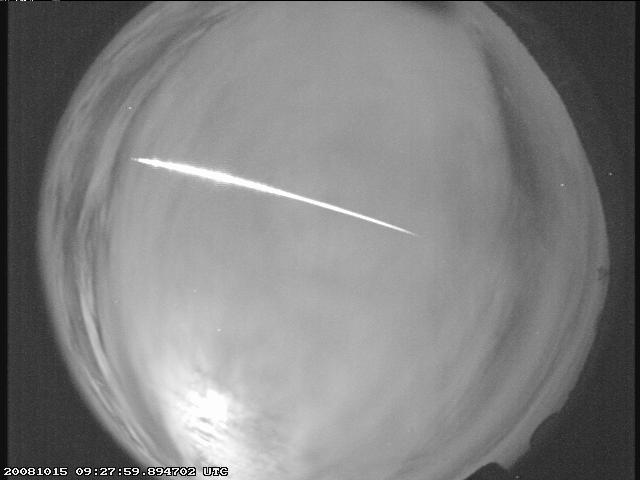
For the second time this year, The University of Western Ontario Meteor Group has captured incredibly rare video footage of a meteor falling to Earth. The team of astronomers suspects the fireball dropped meteorites in a region north of Guelph, Ontario, Canada, that may total as much as a few hundred grams in mass.

The Physics and Astronomy Department at Western has a network of all-sky cameras in southern Ontario that scan the sky monitoring for meteors. 

On Wednesday, October 15 at 5:28 a.m., all seven cameras of Western's Southern Ontario Meteor Network recorded a bright, slow fireball in the predawn sky. 

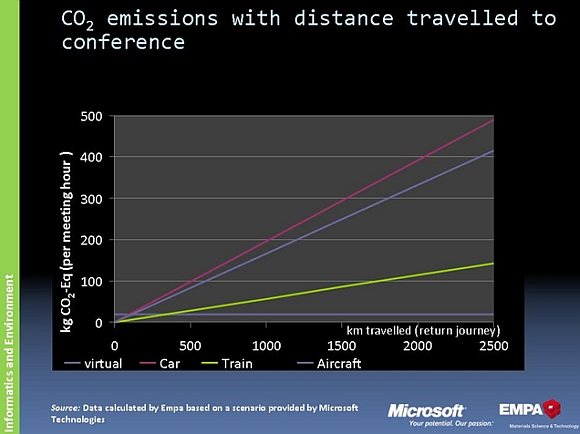
Does your boss  feel like an environmentally aware entrepreneur?   If so, it might  be worth mentioning that business travel, conferences and meetings have an  effect on the environment.   Virtual participation is possible but computers, networks and the entire data infastructure consume massive amounts of power as well.

What is needed is a way to quantify meetings in terms of energy use.   At a recent “Informatics Day at the Technopark Zurich" , a Microsoft booth allowed visitors were able to test how much CO2 they would save, if any, if they replaced a “real” meeting with a videoconference. Using life cycle analysis methods and the «ecoinvent» database, Empa researchers produced comparative data showing what environmental effects were created, and where.
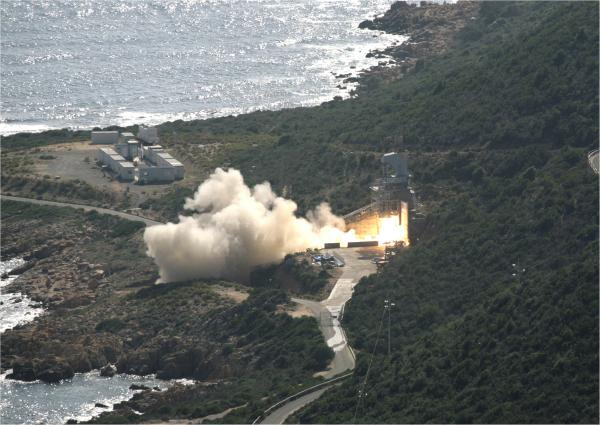
Yesterday, the Zefiro 9-A motor successfully completed its first firing test at the Salto di Quirra Inter-force Test Range in Sardinia (Italy). This was the penultimate firing test for the engine prior to the Vega launcher’s qualification flight, scheduled to take place by the end of 2009.
 
The Zefiro 9-A (Z9-A) solid-fuel rocket motor, which will power the Vega launch vehicle’s third stage, left the production facility of Avio, in Colleferro (Italy), at the end of September and was installed at the test site over the last three weeks. 
 
Does ice-cream actually taste better when it is licked from a cone than when eaten from a spoon?

Massey food technology senior lecturer Kay McMath thinks so. Although she is not aware of any specific scientific evidence to prove it, she says “there are some physical and physiological reasons why there are likely to be differences in flavour”.

“Flavour in ice cream is only released when the fat content – which carries the flavour – is warmed in the mouth to at least body temperature,” she says.
 
“During licking, the tongue is coated with a thin layer of ice-cream which is more quickly warmed and the flavour is detected by the large surface area of the taste buds present on the tongue.”