Banner
The Scorched Cherry Twig And Other Christmas Miracles Get A Science Look

Bleeding hosts and stigmatizations are the best-known medieval miracles but less known ones, like ...

$0.50 Pantoprazole For Stomach Bleeding In ICU Patients Could Save Families Thousands Of Dollars

The inexpensive medication pantoprazole prevents potentially serious stomach bleeding in critically...

Metformin Diabetes Drug Used Off-Label Also Reduces Irregular Heartbeats

Adults with atrial fibrillation (AFib) who are not diabetic but are overweight and took the diabetes...

Your Predator: Badlands Future - Optical Camouflage, Now Made By Bacteria

In the various 'Predator' films, the alien hunter can see across various spectra while enabling...

User picture.
News StaffRSS Feed of this column.

News Releases From All Over The World, Right To You... Read More »

Blogroll

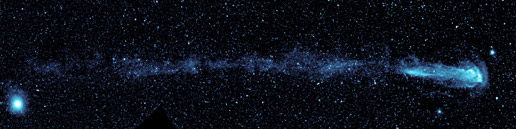
NASA's Galaxy Evolution Explorer has spotted an amazingly long comet-like tail behind a star streaking through space at supersonic speeds. The star, named Mira after the Latin word for "wonderful," has been a favorite of astronomers for about 400 years. It is a fast-moving, older star called a red giant that sheds massive amounts of surface material.

The space-based Galaxy Evolution Explorer scanned the popular star during its ongoing survey of the entire sky in ultraviolet light. Astronomers then noticed what looked like a comet with a gargantuan tail. In fact, material blowing off Mira is forming a wake 13 light-years long, or about 20,000 times the average distance of Pluto from the sun.

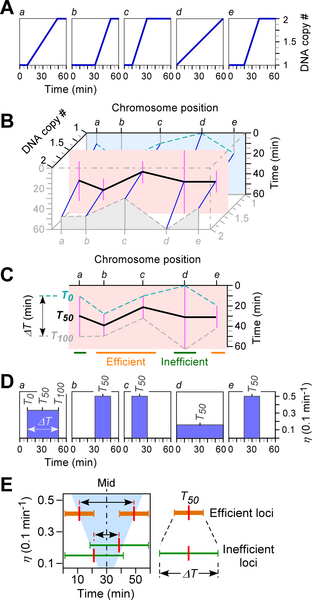
For the first time, findings by scientists at the Genome Institute of Singapore (GIS) may be paving the way for more efficient analyses and tests related to the replication of cells, and ultimately, to the better understanding of human biology, such as in stem cell research.

Faithful duplication of the genome (the hereditary information that is encoded in genetic materials known as DNA) ensures that daughter cells inherit a complete set of genetic materials identical to parent cells. This duplication occurs in the section of the cell cycle known as the S-phase. Extensive research on the budding yeast, an organism often used in modern cell biology research, had revealed that the replication process is initiated at hundreds of origins in the S-phase.

A film that wins critical acclaim is likely to be an R-rated drama, adapted from a prize-winning play or book, based on a true story, with the original author or director involved in writing the screenplay. It is unlikely to be a sequel or remake, a comedy or musical, a summer release, a big-budget project, have a PG-13 rating, open on numerous screens or do a big box office on the first weekend.

Nerve cells must perform millions of neuronal processes and form connections between them during embryonic development to ensure that the nervous system will function properly. Dr. Marta Rosário and Prof. Walter Birchmeier from the Max Delbrück Center for Molecular Medicine (MDC) Berlin-Buch (Germany), a member of the Helmholtz-Association of National Research Centres, have discovered a novel regulator which is crucial for this process and which they named NOMA-GAP (Neurite-Outgrowth MultiAdaptor RhoGAP).

They show that NOMA-GAP is essential for the function of the nerve growth factor (NGF), itself a crucial factor for the functioning of the nervous system and for nerve cell survival.

Mayo Clinic researchers have identified the first immune molecule that appears to play a role in prostate cancer development and in predicting cancer recurrence and progression after surgery. The report on the B7-H3 molecule by Mayo Clinic Cancer Center appears today in Cancer Research.

“This discovery will allow physicians to individualize treatment and observation plans for prostate cancer patients,” says Timothy Roth, M.D., a Mayo Clinic urology resident and lead author of the study. “Being able to tell a patient his specific risk after surgery, and perhaps even prior to surgery, will be a huge step forward.”

Researchers have reported new insight into the pathology underlying a recently identified neurological disorder that strikes middle-aged adults that is caused by alterations in the same gene that causes fragile X syndrome. “Fragile X tremor/ataxia syndrome” (FXTAS) overwhelmingly affects males, usually in their 50s, causing Parkinson’s-like symptoms and cognitive decline. In contrast, fragile X syndrome manifests itself from birth and is the most common form of X-linked mental retardation.

In two related papers, researchers report studies revealing how FXTAS might arise from malfunction of the same gene that causes fragile X syndrome.