Banner
The Scorched Cherry Twig And Other Christmas Miracles Get A Science Look

Bleeding hosts and stigmatizations are the best-known medieval miracles but less known ones, like ...
$0.50 Pantoprazole For Stomach Bleeding In ICU Patients Could Save Families Thousands Of Dollars

The inexpensive medication pantoprazole prevents potentially serious stomach bleeding in critically...
Metformin Diabetes Drug Used Off-Label Also Reduces Irregular Heartbeats

Adults with atrial fibrillation (AFib) who are not diabetic but are overweight and took the diabetes...

Your Predator: Badlands Future - Optical Camouflage, Now Made By Bacteria

In the various 'Predator' films, the alien hunter can see across various spectra while enabling...

User picture.
News StaffRSS Feed of this column.

News Releases From All Over The World, Right To You... Read More »

Blogroll

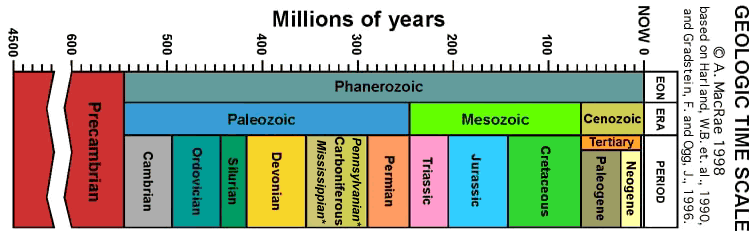
Extinctions happened in periodic cycles in Earth's history but approximately 250 million years ago vast numbers of species disappeared from Earth and life changed from simple to complex. According to Jonathan Payne, assistant professor of geological and environmental sciences at Stanford, a massive, rapid release of carbon may have triggered that extinction and it may tell us something about current global carbon cycle changes.

Payne studies the Permian-Triassic extinction and the following 4 million years of instability in the global carbon cycle.

"People point to the fossil record as a place where we can learn about how our actions today may affect the future course of evolution," Payne said.

Estrogen plays an important role in determining how sensitive a person is to pain, and the estrogen receptor known as ER-beta is particularly significant in this context. These are the conclusions of a study from the Swedish medical university Karolinska Institutet.

"This may mark the beginning of the production of a new class of analgesic drugs", says Professor Jan-Åke Gustafsson, Department of Biosciences and Nutrition.

Earlier studies have shown that estrogen affects how we experience pain, but the mechanisms behind this have been unclear. Estrogen can bind to two different receptors, known as ER-alpha and ER-beta, and the new study describes results obtained concerning the expression of these two receptors in the spinal cord.

Following World War II, the U.S. began increasing its commitment to publicly-funded science. The responsibility of the scientist was thought to be a straightforward process: if the scientists asked the “right” questions, their answers would help policy makers to make the “right” decisions.

However, the questions asked by researchers do not always translate easily into policy.

Which genes are passed on from mother to child is decided very early on during the maturation of the egg cell in the ovary. In a cell division process that is unique to egg cells, half of the chromosomes are eliminated from the egg before it is fertilised. Using a powerful microscope, researchers from the European Molecular Biology Laboratory (EMBL) have now revealed how the molecular machinery functions that is responsible for chromosome reduction of egg cells in mice. In the current issue of Cell they report the assembly of this machinery, which is very different from what happens in all other cells in the body. The process is likely conserved across species and the new insights might help shed light on defects occurring in human egg cell development.

Oregon Health & Science University researchers have figured out how to turn a mouse into a factory for human liver cells that can be used to test how pharmaceuticals are metabolized.

The technique could soon become the gold standard not only for examining drug metabolism in the liver, which helps scientists determine a drug's toxicity.

The space shuttle Endeavour and its seven-member crew lifted off at 6:36 p.m. EDT Wednesday from NASA's Kennedy Space Center in Florida. The astronauts are on their way to the International Space Station for an assembly mission, designated STS-118.

"This is serious business we're in here," said Endeavour's Commander Scott Kelly to the shuttle launch director shortly before lift off. "I'm proud of your team for getting Endeavour ready to go fly. I'm also proud of my crew and the rest of the astronaut office for the competence and professionalism and consistently making something that is incredibly difficult look easy."

Kelly then added, "We'll see you in a couple of weeks, and thanks for loaning us your space shuttle."