Banner
The Scorched Cherry Twig And Other Christmas Miracles Get A Science Look

Bleeding hosts and stigmatizations are the best-known medieval miracles but less known ones, like ...

$0.50 Pantoprazole For Stomach Bleeding In ICU Patients Could Save Families Thousands Of Dollars

The inexpensive medication pantoprazole prevents potentially serious stomach bleeding in critically...

Metformin Diabetes Drug Used Off-Label Also Reduces Irregular Heartbeats

Adults with atrial fibrillation (AFib) who are not diabetic but are overweight and took the diabetes...

Your Predator: Badlands Future - Optical Camouflage, Now Made By Bacteria

In the various 'Predator' films, the alien hunter can see across various spectra while enabling...

User picture.
News StaffRSS Feed of this column.

News Releases From All Over The World, Right To You... Read More »

Blogroll

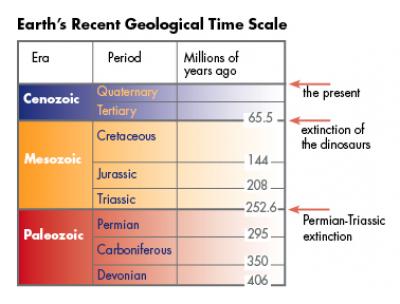
252 million years ago a mass extinction of cataclysmic proportions occurred and the world was changed forever. Prior to that, ocean life was diverse and clam-like organisms called brachiopods dominated. After the extinction little else existed and a different kind of clam-like organism, called a bivalve, took over.

Why did it happen?

The Aurigid meteor shower peaked on September 1, originating from C/1911 N1 Kiess, or comet Kiess, a long-period comet that takes about 2000 years to orbit the Sun. It was discovered in 1935 by Carl Kiess.

As Earth passes through the dust comet Kiess left behind 2000 years ago, meteoroids, or shooting stars, rain upon Earth. They burn up in the atmosphere at very high velocities, about 67 km/s, creating the meteor shower.

The Aurigids get their name from the constellation Auriga, because if you look up in the sky, this is where the shooting stars seem to come from. The dust trail of comet Kiess will not be crossed again in this manner for 70 years.


The constellation of Auriga rising above the horizon.

Researchers at UT Southwestern Medical Center have found that a single gene might control whether or not individuals tend to pile on fat, a discovery that may point to new ways to fight obesity and diabetes.

“From worms to mammals, this gene controls fat formation,” said Dr. Jonathan Graff, associate professor of developmental biology and internal medicine at UT Southwestern and senior author of a study appearing in the Sept. 5 issue of Cell Metabolism.

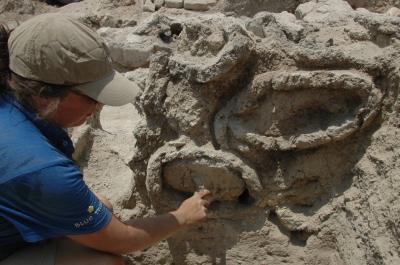
Amihai Mazar, Eleazar L. Sukenik Professor of Archaeology at the Hebrew University, revealed that the first apiary (beehive colony) dating from the Biblical period has been found in excavations he directed this summer at Tel Rehov in Israel’s Beth Shean Valley. This is the earliest apiary to be revealed to date in an archaeological excavation anywhere in the ancient Near East, said Prof. Mazar. It dates from the 10th to early 9th centuries B.C.E.

Tel Rehov is believed to have been one of the most important cities of Israel during the Israelite monarchy. The beehives there were found in the center of a built-up area there that has been excavated since 1997 by Dr. Nava Panitz-Cohen of the Hebrew University. Three rows of beehives were found in the apiary, containing more than 30 hives.

Eminem should be reading up on his Elvis history if he wants to stay around. Famous musicians are more than twice as likely as the rest of the population to die an early death, and within a few years of becoming famous, reveals research in the Journal of Epidemiology and Community Health.

The findings are based on more than 1050 North American and European musicians and singers who shot to fame between 1956 and 1999.

Scientists at Children's Hospital in Pittsburgh have discovered a unique population of adult stem cells derived from human muscle that could be used to treat muscle injuries and diseases such as heart attack and muscular dystrophy.

In a study using human muscle tissue, scientists in Children's Stem Cell Research Center - led by Johnny Huard, PhD, and Bruno Péault, PhD - isolated and characterized stem cells taken from blood vessels (known as myoendothelial cells) that are easily isolated using cell-sorting techniques, proliferate rapidly and can be differentiated in the laboratory into muscle, bone and cartilage cells.