On its opening day, the London Millennium Bridge experienced unexpected swaying due to the large number of people crossing it. A new study finally explains the Millennium Bridge 'wobble' by concluding that humans did not walk the way engineers would have preferred.
It has generally been thought the Millennium Bridge 'wobble' was due to pedestrians synchronizing their footsteps with the bridge motion. However, this is not supported by measurements of the phenomenon on other bridges.
"This article says most people die in bed. I figure if I stay out of bed, I'm safe." - Get Shorty
A map of natural hazard mortality in the United States has been produced and is featured in the International Journal of Health Geographics. It gives a county-level representation of the likelihood of dying as the result of natural events such as floods, earthquakes or extreme weather.
Dinosaur hunters on a month-long expedition to the Sahara desert have returned home in time for Christmas with more than they ever dreamed of finding.
They have unearthed not one but two possible new species of extinct animals. Their success marks one of the most exciting discoveries to come out of Africa for 50 years.
The team have discovered what appears to be a new type of pterosaur and a previously unknown sauropod, a species of giant plant-eating dinosaur. Both would have lived almost one hundred million years ago.
The findings of the world's largest study on the ability of children and young people to taste and what they like have now been published jointly by Danish Science Communication and food scientists from The Faculty of Life Sciences (LIFE) at University of Copenhagen. The subjects were 8,900 Danish schoolchildren.
The short version:
- Girls have a better sense of taste than boys
- Every third child of school age prefers soft drinks which are not sweet
- Children and young people love fish
- Kids do not think of themselves as being fussy eaters
- Boys have a sweeter tooth than girls
... and this all changes when they become teenagers.
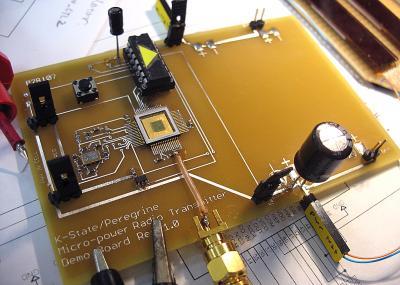
If changing the batteries in the remote control or smoke detector seems like a chore, imagine having to change hundreds of batteries in sensors scattered across a busy bridge. That's why Kansas State University engineers are helping a semiconductor manufacturer implement its idea of an energy-harvesting radio. It could transmit important data -- like stress measurements on a bridge, for instance -- without needing a change of batteries, ever.
Bill Kuhn, K-State professor of electrical and computer engineering, and Xiaohu Zhang, master's student in electrical engineering, are developing an energy-harvesting radio for Peregrine Semiconductor, a San Diego-based integrated circuit manufacturer.
Black holes? Maybe we should think of them as donut holes. The shape of material around black holes has been seen for the first time: an analysis of over 200 active galactic nuclei—cores of galaxies powered by disks of hot material feeding a super-massive black hole—shows that all have a consistent, ordered physical structure that seems to be independent of the black hole's size.


 Here's Where Your Backyard Was 300 Million Years Ago
 Convergent Evolution Cheat Sheet Now 120 Million Years Old
 Synchrotron Could Shed Light On Exotic Dark Photons
 The Pain Scale Is Broken But This May Fix It