Banner
Here's Where Your Backyard Was 300 Million Years Ago

We may use terms like "grounded" and terra firma to mean stability and consistency but geology...

Convergent Evolution Cheat Sheet Now 120 Million Years Old

One tenet of natural selection is a random walk of genes but nature may be more predictable than...

Synchrotron Could Shed Light On Exotic Dark Photons

There are many hypothetical particles proposed to explain dark matter and one idea to explore how...

The Pain Scale Is Broken But This May Fix It

Chronic pain is reported by over 20 percent of the global population but there is no scientific...

User picture.
News StaffRSS Feed of this column.

News Releases From All Over The World, Right To You... Read More »

Blogroll
There are hurdles to clear before malaria elimination can be achieved. A supplement published in Malaria Journal features a series of articles reviewing the many aspects of the research agenda for global malaria elimination.
Astronomy&Astrophysics is publishing spectroscopic observations with NASA's space-based Far-Ultraviolet Spectroscopic Explorer (FUSE) of the white dwarf KPD 0005+5106. The team of German and American astronomers who present these observations show that this white dwarf is among the hottest stars known so far, with a temperature of 200,000 K at its surface. It is so hot that its photosphere exhibits emission lines in the ultraviolet spectrum, a phenomenon that has never been seen before. These emission features stem from extremely ionized calcium (nine-fold ionized, i.e., CaX), which is the highest ionization stage of a chemical element ever discovered in a photospheric stellar spectrum.
A new paper in The Astrophysical Journal suggests that turbulence plays a critical role in creating ripe conditions for the birth of planets, a challenge to the prevailing theory of planet formation, gravitational instability. 

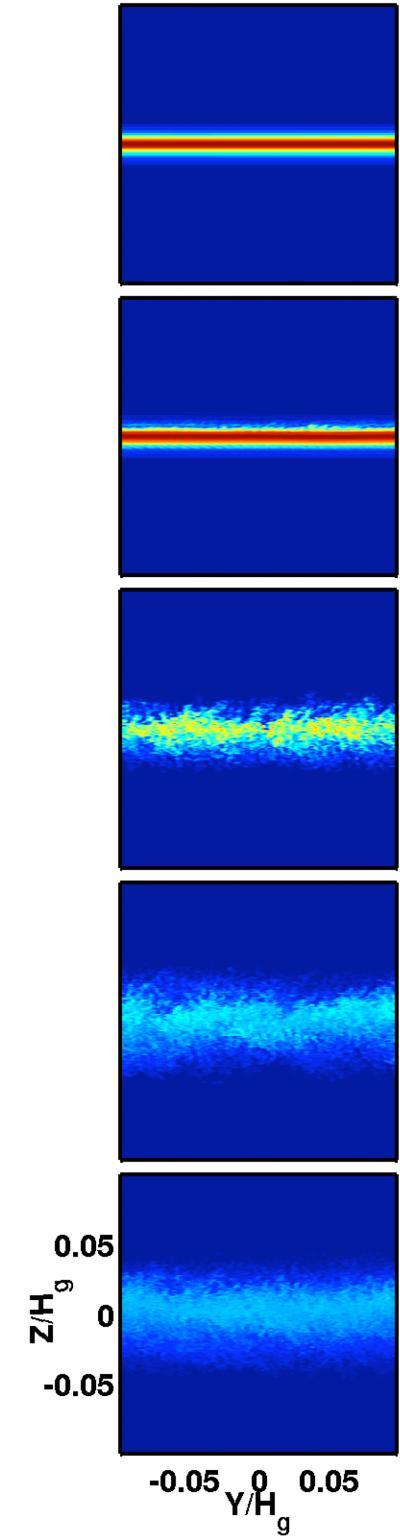
Using three-dimensional simulations of the dust and gas that orbits young stars, the study claims that turbulence is a significant obstacle to gravitational instability, which scientists have used since the 1970s to explain the early stage of planet formation. 
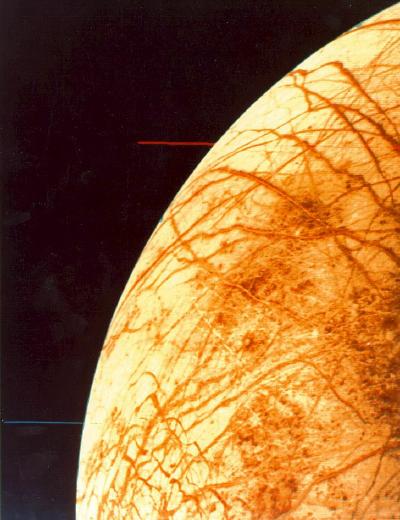
One of the moons in our solar system that scientists think has the potential to harbor life may have a far more dynamic ocean than previously thought.   If Europa is tilted on its axis even slightly as it orbits the giant planet Jupiter, then Jupiter's gravitational pull could be creating powerful waves in Europa's ocean, according to Robert Tyler, an oceanographer with the University of Washington's Applied Physics Laboratory and author of a letter on the subject in the Dec. 11 Nature. As those waves dissipate, they would give off significant heat energy. 

More than one in five women has a secret Santa Claus fantasy, according to  dating website  BeNaughty.com.  As you can guess by their URL, their subscribers probably were more inclined to fantasy about numerous holiday icons, so guard your turkeys at Thanksgiving.

Research by the site reveals that women find the chubby, bearded gift-giver very sexy indeed. More than 1,000 women were asked whether they fancied Santa Claus in the poll. 1 in 10 even wear a Santa costume themselves in the bedroom, though a beard and breasts probably says more about the men they are with than it does the women themselves.

Research by dating site FreeDating.co.uk found that 36% of women would end a relationship over an 'inadequate' Christmas gift.  This was particularly the case when the present was the latest in a series of disappointing let-downs within the relationship.

Examples of gifts which were deemed inadequate included cooking utensils, cleaning products, and a sticky tape dispenser.   Generally speaking, it seems common sense to think that devices meant to cook for a significant other or clean the house would be a bad idea - but that's why science studies are needed.