Banner
Pilot Study: Fibromyalgia Fatigue Improved By TENS Therapy

Fibromyalgia is the term for a poorly-understood condition where people experience pain and fatigue...

High Meat Consumption Linked To Lower Dementia Risk

Older people who eat large amounts of meat have a lower risk of dementia and cognitive decline...

Long Before The Inca Colonized Peru, Natives Had A Thriving Trade Network

A new DNA analysis reveals that long before the Incan Empire took over Peru, animals were...

Mesolithic People Had Meals With More Tradition Than You Thought

The common imagery of prehistoric people is either rooting through dirt for grubs and picking berries...

User picture.
News StaffRSS Feed of this column.

News Releases From All Over The World, Right To You... Read More »

Blogroll

EAST LANSING, Mich. -- High-ranking people don't always turn out to be selfish jerks. It all depends on whether they feel worthy of their prominent social position, new research indicates.

A series of six scientific studies led by Michigan State University scholar Nicholas Hays found that people with high social status who didn't believe they earned that status were much more generous than high-status people who felt they deserved the respect and admiration of others.

Prominent people who don't feel their status is fair and equitable become more generous with others to alleviate that sense of inequity, he explained.

Scientists at the University of Southampton have discovered a potential and novel way of preventing asthma at the origin of the disease, a finding that could challenge the current understanding of the condition.

The research, published in The Journal of Clinical Investigation (JCI) Insight, analysed the impact of the gene ADAM33, which is associated with the development of asthma.

ADAM33 makes an enzyme, which is attached to cells in the airway muscles. When the enzyme loses its anchor to the cell surface, it is prone to going rogue around the lung causing poorer lung function in people who have asthma.

For the first time Japanese researchers discovered that the extracellular domain of taste receptor proteins undergoes a change in structure by binding together taste substances. This structure change is thought to transmit the extracellular binding of taste substances to taste cells. The findings will contribute to our basic understanding of taste mechanisms and the development of a new taste evaluation system that makes use of the screening and detection of taste receptor structure changes.

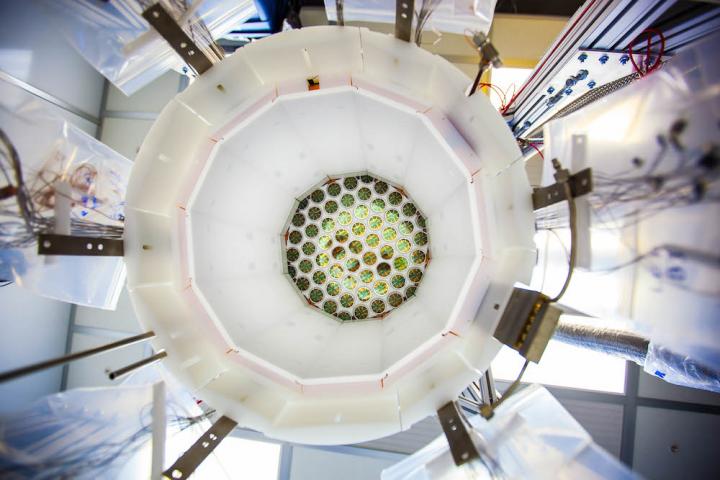
The Large Underground Xenon (LUX) dark matter experiment, which operates beneath a mile of rock at the Sanford Underground Research Facility in the Black Hills of South Dakota, has completed its search for the missing matter of the universe yielding no trace of a dark matter particle. 

LUX's extreme sensitivity makes the team confident that if dark matter particles had interacted with the LUX's xenon target, the detector would almost certainly have seen them. In a 'what you don't find is important also' sense, these new limits on dark matter detection will allow scientists to eliminate many potential models for dark matter particles. 

Ratings of our own abilities are strongly influenced by the performance of others, according to a study published July 20 in Neuron. Interacting with high performers makes us feel more capable in cooperative team settings, but less competent in competitive situations. Moreover, the degree of "self-other-mergence" is associated with activity in a brain region previously implicated in theory of mind--the ability to understand the mental states of oneself and others.

People with a variant copy of the TREM2 gene have an increased risk of developing Alzheimer's disease, but researchers are only beginning to understand why.

A Genentech study has uncovered details of how a type of immune cell helps the brain get rid of the tiny amyloid-beta aggregates that can clump together to form the plaques characteristic of Alzheimer's. The researchers, reporting July 20 in Neuron, found that TREM2 mutations can derail the immune cell's plaque-clearing activity, as can two other genes already known to increase a person's risk for Alzheimer's: APOE and APOJ (known as clusterin).

"I think we're only scratching the surface of what TREM2 does," said Morgan Sheng, a senior author of the paper and Vice-President of Neuroscience at Genentech.