Banner
Pilot Study: Fibromyalgia Fatigue Improved By TENS Therapy

Fibromyalgia is the term for a poorly-understood condition where people experience pain and fatigue...

High Meat Consumption Linked To Lower Dementia Risk

Older people who eat large amounts of meat have a lower risk of dementia and cognitive decline...

Long Before The Inca Colonized Peru, Natives Had A Thriving Trade Network

A new DNA analysis reveals that long before the Incan Empire took over Peru, animals were...

Mesolithic People Had Meals With More Tradition Than You Thought

The common imagery of prehistoric people is either rooting through dirt for grubs and picking berries...

User picture.
News StaffRSS Feed of this column.

News Releases From All Over The World, Right To You... Read More »

Blogroll

Using ESO's VLTI on Cerro Paranal and the VLBA facility operated by NRAO, an international team of astronomers has made what is arguably the most detailed study of the environment of a pulsating red giant star. They performed, for the first time, a series of coordinated observations of three separate layers within the star's tenuous outer envelope: the molecular shell, the dust shell, and the maser shell, leading to significant progress in our understanding of the mechanism of how, before dying, evolved stars lose mass and return it to the interstellar medium.


Sketch of a pulsating red giant of the Mira type overlaid to the inner Solar System.

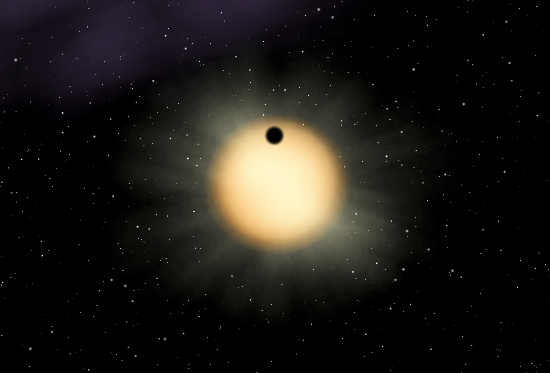
An international team of astronomers with the Trans-atlantic Exoplanet Survey today announce the discovery of their third planet, TrES-3. The new planet was identified by astronomers looking for transiting planets - that is, planets that pass in front of their home star - using a network of small automated telescopes in Arizona, California, and the Canary Islands. TrES-3 was discovered in the constellation Hercules about 10 degrees west of Vega, the brightest star in the summer skies.


A computer-generated simulation of TrES-3 crossing (transiting) the disk of its host star. TrES-3 transits farther from the disk center than any other known transiting planet.

The large molecular gas cloud in the constellation of Taurus is the nearest star formation region and a star formation test environment for expert theorists and observers alike. The XMM-Newton project has provided by far the most sensitive and comprehensive X-ray survey of this region, for the first time systematically detecting almost all young stars embedded in the cloud as X-ray sources, including many objects with the lowest mass, the so-called brown dwarfs, and stars still in the process of growing, the so-called protostars.

Rats paralyzed due to loss of blood flow to the spine returned to near normal ambulatory function six weeks after receiving grafts of human spinal stem cells (hSSCs), researchers from the University of California, San Diego (UCSD) School of Medicine report.

“We demonstrated that when damage has occurred due to a loss of blood flow to the spine’s neural cells, by grafting human neural stem cells directly into the spinal cord we can achieve a progressive recovery of motor function,” said Martin Marsala, M.D., UC San Diego professor of anesthesiology.

It is easy to observe that many networks naturally divide into communities or modules, where links within modules are stronger and denser than those across modules – like the way people from the same age group tend to interact more with each other than with people from different age groups. It is widely believed that networks within cells are modular in much the same way. Drs Zhi Wang and Jianzhi Zhang, from the University of Michigan, now investigate these modular properties and conclude that they may be only a random byproduct of evolution, and not functional at all.

NASA and Columbia University Earth Institute research finds that human-made greenhouse gases have brought the Earth’s climate close to critical tipping points, with potentially dangerous consequences for the planet.

From a combination of climate models, satellite data, and paleoclimate records the scientists conclude that the West Antarctic ice sheet, Arctic ice cover, and regions providing fresh water sources and species habitat are under threat from continued global warming.