Banner
Pilot Study: Fibromyalgia Fatigue Improved By TENS Therapy

Fibromyalgia is the term for a poorly-understood condition where people experience pain and fatigue...

High Meat Consumption Linked To Lower Dementia Risk

Older people who eat large amounts of meat have a lower risk of dementia and cognitive decline...

Long Before The Inca Colonized Peru, Natives Had A Thriving Trade Network

A new DNA analysis reveals that long before the Incan Empire took over Peru, animals were...

Mesolithic People Had Meals With More Tradition Than You Thought

The common imagery of prehistoric people is either rooting through dirt for grubs and picking berries...

User picture.
News StaffRSS Feed of this column.

News Releases From All Over The World, Right To You... Read More »

Blogroll

We haven't come that far, baby. In the 1970's male cartoon characters outnumbered female cartoon characters by a ratio of almost four to one. Research presented at the American Psychological Association's (APA) 105th Annual Convention in Chicago reveals that male cartoon characters still outnumber female cartoon characters almost four to one. Male characters are also still portrayed as dominate, powerful and aggressive. Female characters don't have any "character" at all.

Despite TV watchdogging, Cynthia Spicher, B.A., and psychologist Mary Hudak, Ph.D., from Allegheny College have found little change in the gender stereotypes that America's young minds are spending two to four hours a day viewing.

To see what progress has been made in portraying gender stereotypes in cartoon characters, Dr. Spicher and Dr. Hudak videotaped and categorized 118 cartoon characters from a single episode of each of the following Saturday morning cartoons: The Bugs Bunny/Tweety Show, Aladdin, Ninja Turtles, The Mask, Eek!stravaganza, Spiderman, Tick and Life with Louie. Characters were rated on sex, prominence, gender stereotyping, aggressive behaviors and occupational roles.

The theorists who first created the mathematics that describe the behavior of the recently announced "invisibility cloak" have revealed a new analysis that may extend the current cloak's powers, enabling it to hide even actively radiating objects like a flashlight or cell phone.

Allan Greenleaf, professor of mathematics at the University of Rochester, working with colleagues around the globe, has announced a mathematical theory that predicts some strange goings on inside the cloak—and that what happens inside is crucial to the cloak's effectiveness.

In October, David R.

Pulickel Ajayan, the Henry Burlage Professor of Materials Science and Engineering, is being awarded the MRS Medal from the Materials Research Society and has been named by Scientific American magazine as a Research Leader within the 2006 "Scientific American 50" -- the magazine's prestigious annual list recognizing outstanding acts of leadership in science and technology.

"Professor Ajayan is a world-renowned expert in fabricating materials and devices based on his creative chemical and physical manipulation of carbon," said Acting Provost Robert Palazzo. "His research is unlocking information about how to direct the assembly of carbon at the atomic level, providing opportunities for the assembly of a cornucopia of carbon-based nanostructures.

ESA's Mars Express has obtained images of the Cydonia region, site of the famous 'Face on Mars.' The High Resolution Stereo Camera photos include some of the most spectacular views of the Red Planet ever.

After multiple attempts to image the Cydonia region from April 2004 until July 2006 were frustrated by altitude and atmospheric dust and haze, the High Resolution Stereo Camera (HRSC) on board Mars Express finally obtained, on 22 July, a series of images that show the famous 'face' on Mars in unprecedented detail.

The data were gathered during orbit 3253 over the Cydonia region, with a ground resolution of approximately 13.7 metres per pixel. Cydonia lies at approximately 40.75° North and 350.54° East.

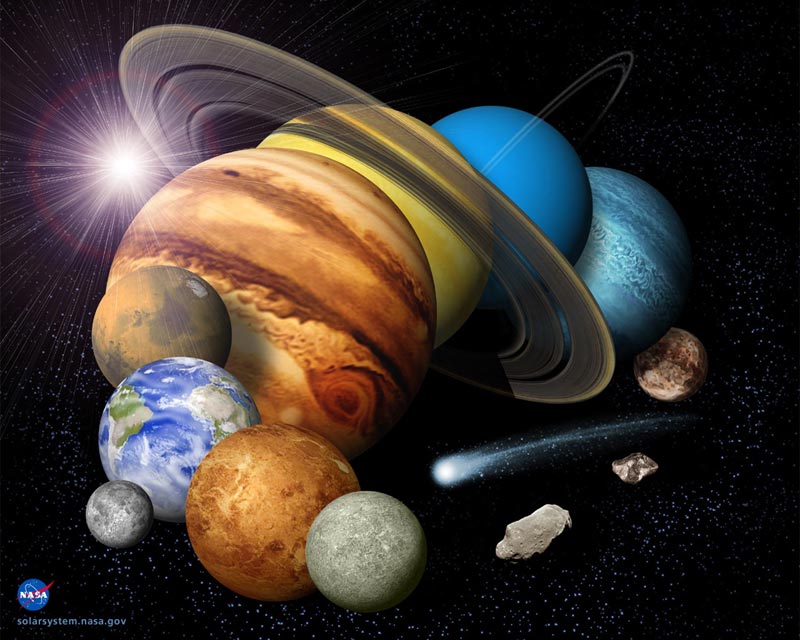
When kids head back to school this fall, they might have some brand new planets to memorize.  

The International Astronomical Union, currently meeting in Prague, is expected to vote on the definition of a planet. The organization, which has named planets and moons since it was founded in 1919, is debating a plan to establish that our solar system has 12 planets. 

Plant geneticists at Rutgers may have solved one of the fundamental concerns about genetically engineered or modified (GM or GMO) crop agriculture: genes leaking into the environment.

In a recent paper published in the Proceedings of the National Academy of Science, Rutgers Professor Pal Maliga and research associate Zora Svab advocate an alternative and more secure means of introducing genetic material into a plant. In GM crops today, novel genes are inserted into a cell nucleus but can eventually wind up in pollen grains or seeds that make their way out into the environment.