Banner
The Scorched Cherry Twig And Other Christmas Miracles Get A Science Look

Bleeding hosts and stigmatizations are the best-known medieval miracles but less known ones, like ...
$0.50 Pantoprazole For Stomach Bleeding In ICU Patients Could Save Families Thousands Of Dollars

The inexpensive medication pantoprazole prevents potentially serious stomach bleeding in critically...
Metformin Diabetes Drug Used Off-Label Also Reduces Irregular Heartbeats

Adults with atrial fibrillation (AFib) who are not diabetic but are overweight and took the diabetes...

Your Predator: Badlands Future - Optical Camouflage, Now Made By Bacteria

In the various 'Predator' films, the alien hunter can see across various spectra while enabling...

User picture.
News StaffRSS Feed of this column.

News Releases From All Over The World, Right To You... Read More »

Blogroll
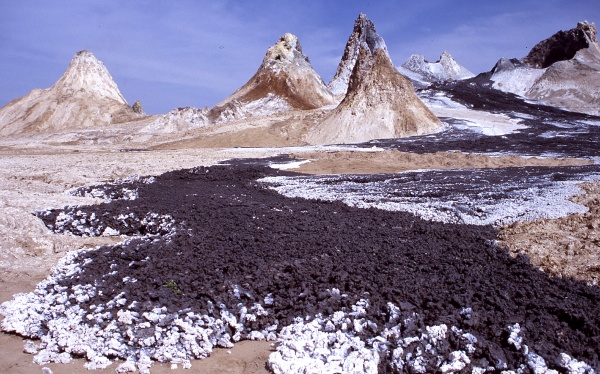
If you didn't know better, you might think the Oldoinyo Lengai volcano in Tanzania was proof of alchemy.

There, in the ancient East African Rift at a place known to local Maasai people as the Mountain of God, Oldoinyo Lengai spews forth carbon dioxide-laden lavas called carbonatites. The carbonatites line the volcano's flanks like snowballs.  Oldoinyo Lengai is the only place on Earth where carbonatites currently erupt -- and where carbon dioxide from a volcano doesn't vanish into thin air as a gas.

In a paper published this week in the journal Nature, scientists report the results of a study of Oldoinyo Lengai's volcanic gas emissions, sampled by the team during a carbonatite lava eruption.

Is "Multiplicity" your favorite movie?   Have you ever wished you could be in two places at once or create an evil twin (and name him Skippy)?   A research project called LifeLike is trying to bring that a little closer to reality.

Project LifeLike is a collaboration between the Electronic Visualization Laboratory (EVL) at the University of Illinois at Chicago, and the Intelligent Systems Laboratory (ISL) at the University of Central Florida and aims to create visualizations of people, or avatars, that are as realistic as possible. While their current results are far from perfect replications of a specific person, their work has advanced the field forward and opens up a host of possible applications in the not-too-distant future.

British parents call for a radical overhaul of the education system, saying that secondary school is not working for over a quarter (28 per cent) of children.

According to independent education foundation Edge, it is a situation that worsens with age as 40 per cent of 15-16 year olds are failing to thrive at school.

And this appears to be impacting on happiness levels as a quarter (26 per cent) of secondary school mums and dads admit they often worry their child is not happy - 23 per cent saying their offspring has not been happy since starting secondary school.

Questioning the one-size fits all approach, two fifths of parents (42 per cent) claim that only academically minded children do well at school.

In Finland, leaders in various fields have taken up the challenge presented by the increasing use of natural resources. Jointly, they have set out to find an answer to the question of how to use natural resources to enhance both national competitiveness and global responsibility. One result of this cooperation is the Natural Resource Strategy for Finland, a unique effort on a global scale.

Ounce for ounce, spinach has more nutritional value than iceberg lettuce; in general, darker colors in leafy vegetables mean more antioxidants and therefore more health benefits.

Knowing that, plant physiologists has developed a way to make lettuce darker and redder — and therefore healthier — using ultraviolet light-emitting diodes (LEDs).
A common blood test for triglycerides – a well-known cardiovascular disease risk factor – may also for the first time allow doctors to predict which patients with diabetes are more likely to develop the serious, common complication of neuropathy. 

Triglycerides are a type of lipid, or fat, that the body makes from calories it doesn't need immediately. Triglycerides are stored in fat cells until they are needed to provide energy. When higher-than-normal amounts circulate in the blood, a person is at higher risk of cardiovascular disease.