Banner
The Scorched Cherry Twig And Other Christmas Miracles Get A Science Look

Bleeding hosts and stigmatizations are the best-known medieval miracles but less known ones, like ...

$0.50 Pantoprazole For Stomach Bleeding In ICU Patients Could Save Families Thousands Of Dollars

The inexpensive medication pantoprazole prevents potentially serious stomach bleeding in critically...

Metformin Diabetes Drug Used Off-Label Also Reduces Irregular Heartbeats

Adults with atrial fibrillation (AFib) who are not diabetic but are overweight and took the diabetes...

Your Predator: Badlands Future - Optical Camouflage, Now Made By Bacteria

In the various 'Predator' films, the alien hunter can see across various spectra while enabling...

User picture.
News StaffRSS Feed of this column.

News Releases From All Over The World, Right To You... Read More »

Blogroll

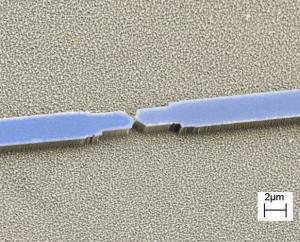
A Georgia Tech physics group has discovered how and why the electrical conductance of metal nanowires changes as their length varies. In a collaborative investigation performed by an experimental team and a theoretical physics team, the group discovered that measured fluctuations in the smallest nanowires’ conductance are caused by a pair of atoms, known as a dimer, shuttling back and forth between the bulk electrical leads. Determining the structural properties of nanowires is a big challenge facing the future construction of nanodevices and nanotechnology. The paper appears in the January 26th issue of Physical Review Letters.


Colorized scanning electron micrograph of the device showing the two electrical leads.

The transition from an ice age to an ice-free planet 300 million years ago was highly unstable, marked by dips and rises in carbon dioxide, extreme swings in climate and drastic effects on tropical vegetation.

"This is the best documented record we have of what happens to the climate system during long-term global warming following an ice age," said Isabel Montañez, professor of geology at the University of California, Davis, and lead author on the paper. But she added that these findings cannot be applied directly to current global warming trends.

In the mid-Permian, 300 million years ago, the Earth was in an ice age. Miles-thick ice sheets covered much of the southern continent, and floating pack ice likely covered the northern polar ocean.

Also, read Scientific Blogging columnist Seth Robert's interview with Brian Wansink here.

While government leaders argue about the practicality of reducing world emissions of carbon dioxide, scientists and engineers are seeking ways to make it happen.

One group of engineers at MIT decided to focus its work on the nanostructure of concrete, the world's most widely used material.