Can air pollution trigger appendicitis? Yes, says a study conducted by researchers at the University of Calgary, University of Toronto and Health Canada who looked at 5191 adults admitted to hospitals in Calgary, Alberta, Canada.
Fifty-two per cent of admissions occurred between April and September, the warmest months of the year in Canada during which people are more likely to be outside.
Therefore, air pollution must be the culprit if your correlation-causation arrow is more like a Scud missile.
Sitting up straight in a chair is obviously good for posture but it can also make you unconsciously more confident, say Ohio State University researchers.
They found that people who were told to sit up straight were more likely to believe thoughts they wrote down while in that posture concerning whether they were qualified for a job while those who were slumped over their desks were less likely to accept written-down feelings about their own qualifications.
The results are an indication that our body posture can affect not only what others think about us, but also how we think about ourselves, said Richard Petty, co-author of the study and professor of psychology at Ohio State.
You would think religious people and atheists don't have a lot in common regarding thinking but they do, says a study by UCLA, Pepperdine and USC neuroscientists.
It's tough to systematically compare religious faith with ordinary cognition, so calibrate accordingly, but in a neuroimaging study the researchers found that while the human brain responded very differently to religious and nonreligious propositions, the process of believing or disbelieving a statement, whether religious or not, was governed by the same areas in the brain.
The power of quantum mechanics for data transmission is intriguing because of potential for secure, high speed communications but current storage and transmission of quantum information is far too fragile to have any practical value in the near term.
In classical communications, a bit can represent one of two states - either 0 or 1. But because photons are quantum mechanical objects, they can exist in multiple states at the same time. Photons can also be combined, in a process known as entanglement, to store a bit of quantum information (i.e. a qubit).
The diagnosis of mental health disorders in the US has nearly doubled in the past 20 years and clinical psychologists and therapists are on the front lines of handling it but many are falling short because they use methods that are out of date or lack any scientific rigor or both.
How is that possible? Because many of the training programs, and especially some Doctorate of Psychology (PsyD) programs and for-profit training centers, are not grounded in science, according to a new report in Psychological Science in the Public Interest.
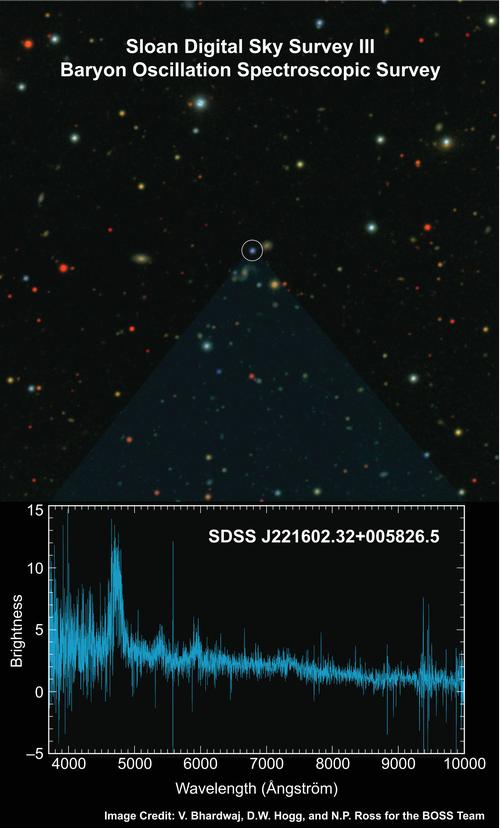
Is 'dark energy', the mysterious unidentified thing that would be a nice explanation for a lot of universal questions, physics or religion? Maybe baryon oscillations can tell us.
Baryon oscillations began when pressure waves travelled through the early universe. An ambitious attempt to trace the history of the universe, called the Baryon Oscillation Spectroscopic Survey (BOSS), has seen first light. BOSS, a part of the Sloan Digital Sky Survey III (SDSS-III), took its first astronomical data on the night of September 14th.


 Males Are Genetically Wired To Beg Females For Food
 The Scorched Cherry Twig And Other Christmas Miracles Get A Science Look
 $0.50 Pantoprazole For Stomach Bleeding In ICU Patients Could Save Families Thousands Of Dollars
 Metformin Diabetes Drug Used Off-Label Also Reduces Irregular Heartbeats