Banner
Object-Based Processing: Numbers Confuse How We Perceive Spaces

Researchers recently studied the relationship between numerical information in our vision, and...

Males Are Genetically Wired To Beg Females For Food

Bees have the reputation of being incredibly organized and spending their days making sure our...

The Scorched Cherry Twig And Other Christmas Miracles Get A Science Look

Bleeding hosts and stigmatizations are the best-known medieval miracles but less known ones, like ...

$0.50 Pantoprazole For Stomach Bleeding In ICU Patients Could Save Families Thousands Of Dollars

The inexpensive medication pantoprazole prevents potentially serious stomach bleeding in critically...

User picture.
News StaffRSS Feed of this column.

News Releases From All Over The World, Right To You... Read More »

Blogroll
The overwhelming majority who have gotten or ever will get COVID-19, resulting from the third coronavirus pandemic, named SARS-CoV-2, of this century, won't know it. Most who are not asymptomatic will have it be the same as a cold.

Yet a few will have severe reactions and require hospitalization. Just like with flu or any cause of respiratory distress, age is the biggest risk factor, as are preexisting conditions that can aggravate numerous health issues, but research by the COVID-19 Host Genetics Initiative has shown that genetic variants in one region on chromosome 3 impose a larger risk that their carriers will develop a severe form of the disease. Across all ages and strata of health.
In the Cueva de la Dehesilla of Cádiz on the Iberian Peninsula, two human skulls and a juvenile goat were discovered in a funerary structure dating to the Middle Neolithic period, 4800-4000 B.C.

The archaeological structures and materials from a funerary ritual tell a tale of human and animal sacrifice, ancestral cults and propitiatory rituals, or they could be divine prayers in commemorative festivities.

The two adult human skulls are an older male and a younger female. The female skull shows a depression in the frontal bone, which probably comes from an incomplete trepanation, as well as cuts in the occipital bone produced by decapitation.
Businesses would like to return to business as usual and government officials reliant on taxes desperately need a return to normal. The people arguing lockdowns need to occur indefinitely live on Twitter.

How can it be done safely?

The example of Bombardier Aviation in an analysis published in Canadian Medical Association Journal finds that creating "work bubbles" during the COVID-19 pandemic can help reduce the risk of company-wide outbreaks while helping essential businesses continue to function.


Hydroxychloroquine is an effective drug for the treatment of diseases like lupus and malaria and because it is used off-label for maladies that act in a biologically similar way to how COVID-19, caused by the SARS-CoV-2 virus, acts in the body, there has been discussion that clinical trials might show it having a positive therapeutic impact.

Could it prevent COVID-19, though? A clinical trial of health care workers finds that it does not, though the good news is that because the trial was health care workers they had low rates of infection anyway, likely due to other prevention measures. Masks, hand-washing, and social distancing work.
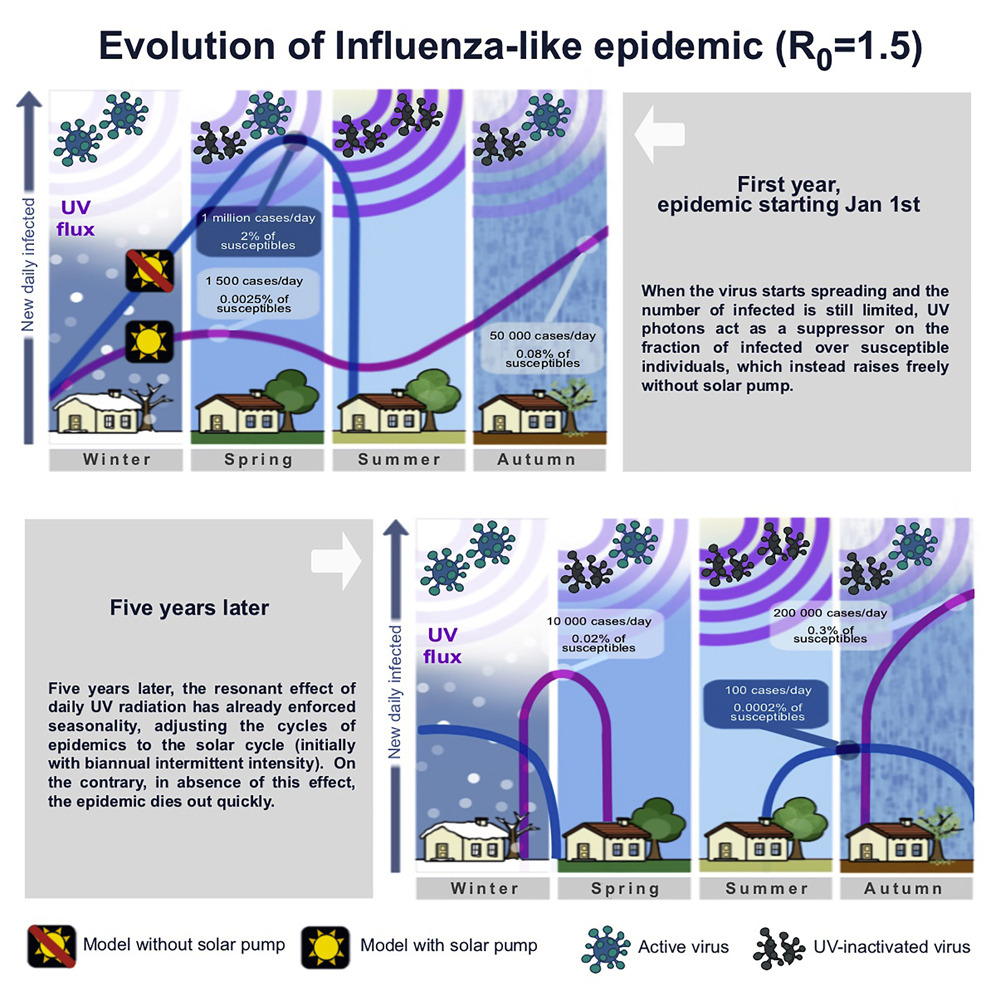
To estimate infection rates of viruses like SARS-CoV-2, immunologists use a basic reproduction number, known as R0 (pronounced “R naught”) - an expression of the number of people likely to catch a disease from one contagious person - and a Susceptible-Infected-Removed (SIR) model.

Yet as we have seen, those are only telling part of the science story. Coronavirus is in the same family as the common cold and for many COVID-19 will be just like the cold, and can spread like the cold. But when it comes to successful transmission, viruses only win they can optimize their aptitude to survive and reproduce in given conditions - which means they lose if we can optimize disease control measures.
In large systems of interacting particles in quantum mechanics, groups of particles can begin to behave like single particles.

Physicists refer to such groups of particles as quasiparticles and while they live, they are useful in helping us understand superconductivity and superfluidity. But many quasiparticles die after less than one second. 

What kills them? How do quasiparticles die?

A new paper goes beyond the usual suspect - quasiparticle decay into lower energy states - and identifies a new culprit: many-body dephasing.