Fake Banner
Enrico Stomeo - A Lifelong Passion For Meteor Studies

I was reached this evening by the news of the passing of a dear friend, Enrico Stomeo. Enrico was...

Surviving Queues: 1 - At The Airport

Nobody likes to wait in line. Whether you are sitting in your car waiting to reach the toll booths...

Choosing Your Bets: The Selection Bias

As some of the long-time readers of this blog know, in this column I have occasionally discussed...

Have A Master In Science, Want A Post-Doc Position Directly?

Do you have a master in Science, and want to start a Post-Doc position directly? You can have it...

User picture.
picture for Hank Campbellpicture for Heidi Hendersonpicture for Patrick Lockerbypicture for Bente Lilja Byepicture for Sascha Vongehrpicture for Johannes Koelman
Tommaso DorigoRSS Feed of this column.

Tommaso Dorigo is an experimental particle physicist, who works for the INFN at the University of Padova, and collaborates with the CMS and the SWGO experiments. He is the president of the Read More »

Blogroll
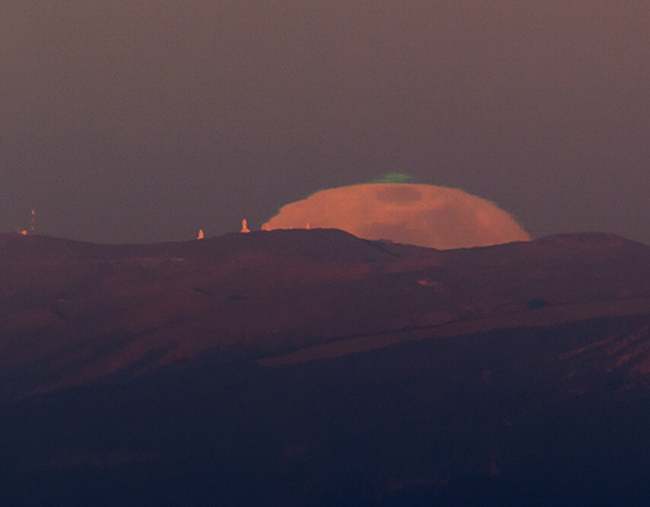
The light we receive from the sun is composed of all visible frequencies, among others, and it therefore appears white to our natural detection system - the human eye. Apparently, evolution caused us to develop a vision which works best at the center of the frequency spectrum emitted by the Sun. 

That notwithstanding, I am sure that if you ask the question "what colour is the Sun" to the average Joe, you will get an equal share of "white" and "yellow", and maybe some "red" answers. Besides, who among us has never painted a red Sun in a blue sky as a child ? 

The second infn school of statistics took place this week in the nice "green island" of Ischia, in the gulf of Naples, Italy. Organized by the INFN section of Naples, the school aims at training Ph.D. students and post-graduates in the foundations and the applications of the statistical methods most used nowadays in particle physics, nuclear physics, and astrophysics.

Yesterday I posed a question - Are the first collisions recorded by the LHC running at 13 TeV the highest-energy ever produced by mankind with subatomic particles ? It was a tricky one, as usual, meant to think about the matter.

I received several tentative answer in the comments thread, and thus answered there. I paste the text here as it is of some interest to some of you and I wish it does not go overlooked.

---

Dear all, 
The LHC has finally started to produce 13-TeV proton-proton collisions!

The picture below shows one such collision, as recorded by the CMS experiment today. The blue boxes show the energy recorded in the calorimeter, which measures particle energy by "destroying" them as they interact with the dense layers of matter that this device is made up of; the yellow curves show tracks reconstructed by the ionization deposits of charged particles left in the silicon detector layers of the inner tracker. 
The European Union has released some data on the latest call for applications for ITN grants. These are "training networks" where academic and non-academic institutions pool up to provide innovative training to doctoral students, in the meanting producing excellent research outputs.

I spent the last weekend in Berlin, attending a conference for editors organized by Elsevier. And I learnt quite a bit during two very busy days. As a newbie - I am handling editor for the journal "Reviews in Physics" since January this year - I did expect to learn a lot from the event; but I will admit that I decided to accept the invitation to attend the event more out of curiosity for a world that is at least in part new to me, rather than out of professional sense of duty.