Remembering numbers is one of the most basic things we do from a young age - early on, a combination lock or a phone number and later any number of things such as ATM codes, social security numbers, and more.
In Western cultures, children learn to place numbers on a mental number line - smaller numbers to the left and spaced further apart than the larger numbers on the right. Then the number line changes to become more linear, with small and large numbers the same distance apart. Children whose number line has made this change are better at remembering numbers, according to a new study published in Psychological Science.
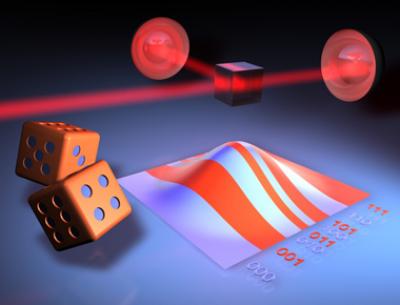
To physicists, nothing is really a coincidence. Even cats in quantum boxes can be explained in mathematical terms, not to mention roulette or the success or failure of an attack in Dungeons&Dragons, but researchers at the Max Planck Institute for the Physics of Light in Erlangen say they have constructed a device that is truly random and generates random numbers that cannot be predicted in advance.
The researchers exploit the fact that measurements based on quantum physics can only produce a special result with a certain degree of probability, that is, randomly. True random numbers are needed for the secure encryption of data and to enable the reliable simulation of economic processes and changes in the climate.
Paleontologists have released details about Concavenator corcovatus, a carnivorous humpbacked dinosaur discovered in Spain - and it oddly had both feathers and scales.
Concavenator corcovatus was a theropod dinosaur that lived during the Cretaceous period, about 130 million years ago. Concavenator corcovatus translates to 'hump-backed predator from Cuenca', where it was discovered.
"We hear a lot about bioterrorism and pandemics," says Sheldon H. Jacobson, a professor of computer science and pediatrics at University of Illinois at Urbana-Champaign,"but the fact of the matter is, the threat to routine immunization is one of the greatest threats we face. If we had problems with our vaccine supply chain, it would have the potential to cause more deaths than any of those other issues."
A million dollars is difficult to imagine but if someone is charging $2 instead of one, that gets attention. Likewise, a quote attributed to communist USSR despot Joesph Stalin is "A single death is a tragedy, a million deaths is a statistic."(1) And he should know, being responsible for 20 million deaths (starting with competitor Leon Trotsky) and so nestled comfortably between Mao and Hitler in world history, but is regarded favorably by some on left whereas a serial killer of a few is reviled by everyone.
A group says they have validated that large-scale tragedies don't connect people emotionally the same way smaller tragedies do, called a "scope-severity paradox".