







If it isn't taxes, it is OPEC but oil prices are likely to go up - people are still going to drive. It's necessary.

So is physical fitness but a new economics analysis finds that if prices to swim go up, people are inclined to drop it rather than pay more - but a gym membership stays. That's reason enough for economists behind a new paper to advocated a new government subsidy.

The work by Brunel University London's Health Economics Research Group consisted of interviews with 1,683 people, 83% of whom took part in physical activity in some form. It found that people facing 10% higher entry fees to swimming pools were 29% less active, once other variations such as their age and differences in income were taken into account. 

Talk to long-time anglers with a favorite spot and they will often tell stories of one fish they could never get. In mythical overtones, they will speak of its ability to avoid capture, attributing an almost supernatural intelligence (for a fish). Such stories were once so common that 'fish story' became its own brand of tall tale.

A new study mapped individual heritable traits of fish to environmental conditions and concluded that some fish really are going to be harder to catch.

The work by the University of Eastern Finland and the Finnish Game and Fisheries Research Institute
in the Paltamo Unit of the Finnish Game and Fisheries Research Institute

In the past, it was common practice to get rid of anything that was used - and unused - in operating rooms, but with rising health care costs due to government insurance and growing realization that many countries have few supplies at all, recovery of unused operating room materials has gotten new life.

Johns Hopkins University School of Medicine reported during the 2014 Clinical Congress of the American College of Surgeons that recovery of unused medical supplies from operating rooms for donation to surgical centers in developing countries can potentially alleviate a significant global burden of surgical diseases. 

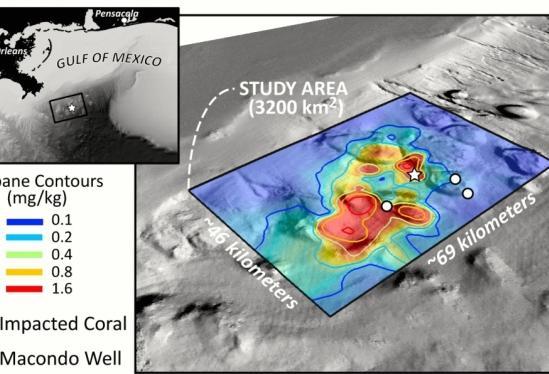
Damage assessments from environmental hazards are always a challenge because of the competing constituencies pulling on science and the fuzzy nature of estimates. After the 2010 Deepwater Horizon spill in the Gulf of Mexico, the Obama administration was editing science reports to reflect its goals, environmentalists were raising money claiming earth was ruined and using wild guesses for damage, and BP lobbyists were mitigating penalties behind the scenes by claiming it wasn't so bad.

What about possibly 2 million barrels of oil that are still down there? Are they a hazard? Where did they go?

 
Credit: Yamanaka Tamaki/Flickr

By Meredith Knight, Genetic Literacy Project

Jean Tirole's theories, capturing reality as an afterthought? IMF, CC BY-NC-ND

By David Spencer, University of Leeds

It’s that time of year again – when academic economics, thanks to the Nobel Prize announcements, is thrust into the public gaze.

In the United States, Democrats have long insisted that women should vote for Democrats, because abortion was the most important issue.

Abortion is not really an issue any more. It was allowed by states prior to the Roe v. Wade Supreme Court decision and has been the law of the land for 40 years. In cases where someone tries to run on abortion, it fails. But marketing scholars say global warming has replaced abortion as the litmus test for why women should be Democrats - if women care about long-term consequences of their actions, that is.

In the 1960s and '70s, population bomb reality was said to be as settled as climate change is today. No less than Dr. John Holdren, current Obama administration Science Czar, co-authored a book called Ecoscience, which argued that forced sterilization and mass abortions might  be necessary, and even viable under the equal protection clause of the Constitution.

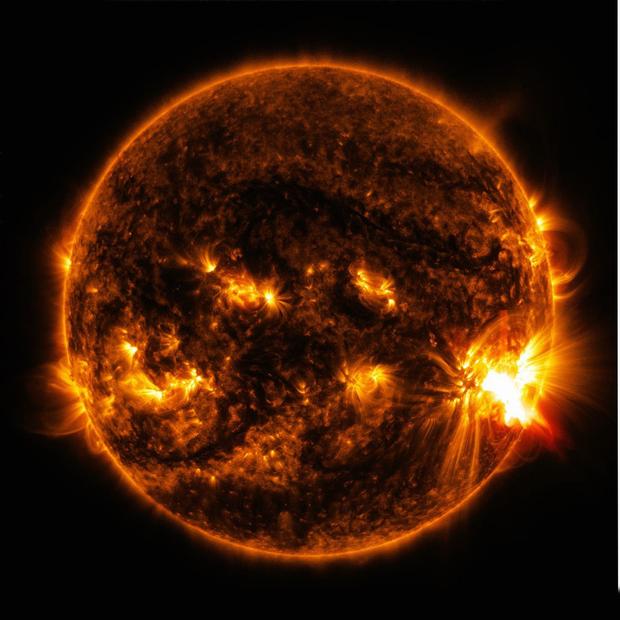
This morning, a large active region on the sun erupted with another X-class flare, its fourth since Oct. 24th. 

Solar flares are powerful bursts of radiation. Harmful radiation from a flare cannot pass through Earth's atmosphere to physically affect humans on the ground, however -- when intense enough -- they can disturb the atmosphere in the layer where GPS and communications signals travel.

The first images of a nova during its early fireball stage - when it ejects material and gases expand and cool - have been delivered from a nova that erupted last year in the constellation Delphinus.  

A nova occurs after a thin layer of hydrogen builds up on the surface of a white dwarf--a highly evolved star with the mass of the sun packed into the volume of the Earth. A normal star accompanies the white dwarf in a binary star system, providing that hydrogen as the two stars orbit each other.


