
By Michael Greshko, Inside Science - In the classic 1989 film Back to the Future 2, intrepid time traveler Marty McFly jumps ahead a few decades, to October 21, 2015.

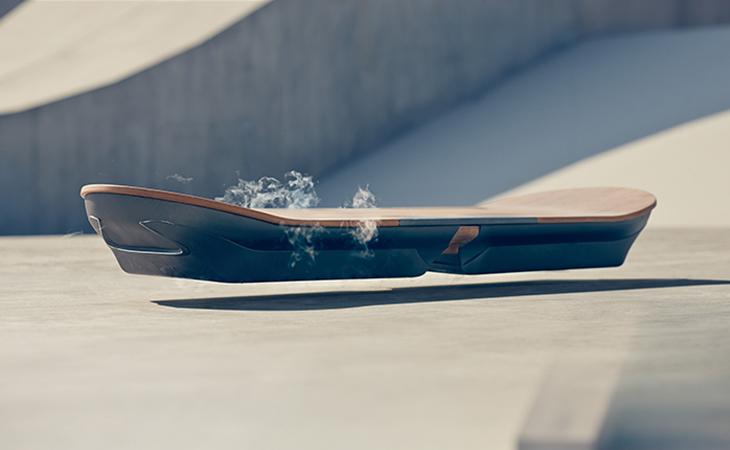
Luxury car manufacturer Lexus appears to be ready for him. This week, they announced that they've built a "real, rideable" hoverboard. 

They've even released video of it, oozing fog and mysteriously floating over what looks like a concrete sidewalk. Check out the 38-second teaser for yourself:
For my Lego Optics Lab I have so far built a beam splitter, and a small lens holder. The beam splitter article got a link on io9 (my name is misspelled) and on Scientific American.
Was America at its greatest scientifically when academics made far less money and were politically representative? Not if science output, Nobel prizes and adult science literacy are the measures, because America leads in all categories.

Yet with six figure incomes for faculty and less diversity has come greater distrust. Conservatives, for example, once had the highest trust in science, and now they are near the lowest, along with progressives. The public regularly thinks that anyone who cashes a paycheck is unethical, people don't trust medicine, food or energy science on the left and the right thinks climate scientists are shills.


If you ask some people why they would never want to get divorced, they joke that they would not want to have to 'get back down to dating weight', but do married people really give up and get heavier?

Recent research has reignited concerns that exposure to chemicals from plastics might be to blame for low sperm counts in young men. I share the concerns about the high prevalence of low sperm counts (one in six young men), and my research is directed at trying to identify what causes it. But whether plastics are to blame isn’t a simple matter.

We can blame smartphone alerts, constant connectivity and a deluge of media for sleep deprivation but that is talking about the symptoms rather than the disease. The root cause is instead the thing that has led to cultural and social improvements for over 100 years - artificial light.

Salmon are severely impacted by the loss of floodplain habitats near Oregon's Tillamook Bay, where nearly 90 percent of estuaries' tidal wetlands have been lost to development -- threatening the survival of coho salmon and the safety of the local community. Now, the Federal Emergency Management Agency, NOAA Fisheries, and others have come together to reduce flood risk, increase resiliency of the ecosystem, and restore salmon habitat in Tillamook Bay under the auspices of The Southern Flow Corridor project, as the proposed collaborative effort is known. It will reconnect over 500 acres of floodplain habitat to two of the Bay's most productive salmon-bearing streams -- the Wilson and Trask Rivers.

A simple and provocative title – The Missing Memristor has Not been Found! This harsh admission of reality without sugar coating is the very title, and not of some opinion piece, but of a scientific paper published by the very same Nature Publishing Group that is criticized right away in that very paper:


Although we know influenza viruses circulate in temperate, populated parts of Australia every winter, predicting the precise timing and relative intensity of flu seasons is a fraught undertaking.

I was saddened today to hear of the death of David Cline. I do not have much to say here - I am not good with obituaries - but I do remember meeting him at a conference in Albuquerque in 2008, where we chatted on several topics, among them the history of the CDF experiment, a topic on which I had just started to write a book. 

Perhaps the best I can do here as a way to remember Cline, whose contributions to particle physics can and will certainly be better described by many others (for example,