Shaved heads have come in and out of fashion over the past few decades, but some people don’t have the option of allowing their locks to grow.
Thankfully, for those who do suffer from hair loss, or alopecia, help may be at hand. Somewhat counter-intuitively an effective treatment for baldness may come from plucking a certain number of hairs – in a specific formation – from the scalp.
A remote gas planet has been detected about 13,000 light-years away, making it one of the most distant planets known.
The Poland-based Optical Gravitational Lensing Experiment (OGLE) Warsaw Telescope at the Las Campanas Observatory in Chile scans the skies for planets using a method called microlensing. A microlensing event occurs when one star happens to pass in front of another, and its gravity acts as a lens to magnify and brighten the more distant star's light. If that foreground star happens to be orbited by a planet, the planet might cause a blip in the magnification. For a new study in Astrophysical Journal the researchers combined that with data from NASA's Spitzer Space Telescope.
Like virtual water and virtual emissions, looking at organic food through a prism of implicit benefits translated into estimated dollars makes it look a lot more economically viable than it otherwise might appear.
The new estimate says that organic farming systems do a better job of capitalizing on nature's services than they are credited with, and natural processes that aid farming and that can substitute for costly fossil fuel-based inputs are cost-effective.
A new study has found that after just five days of eating a high-fat diet, the way in which the body's muscle processes nutrients changes.
When food is eaten, the level of glucose in the blood rises. The body's muscle is a major clearinghouse for this glucose. It may break it down for energy, or it can store it for later use. Since muscle makes up about 30 percent of our body weight and it is such an important site for glucose metabolism, if normal metabolism is altered, it can have consequences on the rest of the body and can lead to health issues.
Having once lived in the Pittsburgh metropolitan area, on occasion I would drive to those old gigantic relics of steel mills.
They were behemoths and so were the buildings that housed them. They looked like they could block out the sun. In John Ford's "The Quiet Man", a native of Ireland asked John Wayne's character what they feed men in Pittsburgh that makes them so big and Wayne replied, "Steel, and pig-iron furnaces so hot a man forgets his fear of hell". In the early 1950s it was a job for hard men.

The tragic death recently of a young Queensland boxer raised the question of safety in the sport and whether boxing should be banned.
Claims that boxing is safer than a number of very popular and well-accepted sports warrant careful scrutiny as they often derive from overly simplistic analyses.
The risks associated with boxing should never be trivialized, but science and technology could possibly help to mitigate them.
By identifying and comparing the sequences of more than 400 receptors in the genomes of two fruit flies and three mosquito species, entomologists have unlocked one of the hormonal mechanisms that allow mosquitoes to produce eggs. They identified a single gene for a receptor with an unknown function within the species distribution.
The one common element in recent American weather has been its diversity. The West Coast has been drier than usual while the East Coast has had more snow. Fish are swimming into new waters and so hungry seals that don't follow them aare washing up on California beaches.
A long-lived patch of warm water off the West Coast, about 1 to 4 degrees Celsius (2 to 7 degrees Fahrenheit) above normal, is part of what's wreaking much of this mayhem, according to two papers Geophysical Research Letters. No, that warm blob was not caused by climate change, though it has many of the same effects for West Coast weather.
On one side of the political spectrum in America and across a broader swath of Europe, science is controversial - especially genetic engineering. But genetic engineering has been done since humans first deduced they could shape the natural world, if anything it has gotten precise in a way that was never possible before.
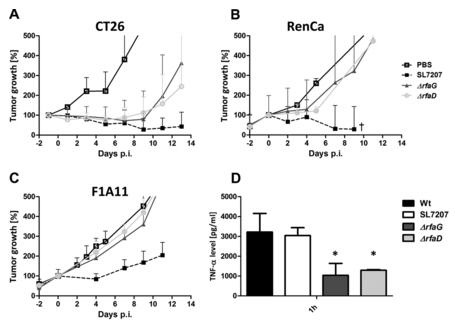
Now it mean even help fight against cancer - and it may do so using Salmonella, more famous as a bacteria that lives in intestines.

This week Hilary Clinton and Marco Rubio announced their candidacies for President of the United States. This puts them alongside Jeb Bush, Scott Walker and I’m not sure who else.
One thing all these candidates have in common is that not one of them has mentioned antibiotics – at least as far as I know. Do any of you know anything different?
So here we are. Antibiotic resistance is killing a minimum of 23,000 Americans every year according to the CDC. (I think that is a gross underestimate of reality.) The FDA just published a study showing large increase in antibiotic use on US farms – but they don’t know how or why the antibiotics are used.