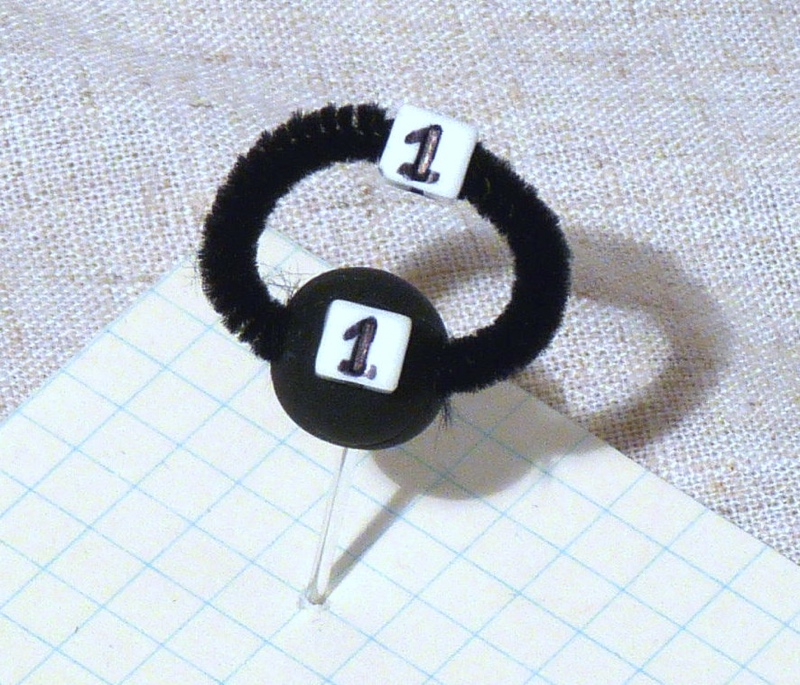

Third graders enjoy clay and pipe cleaners. It might sound cruel to teach them graduate level graph theory most math Ph.D.’s have not seen, but I might get away with it if I uses the right craft supplies. Tell kids spinach is good for them. Children are right to skeptical, as I expect of my reader.

[The video is a reading of the content contained herein, so click or skip]


... Not really.

What startled me most was that a colleague of mine at the University of Padova even sent a message to my departments' mailing list, saying that the new result is very important. But it clearly isn't! In fact, the exclusion at 95% CL in the range of Higgs boson masses that CDF and DZERO could put together from the analysis of additional data is almost exactly the same as the one that they published last Summer.

But maybe I should make a step back and explain the matter from the start, to let you judge by yourself the relevance of the new Tevatron bounds on the rate of Higgs boson production in proton-antiproton collisions.

CDF and DZERO are analyzing the proton-antiproton collisions at 2 TeV that the Tevatron collider is producing since 2001.

Everyone's heard of the Darwin Awards, right? It's where some poor soul dies in such a monumentally stupid way that it can be considered that they have done the human gene pool a great favour by inadvertantly altruistically killing themselves and removing their genes. Well, I have a candidate from the fossil record; a late famennian placoderm, that definitely deserves such an accolade.

Firstly though, a quick primer on placoderms. In short, they were big armoured predatory fishes that were widespread in the Devonian. But, by big, I mean really big. Some of these dudes were as big as a double decker bus and would have pretty happily chomped through a car like it was a ham sandwich.
Bananas in their natural state have up to a hundred seeds but all commercial varieties that you see in stores are seedless.   Making seedless varieties made bananas wildly popular, which was good for the people who grow them and good for the people who eat them.     That is a science win.

Researchers have now discovered a way to make "the most delicious fruit known to man", as Mark Twain called it, more popular with the public also.   The cherimoya, or custard apple, has lots of big, awkward seeds but a group of researchers studied the seedless variety of sugar apple, a relative of the cherimoya, and noted that the ovules, which would normally form seeds, lacked an outer coat.
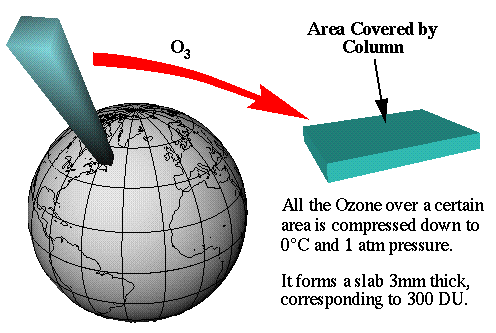
Low temperatures in the Arctic 'ozone layer' have recently initiated massive ozone depletion, which means the Arctic could experience a record loss of this trace gas that protects the Earth's surface against ultraviolet radiation from the sun. The result has been found by a measurement network of over 30 ozone sounding stations spread all over the Arctic and Subarctic.

In the long term the ozone layer will recover thanks to extensive environmental policy measures enacted decades ago for its protection. This winter's likely record-breaking ozone loss does not alter this expectation.
Earthquakes are big news due to the devastating 8.9 magnitude earthquake that struck Japan on Friday.   As a result, some are curious about the worst earthquakes and resulting tsunamis we know about.   Prior to the 20th century, methods for measuring were unreliable.

Researchers say a new tool may more about earthquakes of the ancient past and even help predict earthquakes of the future. 

Prof. Shmuel Marco of Tel Aviv University's Department of Geophysics and Planetary Sciences in the Raymond and Beverly Sackler Faculty of Exact Sciences and his colleagues have created a new tool which they have described as a "fossil seismograph," to help geophysicists and other researchers understand patterns of seismic activity in the past.

