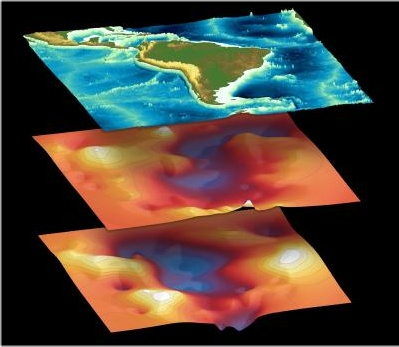
Patterns of brain activity allow researchers to know what number a person has just seen or how many dots a person has been presented with, according to a report published in Current Biology.
The findings confirm the notion that numbers are encoded in the brain via detailed and specific activity patterns and open the door to more sophisticated exploration of humans' high-level numerical abilities. Although "number-tuned" neurons have been found in monkeys, scientists hadn't managed to get any farther than particular brain regions before now in humans.
If you learn a foreign language when you are young but the exposure to that language is brief and you don't get to hear or practice it subsequently, does the neglected language fade away from our memory?
Yes, forgetting is forgetting, has been the belief ... you 'use it or lose it' ... but language learning may instead be more like 'riding a bike' and even a "forgotten" language may be more deeply engraved in our minds than we realize.
European-tasting wines from American species and cultivars? It could happen, say German researchers who have unraveled an unexpected twist in grapevine DNA.
Acoelomorpha, a collection of worms which comprises roughly 350 species, is part of a much larger group called bilateral animals, which are organisms that have symmetrical body forms and include humans, insects and worms. Apparently there has been a question about acoelomorpha, namely where do they fit in taxonomically?
Acoelomorpha has been a "rogue animal," says Casey Dunn, an evolutionary biologist at Brown University. "It has been wandering throughout the animal tree of life."
(?!?)
Hormone therapy treatmenbt for men with advanced prostate cancer has been associated with an increased chance of developing various heart problems but some choices of therapy are less risky than others.
Global warming may not be a hot button topic these days because other threats, like unemployment, terrorist attacks or death panels, are getting the media attention, says University of Colorado at Boulder psychology Professor Leaf Van Boven.
That makes sense. Media needs to sell media and some hype doesn't hurt. People tend to view their recent emotions, such as their perceptions of threats or risks, as more intense and important than their previous emotions. In one part of the study focusing on terrorist threats and using materials adapted from the U.S. Department of Homeland Security, Van Boven and his research colleagues presented two scenarios to people in a college laboratory depicting warnings about traveling abroad to two countries.
Highways and roads cost money but it's never a bad idea to save some cost and inconvenience using optimal design and materials which leads to fewer repairs. Unfortunately there haven't been any great methods for determining how strongly (and safely) roads were built but a scientist in Sweden has developed a method where sound waves can reveal what a road looks like underneath and thereby show whether it is being properly built.
According to the Swedish Road Administration, the method, which is expected to become the new standard, may entail major quality enhancements and cost savings.
There's no shortage of new theories about how kids help to learn better. Unfortunately when it comes to kids and education, the only way to measure success is after the fact when it may already be too late.
Recent work is focusing on social learning. It says that infants and young children learn from imitation and by following the actions of those around them, adopting mannerisms and speech patterns. A new study sought to compare television/computers and audio versus face-to-face human interaction in learning.
Most of us like to be in control: of what happens around us, of our own feelings, of our actions, of the actions and well-being of our beloved ones. Being in control means feeling secure, unthreatened. It is the prevalence of order on chaos. And chaos, I have grown to realize, is one of the things that scares me most. Yes, I am a true control freak.
Committees and organizations usually start for the right reasons but over time they need to become self-perpetuating.
The International Commission on Stratigraphy (ICS) has managed to milk entire decades out of deciding the boundary dates for the Quaternary Age, which covers both the ice age and moment early man first started to use tools, and it seems they have finally voted on an answer.
Voting in science? Indeed, they have formally agreed to move the boundary dates for the prehistoric Quaternary age by 800,000 years, reports the Journal of Quaternary Science.