Identifying a face can be difficult when it is shown for only a fraction of a second but young adults have a distinct advantage over elderly people in those conditions, say researchers writing in the open access journal BMC Neuroscience, who found indications that elderly people have reduced perception speed.
I ran into an interesting linguistic stumbling block. I'll call it the
"It's science, so it must be hard" frame of mind. I wrote to some friends and family about this project, saying:
I'm launching a satellite for fun, to make music from space. It's called Project Calliope, and I'm writing about it up at: http://scientificblogging.com/satellite_diaries/feed
It's pretty much just me, with some friends helping with different parts of it, and a couple of sponsors helping cover costs (hopefully). I'll be the first to admit it's unusual, but I've always wanted to be part of the space race.
And I received one particular reply of:
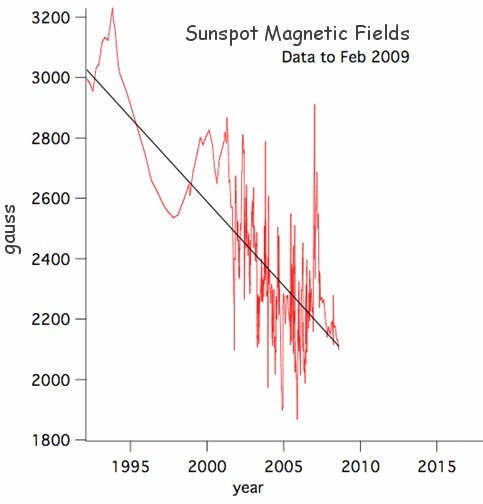
We have been in an anomalously long Solar Minimum. The sun has an 11 year cycle from Minimum to Maximum. But the cycles are (like most things in nature) not exact, and some are longer than the others. We are coming out of Solar Minimum... or are we?
Even in the midst of our current cycle, solar physicists were predicting a long minimum, and, humorously, seemed evenly divided over whether this meant we would have a more active Maximum, or a far less active Maximum. For example, David Hathaway in the NASA article
"Solar Cycle 25 peaking around 2022 could be one of the weakest in centuries" clearly predicts the latter.
Arbor energy? No, they're not smoking plants, they're powering circuits with them. It turns out that there is electricity in trees, in small but measurable quantities, and it's enough for University of Washington researchers to run an electronic circuit.
A study last year from the Massachusetts Institute of Technology found that plants generate a voltage of up to 200 millivolts when one electrode is placed in a plant and the other in the surrounding soil. Those researchers have since started a company developing forest sensors that exploit this new power source.
What does peer review do for science and what does the scientific community want it to do? Should peer review detect fraud and misconduct? Does peer review illuminate good ideas or shut them down? Should reviewers be anonymous?
The Peer Review Survey 2009, a large international poll of authors and reviewers, released its preliminary findings today.
Peer review is considered fundamental to integration of new research findings and it allows other researchers to analyze findings and society at large to weigh up research claims. It results in 1.3 million2 articles published every year and it has been growing rapidly with the expansion of the global research community - and corporate publishers.
About 10% of couples who want a baby have fertility problems and causes offered tend to break down around advocacy issues; environmentalists blame pollution while psychiatrists point to our stressful lifestyles, but evolutionary biologist Dr. Oren Hasson of Tel Aviv University's Department of Zoology has a different take than the others, though also based on his speciality.
The reproductive organs of men and women are currently involved in an evolutionary arms race, he says in a new study, and the fight isn't over yet.
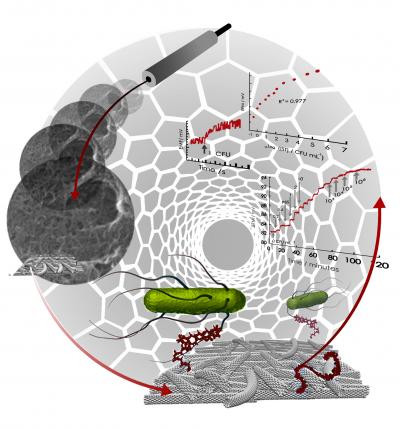
Microbiologists from the University of Essex have shown they can break down and remove toxic compounds from crude oil and tar sands using microbes. These acidic compounds persist in the environment, taking up to 10 years to break down.
Tar sand deposits contain the world’s largest supply of oil. With dwindling supplies of high quality light crude oil, oil producers are looking towards alternative oil supplies such as heavy crude oils and super heavy crudes like tar sands. However, the process of oil extraction and subsequent refining produces high concentrations of toxic by-products.
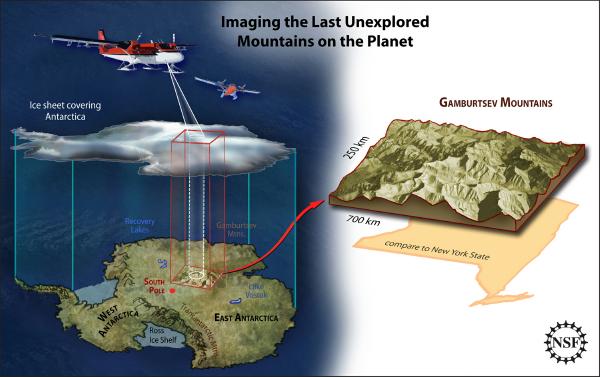
An international team of scientists has not only verified the existence of a mountain range that is suspected to have caused the massive East Antarctic Ice Sheet to form, but also has created a detailed picture of the rugged landscape buried under more than four kilometers (2.5 miles) of ice.
You've heard the saying that money won't buy happiness; of course, that is true though some of it is also
sweet lemons rationalization.
So why is it that so many special interest groups insist they need more money or special treatment in order to be happy?
Professor Mariano Rojas from Mexico's Facultad Latinoamericana de Ciencias Sociales agrees and says that public policy programs aiming to tackle poverty need to move beyond simply raising people's income - because there's more to quality of life than money.
Salmonella typhi, the bacteria that causes typhoid fever, is obviously dangerous, with some 13 million people contracting typhoid fever annually, fatally for 500,000 of them.
Sanitation is the primary cause. For Americans there are under 500 fewer cases per year, most of those coming from visits to Mexico and South America. It is also more common in India, Pakistan, and Egypt.