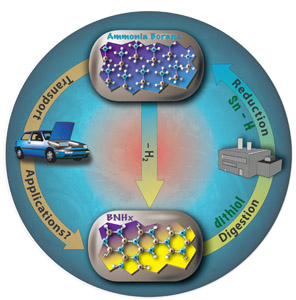
A new method for 'recycling' hydrogen-containing fuel materials could open the door to economically viable hydrogen-based vehicles, according to research in an article appearing today in Angewandte Chemie.
Hydrogen has long been considered an ideal fuel for transportation; it is abundant and can be used to run a fuel cell, which is much more efficient than internal combustion engines, and that also eliminates the formation of gaseous byproducts that are detrimental to the environment.
The secret is out; there's only one science blogging site out there with its name on a satellite and it is us.
Well, so far it is us. The commies in Star City were first into space but the good ol' US of A put a man on the moon and that's what gets remembered. So we can't rest on our laurels just because we're the first to develop it - and commit money - if we're going to put Bloggy into space we need to get it done.
What am I talking about? Bloggy in
space?

Dear Diary,
It was a secret for a while, but I'm going to launch my own satellite! It's going to make music from space. Curious?
It is dangerous to write about neat things. That makes you want to do them yourself. After writing about satellites, I became inspired to build one myself. And it'll be a first-- a musical satellite. A satellite whose sole purpose is to make music until it dies-- music from science.
Thirteen percent of pregnant women in the United States have no health insurance.
The president, when not worrying about the gun nuts, wants to cover them.
One would think these facts alone might encourage some sanity,even unity, in the ever-childish debate about healthcare reform. It’s a natural for the family values cult. Ditto for the meshugga anti-abortion crowd. Why, you can even imagine those terrible death panelists advocating for mommy Obammy care, even if what they really want is to ensure a steady stream of future Soylent Green.
I recently watched a show about alien planets orbiting distant stars. It emphasized the differences between these planets and Earth – too hot, too cold, iron rain, noxious gas – places where humans couldn’t live, but maybe some organisms might.
What I, and everyone else, would like to find is a planet that is like Earth. Some planet orbiting an Earth-like star in the Goldilocks zone – not too hot, not too cold, but just right. A planet with water, and with a breathable atmosphere.
After earning the ire of
computational biologists and
network theorists last week, it's time to get to the positive side of networks and systems biology. If you hadn't guessed it before, the name of this blog reflects my interest in complex biological systems. When I rant about networks and comp. bio., it's tough love, and I really have the best interests of the field at heart.
Someone recently sent me a Fox News article from about a month ago. It’s about risks of using public networks, specifically wireless ones — while the issue isn’t limited to wireless, few people wire themselves in any more.
The newest trend in Internet fraud is “vacation hacking,” a sinister sort of tourist trap. Cybercriminals are targeting travelers by creating phony Wi-Fi hot spots in airports, in hotels, and even aboard airliners.Vacationers on their way to fun in the sun, or already there, think they’re using designated Wi-Fi access points.
A new paradigm in the way we look at cancer with important implications on how we treat it is about to be published in the British Journal of Cancer by Portuguese, Belgian and American researchers. The group use a mathematical approach to reveal how - by changing the dynamics of interaction between the cancer cells and those of the affected tissue – it is possible to control and even potentially cure the disease.
Numerous studies have outlined the benefits of
omega-3 fatty acids but recommendations on how much you should get by people not trying to sell you something are less common. A team of French scientists say they have found the dose of DHA - docosahexaenoic acid, found in cold water fatty fish and fish oil supplements - that is "just right" for preventing cardiovascular disease in healthy men.
Every week you probably see papers ( here and elsewhere) reporting the discovery of new genetic variants that affect the risk of coronary artery disease and heart attacks.
It's an exciting time and the findings will undoubtedly lead to new biological insights into the mechanisms that cause heart attacks, which in turn may result in new types of treatments, but how much value is there to it individually now? Is 'personalized medicine' for heart attacks on the way?