

Several studies demonstrated that alcohol-dependent patients show altered responses to alcohol-related cues. It is assumed that the regular association of these cues with the ingestion of alcohol leads to conditioned reactions, motivating reward or relief craving and instigating drug intake.

A group of German investigators has reported on this phenomenon in the current issue of Psychotherapy and Psychosomatics. They used an innovative method for studying this issue: the measurement of startle reflex, which is the eyeblink response to a sudden loud noise, that is normally inhibited by a pleasant foreground and potentiated when unpleasant stimuli are presented.

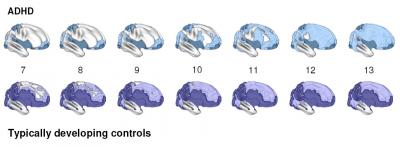
In youth with attention deficit hyperactivity disorder (ADHD), the brain matures in a normal pattern but is delayed three years in some regions, on average, compared to youth without the disorder, an imaging study by researchers at the National Institutes of Health’s (NIH) National Institute of Mental Health (NIMH) has revealed.

The delay in ADHD was most prominent in regions at the front of the brain’s outer mantle (cortex), important for the ability to control thinking, attention and planning. Otherwise, both groups showed a similar back-to-front wave of brain maturation with different areas peaking in thickness at different times.

Chimpanzees crave roots and tubers even when food is plentiful above ground, according to a new study that raises questions about the relative importance of meat for brain evolution. The study documents a novel use of tools by chimps to dig for tubers and roots in the savanna woodlands of western Tanzania.

The chimps’ eagerness for buried treats offers new insights in an ongoing debate about the role of meat versus potato-like foods in the diet of our hominid ancestors, said first author Adriana Hernandez-Aguilar, who collected the field data for her doctoral research at the University of Southern California.

The debate centers on the diet followed by early hominids as their brain and body size slowly increased towards a human level.

Two papers in the latest issue of the American Journal of Clinical Nutrition provide more support for the idea that omega-3s improve brain function.

The first was a cross-sectional study involving about 2000 persons 70-74 years old in Norway. Their fish consumption was measured and they took a battery of cognitive tests. The more fish you ate, the better your score on every test, even after adjustment for several things.

A diet rich in fish, omega-3 oils, fruits and vegetables may lower your risk of dementia and Alzheimer’s disease, whereas consuming omega-6 rich oils could increase chances of developing memory problems, according to a study published in the November 13, 2007, issue of Neurology®. The study did not find any association between consuming corn oil, peanut oil, lard, meat or wine and lowering risk of dementia.

For the study, researchers examined the diets of 8,085 men and women over the age of 65 who did not have dementia at the beginning of the study. Over four years of follow-up, 183 of the participants developed Alzheimer’s disease and 98 developed another type of dementia.

Scientists at John Carroll University, working in its Lighting Innovations Institute, have developed an affordable accessory that appears to reduce the symptoms of ADHD. Their discovery also has also been shown to improve sleep patterns among people who have difficulty falling asleep.

The John Carroll researchers have created glasses designed to block blue light, therefore altering a person’s circadian rhythm, which leads to improvement in ADHD symptoms and sleep disorders.

The individual puts on the glasses a couple of hours ahead of bedtime, advancing the circadian rhythm. The special glasses block the blue rays that cause a delay in the start of the flow of melatonin, the sleep hormone. Normally, melatonin flow doesn’t begin until after the individual goes into darkness.

One of the foundations of Einstein's Special Relativity is that no particular frame of reference is better than any other - whether you're sitting on the couch or barreling through space on a rocket, physics doesn't change. On the other hand, as many physics undergrads learn, choosing the right reference frame can simplify your homework problems a lot.

Thanks to Einstein, physicists know that the world looks different depending on how fast you're moving.

A new antenna made of plasma (a gas heated to the point that the electrons are ripped free of atoms and molecules) works just like conventional metal antennas, except that it vanishes when you turn it off.

That's important on the battlefield and in other applications where antennas need to be kept out of sight. In addition, unlike metal antennas, the electrical characteristics of a plasma antenna can be rapidly adjusted to counteract signal jamming attempts.

Plasma antennas behave much like solid metal antennas because electrons flow freely in the hot gas, just as they do in metal conductors. But plasmas only exist when the gasses they're made of are very hot.

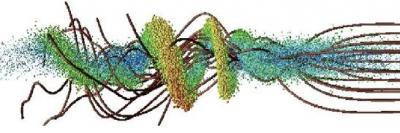
Tiny probes packed with instrumentation have been turned loose in a laboratory in France. The marble-sized devices are an important step on the road to long-anticipated miniaturized machines known as smart dust (picture the artificial swarm in Michael Creighton's "Prey," only without the bloodlust). The small and simple machines are being developed to be released in large numbers to collect data about the motion of fluid systems such as ocean currents and atmospheric winds.

The two centimeter probes are on the large side for smart dust (typically, miniature machines must fill a volume of a cubic centimeter or less to make the cut), still the probes' abilities are impressive for their size.

It defies business sense to let lower supply raise costs and encourage energy alternatives but a study released today by Rice University's Baker Institute for Public Policy finds that the "Big Five" international oil companies (IOCs) are spending less money on oil exploration in real terms despite a four-fold increase in operating cash flow since the early 1990s.

Why would that happen? It may be knowledge that political upheavals in places like Venezuela and Russia could invalidate the investment entirely, making it unattractive for large companies who would be at risk.