







There is no question in my mind but that oil will rise to at least $100 a barrel within the next two years. It is easy to see a scenario of $125 a barrel price in the same time frame. The triple digit price of oil will become the norm. Recently it has been trading in the $80-90 range, and as it approached the upper end of that range the media began again covering the story with “sky is falling” concern about what this might mean for the economy. This reminded me of the comment that James Schlesinger, the first U.S.

The emergence of drug resistant forms of HIV often underlies the failure of current antiretroviral therapies for HIV infection. Specific mutations in the HIV genome confer resistance to individual drugs.

Recombination, a process similar to sexual reproduction in higher organisms, can accelerate the accumulation of resistance mutations by mixing the contents of distinct viral genomes and expedite the failure of therapy. The dynamics of the emergence of recombinant forms of HIV in infected individuals remains poorly understood.

Of course. He didn't. And dozens of writers you have never heard of, much less read, much less quoted in everyday conversation, have. These wrongs are corrected in an alternative universe described here. The Biology/Medicine Prize has also been fairly ridiculous, although at least Robert Gallo hasn't gotten one:

Mankind’s closest living relatives – the world’s apes, monkeys, lemurs and other primates – are under unprecedented threat from destruction of tropical forests, illegal wildlife trade and commercial bushmeat hunting, with 29 percent of all species in danger of going extinct, according to a new report by the Primate Specialist Group of IUCN’s Species Survival Commission (SSC) and the International Primatological Society (IPS), in collaboration with Conservation International (CI).

Titled "Primates in Peril: The World’s 25 Most Endangered Primates—2006–2008", the report compiled by 60 experts from 21 countries warns that failure to respond to the mounting threats now exacerbated by climate change will bring the first primate extinctions in more than a century.

According to a small-scale, in-office, observational study, psychiatrists and parents have significantly different perceptions of the importance of pediatric ADHD and psychiatric comorbidities, particularly regarding the patients’ most concerning behavior.

The study, which utilized accepted sociolinguistic methodologies to evaluate the tone, content and structure of in-office visits, was presented recently at the 20th annual U.S.

Cornell archaeologists are rewriting history with the help of tree rings from 900-year-old trees, wood found on ancient buildings and through analysis of the isotopes (especially radiocarbon dating) and chemistry they can find in that wood.

By collecting thousands of years worth of overlapping tree rings, with each ring representing a tree's annual growth, the researchers have created long-term records in the eastern Mediterranean that allow them to precisely date such seminal milestones in history as when Hammurabi, "the law-giver," reigned, when the massive Santorini volcanic eruption occurred, and the timelines of the Bronze and Iron ages, as well as many more recent events.

Researchers at the Royal Veterinary College, London, have made a significant breakthrough in their understanding of how infection of the uterus damages fertility in cows. Their findings, which show that common uterine infections can damage the ovaries, may provide insights into how to treat infections such as Chlamydia in humans.

Funded by the Wellcome Trust and the Biotechnology and Biological Sciences Research Council, researchers led by Professor Martin Sheldon studied the effect that uterine disease has on the reproductive system in cows.

New images taken with NASA’s Hubble Space Telescope have revealed the wild side of an elliptical galaxy, nearly two billion light-years away, that previously had been considered mild-mannered.

The Hubble photos show shells of stars around a bright quasar, known as MC2 1635+119, which dominates the center of the galaxy. The presence of the shells is an indication of a titanic clash with another galaxy in the relatively recent past.

The collision, which is funneling gas into the galaxy’s center, is feeding a supermassive black hole. The accretion onto the black hole is the quasar’s energy-source.

Questions about human migration from Asia to the Americas have perplexed anthropologists for decades, but as scenarios about the peopling of the New World come and go, the big questions have remained. Do the ancestors of Native Americans derive from only a small number of “founders” who trekked to the Americas via the Bering land bridge? How did their migration to the New World proceed?

A team of 21 researchers, led by Ripan Malhi, a geneticist in the department of anthropology at the University of Illinois, has a new set of ideas.

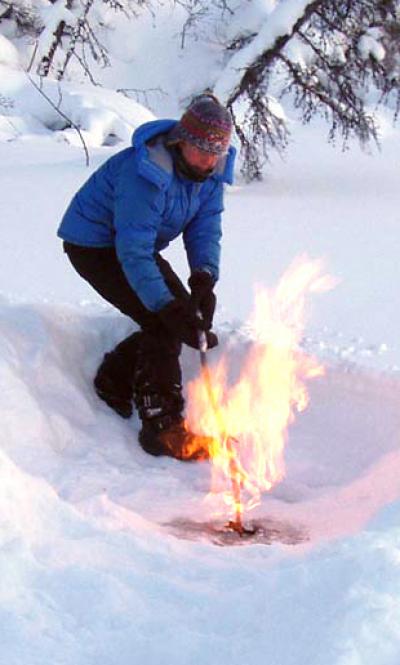
A team of scientists led by a researcher at the University of Alaska Fairbanks has identified a new likely source of a spike in atmospheric methane coming out of the North during the end of the last ice age.

Methane bubbling from arctic lakes could have been responsible for up to 87 percent of that methane spike, said UAF researcher Katey Walter, lead author of a report printed in the Oct. 26 issue of Science magazine. The findings could help scientists understand how current warming might affect atmospheric levels of methane, a gas that is thought to contribute to climate change.

“It tells us that this isn’t just something that is ongoing now. It would have been a positive feedback to climate warming then, as it is today,” said Walter.

