




A team of Canadian and U.S. researchers have uncovered evidence that ragged, kilometre-high undulating features on the surface of Mars were shorelines of massive ancient oceans that once covered one-third of the planet in water.

Mars’ oceanic past has been debated since Viking spacecraft images from the 1970’s pinpointed features that seemed similar to shorelines on the Earth. However, in the 1990s, NASA’s Mars Global Surveyor revealed that peaks and dips along these features had topographic differences of nearly 3 kilometres. Since old shorelines on Earth remain nearly flat relative to sea level, there was widespread skepticism that these features represented ancient shorelines.

A unique discovery of two celestial explosions at exactly the same position in the sky has led astronomers to suggest they have witnessed the death of one of the most massive stars that can exist.

A global collaboration of astronomers, led by Queen’s University Belfast teamed up with Japanese supernova hunter Koichi Itagaki to report an amazing new discovery. This is the first time such a double explosion has been observed and challenges our understanding of star-deaths.


Credit (c) Frederic Durillon - www.animea.com, Courtesy Service d'Astrophysique/CEA

Why do some online communities succeed, like Second Life, Facebook and, well, this one, and some fail?

The answer may be in what their communities think about 'giving' and it can tell us a lot about people in general.

Everyone does something on social sites for a reason. People like to 'get paid' even if that doesn't mean money. It is why people submit articles to Digg - submitters get the satisfaction of knowing they brought an interesting article to people that they may not have found themselves.

Sandia National Laboratories is pioneering the future of superalloy materials by advancing the science behind how those superalloys are made.

As part of Sandia’s nanoscale research, a group of experts specializing in inorganic synthesis and characterization, modeling, and radiation science have designed a radical system of experiments to study the science of creating metal and alloy nanoparticles.


CLICK IMAGE FOR FULL SIZE.

A young star’s strange elliptical ring of dust likely heralds the presence of an undiscovered Neptune-sized planet, says a University of Rochester astronomer

Stars in the early stages of life are surrounded by dust clouds that thin out and dissipate as the star reaches maturity, becoming rings in their final stages. One star, however, has a dust ring that has long puzzled astronomers because it is not centered around the star as usual. Instead, the ring is elliptical, with the parent star off to one side.


Hubble image of Fomalhaut and ring. Credit: NASA

It's no secret that humans can recognize siblings on a biological level. Now it turns out plants can also, according to biologists at McMaster University. Even more, they get downright competitive with strangers of the same species.

“The ability to recognize and favour kin is common in animals, but this is the first time it has been shown in plants” said Susan Dudley, associate professor of biology at McMaster University in Hamilton, Canada. “When plants share their pots, they get competitive and start growing more roots, which allows them to grab water and mineral nutrients before their neighbours get them.

A team of researchers led by University of Virginia Health System geneticists has uncovered a major secret in the mystery of how the DNA helix replicates itself time after time.

It turns out that it is not just the sequence of the bases (building blocks) in the DNA, but also how loosely or tightly the chromatin (the material that makes up chromosomes) is packed at different points of the chromosome that is critical.

Human-caused nitrogen deposition has been indirectly “fertilizing” forests, increasing their growth and sequestering major amounts of carbon, a new study suggests.

The findings create a more complex view of the carbon cycle in forests, where it was already known that logging or other stand-replacement events – whether natural or not – create periods of 5-20 years when there is a net release of carbon dioxide from forests to the atmosphere, instead of sequestration as they do later on.

A decade or so ago, a spate of high profile legal cases arose in which people were accused, and often convicted, on the basis of “recovered memories.” These memories, usually recollections of childhood abuse, arose years after the incident occurred and often during intensive psychotherapy.

So how accurate are recovered memories? The answer is not so clear. In fact, this question has lead to one of the most contentious issues in the fields of psychology and psychiatry.

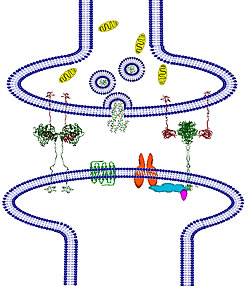
As a result of mapping the structure of the protein complex implicated in autism spectrum disorders, a research team led by scientists at University of California, San Diego have discovered how particular genetic mutations affect this complex and contribute to the developmental abnormalities found in children with autism. Their work should help scientists pinpoint the consequences of other genetic abnormalities associated with the disorder.


Neuroligin/neurexin complex in the synapse

