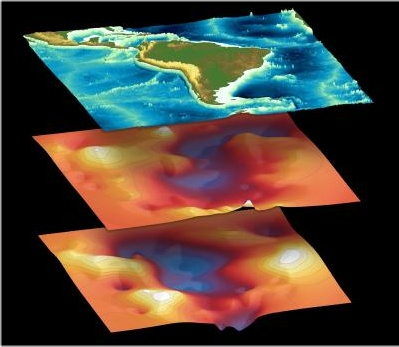



Researchers have attempted to measure all the material leaving and entering a mountain range over millions of years and discovered that glacial erosion can, under the right circumstances, wear down mountains faster than plate tectonics can build them.

A study of the St. Elias Mountains on the Alaskan coast by researchers from The University of Texas at Austin, University of Florida, Oregon State University and elsewhere found that erosion accelerated sharply about one million years ago.

Whenever mummies are mentioned, our imaginations stray to the dusty tombs and gilded relics of ancient Egyptian burial sites. With their eerily lifelike repose, the preserved bodies of ancient Pharaohs like Hatshepsut and Tutankhamen stir our imaginations and stoke our interest in people and cultures which have long since passed away.

Scientists have revealed that glucocorticoids, a class of steroid hormones that are commonly prescribed as drugs, enhance muscle endurance and alleviate muscular dystrophy through activation of the gene KLF15. Critically, this pathway is not involved in muscle wasting or the other major detrimental effects of prolonged steroid use.

The discovery could lead to the development of new medications that improve muscle function without the negative consequences caused by long-term steroid exposure, especially important for progressive muscle wasting diseases like Duchenne's muscular dystrophy (DMD).

Ground-breaking new research has shown that erosion caused by glaciation during ice ages can, in the right circumstances, wear down mountains faster than plate tectonics can build them.

The international study, including Dr Ian Bailey from the University of Exeter, has given a fascinating insight into how climate and tectonic forces influence mountain building over a prolonged period of time.

The research team attempted to measure all the material that left and entered the St Elias Mountain range, on the Alaskan coast, over the past five million years, using state-of-the-art seismic imaging equipment and marine coring.

The introduction of agriculture into Europe about 8,500 years ago changed the way people lived right down to their DNA.

Until recently, scientists could try to understand the way humans adapted genetically to changes that occurred thousands of years ago only by looking at DNA variation in today's populations. But our modern genomes contain mere echoes of the past that can't be connected to specific events.

Now, an international team reports in Nature that researchers can see how natural selection happened by analyzing ancient human DNA.

Assisted dying may become legal in Canada on Feb. 6, 2016 and given that country's recent lurch to one side of the political spectrum, doctors are worried that a more social authoritarian government will penalize then if they have conscientious objections to assisted dying.

Dr. John Fletcher, Editor-in-Chief of CMAJ (Canadian Medical Association Journal) argues that just as physicians in Canada are currently allowed to opt out of referring pregnant women for abortion, so too must a similar option be available in the case of referrals for assisted death.

Engineers have developed a new technology that uses an oscillating electric field to easily and quickly isolate drug-delivery nanoparticles from blood. 

Nanoparticles are generally one thousand times smaller than the width of a human hair and are difficult to separate from plasma, the liquid component of blood, due to their small size and low density. Traditional methods to remove nanoparticles from plasma samples typically involve diluting the plasma, adding a high concentration sugar solution to the plasma and spinning it in a centrifuge, or attaching a targeting agent to the surface of the nanoparticles.

These methods either alter the normal behavior of the nanoparticles or cannot be applied to some of the most common nanoparticle types.

Champion of regeneration, the freshwater polyp Hydra is capable of reforming a complete individual from any fragment of its body. It is even able to remain alive when all its neurons have disappeared. Researcher the University of Geneva (UNIGE), Switzerland, have discovered how: cells of the epithelial type modify their genetic program by overexpressing a series of genes, among which some are involved in diverse nervous functions. Studying Hydra cellular plasticity may thus influence research in the context of neurodegenerative diseases. The results are published in Philosophical Transactions of the Royal Society.

Migration between different communities of bacteria is the key to the type of gene transfer that can lead to the spread of traits such as antibiotic resistance, according to researchers. While horizontal gene transfer - also known as bacterial sex - has long been acknowledged as central to microbial evolution, why it is able to exert such a strong effect has remained a mystery. 

But now scientists at Oxford University have demonstrated through mathematical modelling that the secret is migration, whereby movement between communities of microbes greatly increases the chances of different species of bacteria being able to swap DNA and adopt new traits.

The study sheds new light on how the spread of traits such as antibiotic resistance is able to happen.

While in the process of fact-checking information that is contained in the book I am finalizing, I had the pleasure to have a short discussion with Gordon Kane during the weekend. A Victor Weisskopf distinguished professor at the University of Michigan as well as a director emeritus of the Michigan Center for Theoretical Physics, Gordon is one of the fathers of Supersymmetry, and has devoted the last three decades to its study.


