
One organization and one law, the federal government's National Center for Complementary and Alternative Medicine (formerly the National Center for Complementary and Alternative Medicine) and the Dietary Supplement Health and Education Act of 1994 (DSHEA), are why a govenment that won't let you get a haircut without a certification and hygiene standards won't do anything about supplements until dead bodies show up.

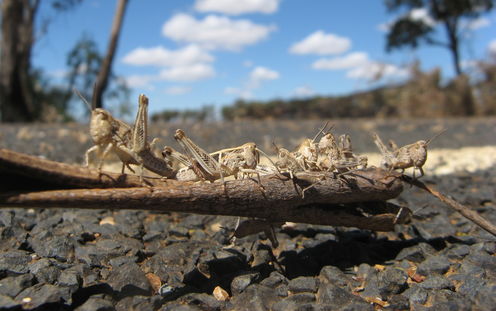
From the Biblical plagues of Egypt to a major infestation in Madacasgar two years ago, locust swarms have caused chaos throughout history. Just one swarm can cover 20% of the land surface of the Earth, affecting the livelihood of 10% of the world’s population by consuming up to 200 tons of vegetation per day.

Have you ever used Airbnb or other hotel replacement services when traveling? If yes, you are likely to travel more than you used to, you choose your destination from among a wider set of alternatives, and you are more active in your destination, according to a recent paper from the University of Eastern Finland and Washington State University. 

The authors found that tourists are interested in peer-to-peer accommodation services like Airbnb due to social and financial reasons. Users of peer-to-peer accommodation services are often in social interaction with their hosts, and peer-to-peer accommodation services are a cost-effective alternative to hotels.
 

DNA represents a dynamic form of information, balancing efficient storage and access requirements. Packaging approximately 1.8m of DNA into something as small as a cell nucleus is no mean feat, but unpacking it again to access the required sections and genes? That requires organization.

In a nutshell, this is achieved through DNA condensed and packaged as chromatin, a complex of DNA and proteins called histones, which is constantly modified as the DNA is accessed. The histone proteins need constant replacement to maintain the correct chromatin structure required for all DNA related processes in the cell.

Top quarks, the heaviest known elementary particles, were discovered in 1995 by the CDF and DZERO collaborations, when the two Fermilab experiments spotted the decay of  top-antitop pairs produced by strong interactions in the proton-antiproton collisions provided by the Tevatron collider at 1.8 TeV center-of-mass energy. 

Thiazide is a popular diuretic for lowering high blood pressure but may not excrete salt as expected in patients with congestive heart failure and or dehydration and should be taken with caution, according to a study in mouse models presented at a meeting of the American Society of Nephrology's Kidney Week activities in San Diego.

If you are skeptical of nutrition advice in general, or Miracle Vegetable of the Week claims in mainstream media, you have good reason: In a world where the United Nations body on cancer meta-analyses, which self-identifies as the most important carcinogen-finder in the world, lists sausage as the same level of hazard as cigarettes and mustard gas, it's fine to roll your eyes and groan and wonder how long before yet another meaningless Prop. 65 warning label shows up in California.

Scientists have nearly completed the first map of the mantle under the tectonic plate that is colliding with the Pacific Northwest and putting Seattle, Portland and Vancouver at risk of the largest earthquakes and tsunamis in the world.

The new report describes how the movement of the ocean-bottom Juan de Fuca plate is connected to the flow of the mantle 150 kilometers (100 miles) underground, which could help seismologists understand the forces generating quakes as large as the destructive Tohoku quake that struck Japan in 2011 and led to the tsunami that caused the issues at the Fukushima nuclear plant.

CAMBRIDGE, MA -- MIT engineers have designed magnetic protein nanoparticles that can be used to track cells or to monitor interactions within cells. The particles, described today in Nature Communications, are an enhanced version of a naturally occurring, weakly magnetic protein called ferritin.

"Ferritin, which is as close as biology has given us to a naturally magnetic protein nanoparticle, is really not that magnetic. That's what this paper is addressing," says Alan Jasanoff, an MIT professor of biological engineering and the paper's senior author. "We used the tools of protein engineering to try to boost the magnetic characteristics of this protein."

If you are planning to take the long trip to Mars, don't forget to pack sleeping pills and skin cream.

A new study examines the medications used by astronauts on long-duration missions to the International Space Station. As one might expect, the study shows that much of the medicine taken by astronauts in space relates to the unusual and confined microgravity environment in which they work or to the actual work that they are doing to complete their missions. Among these medications, the report shows that the use of sleep aids and incidence of skin rashes were higher than expected.