


A year of treatment with nicotinamide, a form of vitamin B3, significantly lowered the risk of common, non-melanoma skin cancer in high-risk patients, according to a paper in the New England Journal of Medicine.

All 386 participants in the study had a history of skin cancer, increasing their risk for additional skin cancers. Taken as a twice-daily pill for 12 months, nicotinamide reduced the incidence of new non-melanoma skin cancers by 23 percent relative to placebo controls and cut the incidence of pre-cancerous sun spots by around 15 percent. 

Researchers don’t always get it right. Scientists used to toiling in obscurity on arcane subjects can be lured into presenting hyperbolic conclusions from a media that demands sensational headlines, and confirmation bias remains a powerful psychological force within the scientific community.

So what does the media do when honest researchers realize their attention-getting findings were simply wrong? 

If this case of “bee addiction” is any indicator, the answer is nothing.

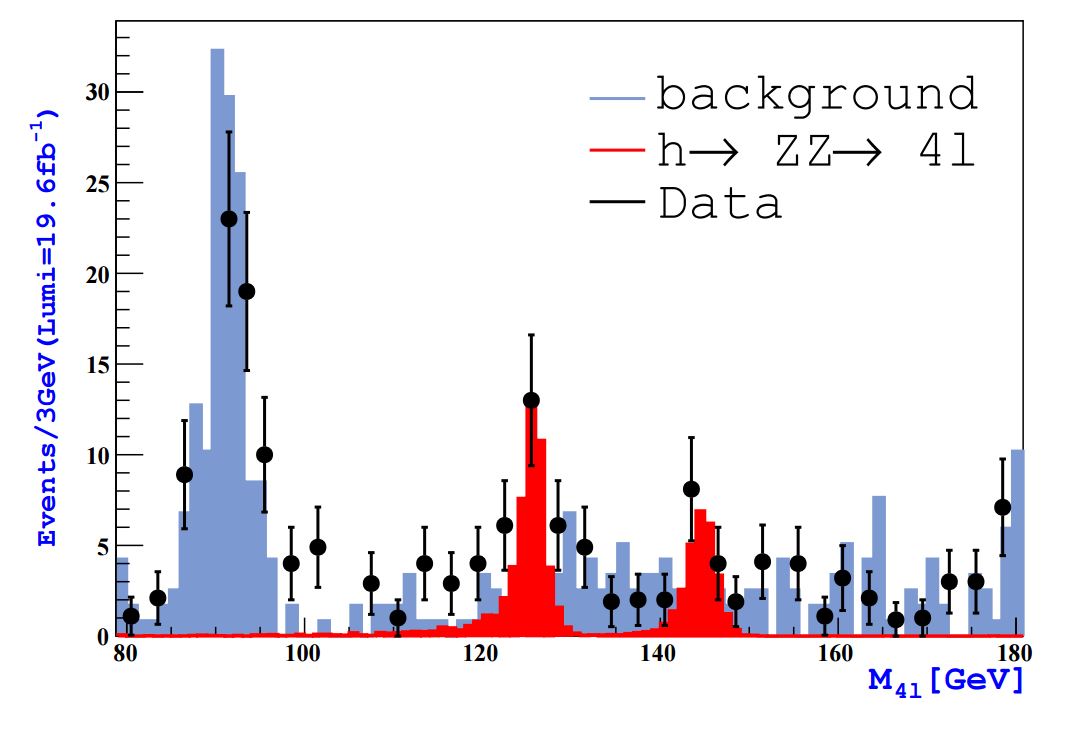
A longtime follower of this blog, Tony Smith, pointed out to me today this arxiv paper published three days ago. In it, CMS data from Run 1 of the LHC are used to speculate that there might be a second Higgs boson hiding in the data at a mass of about 145 GeV. Check out the two graphs that they produce.
The first one, shown below, is their own interpretation of the four-lepton invariant mass from CMS data and background in the H-->ZZ--> four lepton final state:


Scientists from the Institute of Organic Chemistry and Biochemistry in Prague, Czech Republic, and the Max Planck Institute for Chemical Ecology in Jena, Germany, studied the pheromone chemistry of moths and discovered a new evolutionary mechanism: A single amino acid residue in desaturases − enzymes that introduce double bonds, of the tobacco hornworm Manduca sexta − switches the desaturase products from mono- and di-unsaturated to tri-unsaturated sex pheromone precursors.

Regulation of a family of brain proteins known as bromodomain and extra-terminal domain containing transcription regulators (BETs) plays a key role in normal cognition and behavior, according to a study conducted at the Icahn School of Medicine at Mount Sinai and published advanced online on September 21 and in print October 19 in The Journal of Experimental Medicine.

The Mount Sinai study focuses on epigenetics, the study of changes in the action of human genes caused by molecules that regulate when, where and to what degree our genetic material is activated, rather than focusing on genetic changes in the DNA code we inherit from our parents.

Yesterday my 16 year old son surprised me by explaining that he had been taught at school what alpha, beta, and gamma decays are. He had learned a lot, but I was able to add a little more background information to the picture as he asked me what was the neutrino, which his professor had correctly explained was one of the particles emitted in beta decay.

With hindsight, my surprise probably comes from keeping my brain inactive and sticking to a rather conservative idea of how sciences should be taught at school; that idea is that understanding physics requires you to have some solid basis in maths, and that the explanation of phenomena should proceed along with quantitative calculations. 

Alva-Amco Pharmacal Companies, Inc. is recommending that parents give their children a placebo - something real doctors would never do. The product they are selling is called Nauzene and they are promoting it for gastroenteritis, the inflammation of the stomach and intestinal tract that can cause nausea, vomiting, diarrhea and abdominal cramping and is commonly called "stomach flu."

The manufacturers say it will relieve upset stomach "without the added risk of salicylates found in some other remedies that can cause health issues in young children." They also say it is paraben-free and Free of artificial flavors or dyes.

A single blood test could reveal whether an otherwise healthy person is unusually likely to die of pneumonia or sepsis within the next 14 years.

Based on an analysis of 10,000 individuals, researchers have identified a molecular byproduct of inflammation, called GlycA, which seems to predict premature death due to infections.

The findings, published October 22 in Cell Systems, suggest that high GlycA levels in the blood indicate a state of chronic inflammation that may arise from low-level chronic infection or an overactive immune response. That inflammation damages the body, which likely renders individuals more susceptible to severe infections.

Like seeds, pollen loses most of its water during maturation, entering a state of suspended animation. This allows it to survive its journey from male to female organs of a flower, where it is rehydrated by sugary fluids secreted by the female organ, and springs into life again.

But rehydrating is a dangerous process, one that can kill the pollen grain before it can fertilize the egg if not properly controlled.

New research from the lab of Elizabeth Haswell, PhD, associate professor of biology in Arts&Sciences at Washington University in St. Louis, shows how pollen survives the reanimation process. A specialized protein with ancient origins helps the hydrating pollen grain relieve excessive pressure and survive the stressful transition.

Delivering the hormone leptin directly to the brain through gene therapy can aid weight loss without the significant side effect of bone loss, according to new research.

Rapid or significant weight loss through dieting can trigger bone loss. Loss of bone density, in turn, can lead to increased susceptibility to bone fractures in older adults, which can have a debilitating effect on quality of life.

The bone loss is most concerning in people whose weight fluctuates due to "yo-yo" dieting, or repeated cycles of weight gain and loss, because bone lost during weight loss is not typically regained when the person gains weight again, said Urszula Iwaniec, an associate professor in the College of Public Health and Human Sciences at Oregon State University.

