
Doctors at the University of Arizona Cancer Center at St. Joseph's Hospital and Medical Center in Phoenix report  in Lancet Oncology that a new treatment for ovarian cancer can improve response rates (increase the rate of tumor shrinkage) and prolong the time until cancers recur.  

Trebananib (formally known as AMG 386; Amgen) is a first-in-class peptide-Fc fusion protein (or peptibody) that targets angiogenesis (the growth of new blood vessels into cancerous tumors) by inhibiting the binding of both angiopoietin 1 and 2 to the Tie2 receptor.

This is a different mechanism of action than other agents that also effect angiogenesis by inhibiting vascular endothelial growth factor (VEGF) such as bevacizumab (Avastin; Genentech).  

Epidemiologists who analyzed survey questionnaire responses came up with a new way to predict risk of lung cancer - the time you spent before lighting up the first time.

Lung cancer prediction is tricky business - though it is commonly assume that people who smoke will get lung cancer, shockingly few smokers do and almost half of lung cancer patients didn't smoke. There are standard markers that epidemiologists have used to match cancer risk - how many cigarettes per day and even cumulative exposure (pack-years).

The new survey results lead them to suggest that time before first light up may be a predictor for both light and heavy smokers. 

People who get a blacklegged tick bite may be getting more pathogens than they expected.  A new study found that ticks are almost twice as likely as previously believed to be infected with two pathogens—the bacterium that causes Lyme disease and the protozoan that causes babesiosis.  

Almost 30 percent of the ticks were infected with the agent of Lyme disease. One-third of these were also infected with at least one other pathogen. The agents of Lyme disease and babesiosis were found together in 7 percent of ticks.

There's no politics in ice cream but if there were, you can bet Ben  &  Jerry's would be the official ice cream of Mother Jones and Union of Concerned Scientists and other Democrats everywhere.

It's over-priced, it has all the correct social positions for the coasts, and it engages in the sort of naturalistic fallacies and logical flip-flops that anti-science progressives love.

Like: ice cream is not healthy if it has GMOs.

Well, it's junk food. It's inherently unhealthy yet they have said with a straight face they want their customers to believe they made it healthier by not having syrup made from a corn that had a genetic modification to allow it to be grown with fewer toxic chemicals.

If you could live longer, would you be weaned on an extreme, emaciating diet?

The search for the foundation of youth has been happening forever and a popular idea in recent years has been caloric restriction - mice weaned on starvation diets live long and a new study of the tiny nematode worm C. elegans finds results even more alarming - it triggered a state of arrested development.

Einstein's theory of relativity conceptualizes time as we would a spatial dimension, like height, width, and depth. But unlike dimensions, time seems to permit motion in only one direction: forward. 

This directional asymmetry — the "arrow of time" — is something of a head fake in theoretical physics. It's not a dimension if it's based on three dimensions and it isn't a dimension if it only goes one way. Like an ant walking around a wire in string theory, it makes for fine popular storytelling, but is it science? 

A new survey shows egg carton labels are confusing organic consumers. They don't really know the difference between "pasture-raised" eggs and the “free-range” and “cage-free” kind but a pasture-raised company is banking on the fact that if people do know, they will spend more on their eggs.

Almost anything can be free-range, for example. If a chicken can poke their head through a hole, well, that's free range. And cage free can still be jammed in tighter than a United Airlines cross-country flight, it just can't be in a cage.

It's puzzling how some people can look at a baby and say 'she looks like her dad' - computers have historically been even more limited. While a four-year-old can look at a cartoon of a chicken and say "That's a chicken", that sort of problem stumps computers.

But next week at the IEEE Computer Vision and Pattern Recognition conference in Columbus, a University of Central Florida research team is going to show a facial recognition tool that is not only capable of matching pictures of parents and their children but can create accurate photos of missing children who will have aged.

Nature gets a bad rap, according to a new paper. For thousands of years, fickle weather has been blamed for tremendous suffering caused by massive flooding along the Yellow River, long known in China as the "River of Sorrow" and "Scourge of the Sons of Han."

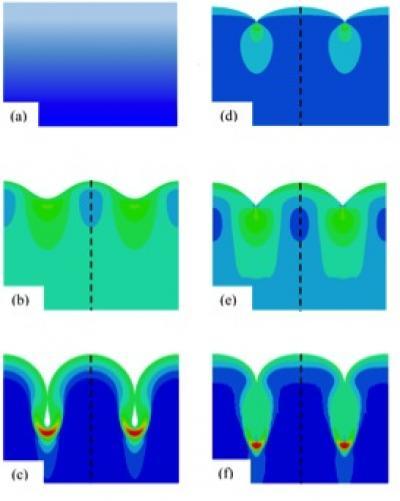
Scientists have created a one-step process for producing highly efficient materials that let the maximum amount of sunlight reach a solar cell - by finding a simple way to etch nanoscale spikes into silicon that allows more than 99 percent of sunlight to reach the cells' active elements, where it can be turned into electricity.

The more light absorbed by a solar panel's active elements, the more power it will produce. But the light has to get there. Coatings in current use that protect the active elements let most light pass but reflect some as well.

Various strategies have cut reflectance down to about 6 percent but the anti-reflection is limited to a specific range of light, incident angle and wavelength.

