


This news release is available in German.

Researchers from North Carolina State University have developed a new technique that uses existing technology to allow researchers and natural resource managers to collect significantly more information on water quality to better inform policy decisions.

"Right now, incomplete or infrequent water quality data can give people an inaccurate picture of what's happening – and making decisions based on inaccurate data can be risky," says Dr. François Birgand, an assistant professor of biological and agricultural engineering at NC State and co-author of a paper describing the work. "Our approach will help people get more detailed data more often, giving them the whole story and allowing them to make informed decisions."

The banana variety Yangambi km5 produces toxic substances that kill the nematode Radopholus similis, a roundworm that infects the root tissue of banana plants – to the frustration of farmers worldwide. The finding bodes well for the Grande Naine, the export banana par excellence, which is very susceptible to the roundworms.

This news release is available in German.

Scientists in Freiburg may have discovered a fundamental aggravating factor in autoimmune diseases. If B-lymphocytes lack the protein PTP1B, the cells will become hyperactive for stimulatory signals and can thus promote an autoimmune attack. This study offers an additional explanation to how B-cells regulate an immune response.

Beer drinkers know that hops are what gives the drink its bitterness and aroma. Recently, scientists reported that the part of hops that isn't used for making beer contains healthful antioxidants and could be used to battle cavities and gum disease.

A new identified some of the substances that could be responsible for these healthful effects. 

How do researchers know what color ancient fossils were when they lived?

Paleontologists studying fossilized feathers have proposed that the shapes of certain microscopic structures inside the feathers can reveal the color of ancient birds but new research finds that it is not yet possible to tell if these structures – thought to be melanosomes – are what they seem, or if they are merely the remnants of ancient bacteria.

Synthetic spider silk of fantastical, superhero strength is finally speeding toward commercial reality.

The material, which is five times stronger than steel, could be used in products from bulletproof vests to medical implants, according to an article in Chemical&Engineering News (C&EN).

ITHACA, N.Y. – Like mobsters following strict orders, newly engineered molecules called "ubiquibodies" can mark specific proteins inside a cell for destruction – a molecular kiss of death that is paving the way for new drug therapies and powerful research tools.

Led by professor Matthew DeLisa, chemical engineers at Cornell University have developed a new type of antibody, called a "ubiquibody," which is an antibody fragment they have inserted into the natural process known as the ubiquitin-proteasome pathway (UPP). Their work appears in the March 16 issue of the Journal of Biological Chemistry and is highlighted in an analysis piece in the publication SciBX.

This news release is available in French.

Montreal, March 5, 2014 — There are clear benefits to raising a bilingual child. But could there be some things learning a second language doesn't produce, such as a more open-minded youngster?

New research from Concordia University shows that, like monolingual children, bilingual children prefer to interact with those who speak their mother tongue with a native accent rather than with peers with a foreign accent.

Imagine driving on a dark road. In the distance you see a single light. As the light approaches it splits into two headlights. That's a car, not a motorcycle, your brain tells you.

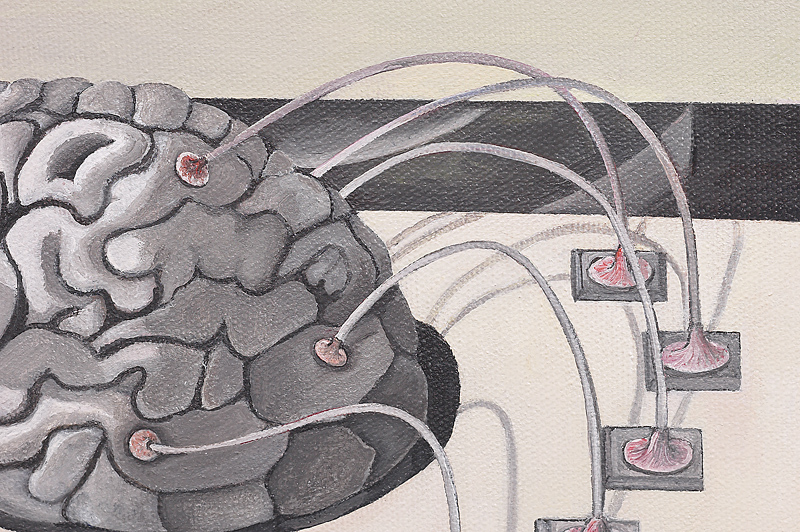
A new study found that neural circuits in the brain rapidly multitask between detecting and discriminating sensory input, such as headlights in the distance. That's different from how electronic circuits work, where one circuit performs a very specific task. The brain, the study found, is wired in way that allows a single pathway to perform multiple tasks.

