







Want to know how to create a $1 million company? Give $60 million to someone claiming they are going to revolutionize journalism by hiring a bunch of young, edgy people who don't care about business or making money, but who believe success happens by being popular on Facebook.

You know who is the only company with long-term success being popular on Facebook? Facebook. For everyone else, it is a terrible business model. "Field of Dreams" was just a movie, folks, wishful thinking and building something no one wanted is not why Reaganomics worked. 
Women May Earn Just 49 Cents on the Dollar, is the title of an article by Annie Lowrey in The Atlantic.

It's only below the fold that, after laying out lots of links and obfuscation and conflicting claims designed to make the audience believe the situation is oh so complicated that we get this quiet disclaimer:

One of the most baffling puzzles of modern astrophysics is the nature of Fast Radio Bursts, which were discovered in 2007. These are seemingly rare, extremely bright flashes of light with radio wavelengths. They last only milliseconds; originate outside our galaxy, the Milky Way; come from regions with enormously strong magnetic fields; and pass through a significant amount of gas or dust before reaching Earth.

John Wiley  &  Sons Inc., the global academic publishing house with nearly $2 billion in revenue, recently got embroiled in a Twitter controversy about the efforts of one publication to go open access.
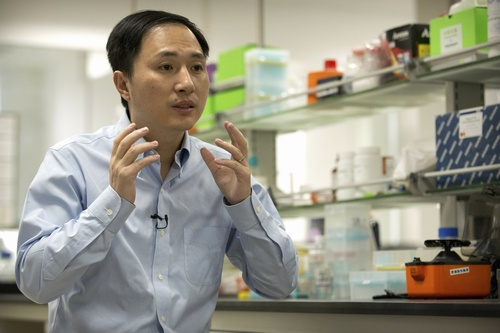
Though vitriol and outrage are common in western culture in 2018, when it comes to claims that a researcher in China used CRISPR technology to edit a human embryo, bloggers, journalists and scientists on social media have taken it to another level.

Without even reading the paper. Because there isn't one. Nor is there any data.

It's just some guy claiming he did it, not once but twice. And based on that people are going on tirades about how it violates ethics - well, their subjective notion of ethics, none of which have anything to do with the culture of China. 
A new paper in Health, Risk&Society reports that women concerned about breast cancer often go to "Dr. Google" first but how much they trust it varies - more educated women, for example, trust it more, while less educated women would rather see a doctor.
When Dr. He Jiankui announced that he had used CRISPR to prevent future HIV infection in twin girls, there was outrage across the United States, but most of it had nothing to do with science. It was instead concern that a mad scientist with suspect ethics had used a new technology to edit human embryos, and if that remains unchecked Frankenhumans could be born. 

It may be 2018 but it feels like 2001 all over again. 

Obesity is a disease where people accumulate more and more fat. When they reach a certain point, their fat stops working and they develop disease, such as type 2 diabetes. But not all fat is bad. The fat that accumulates in obesity is called white fat, but a second form of fat (brown fat) could actually be used to treat obesity.

Brown fat has evolved to turn fuel into heat. In small animals, like mice and voles, brown fat makes heat that helps them survive, even in freezing temperatures.

Oxygen in the Earth’s atmosphere is necessary for complex forms of life, which use it during aerobic respiration to make energy. The levels of oxygen dramatically rose in the atmosphere around 2.4 billion years ago, and speculation is that is when organisms called cyanobacteria, which perform the same type of organic photosynthesis that all plants do today, first evolved, and  could perform oxygen-producing (oxygenic) photosynthesis.

Perhaps cyanobacteria could have evolved before 2.4 billion years ago but something prevented oxygen from accumulating in the air.

The idea of scientists tinkering with the genes of babies was once the provenance of science fiction, but now it’s apparently entered the realm of reality: On Nov. 26, Chinese scientist He Jiankui reported the historic live births of twin girls whose genes he had edited. The goal may have been noble: to use CRISPR to alter their genes to include a variant protective against transmission of HIV.

