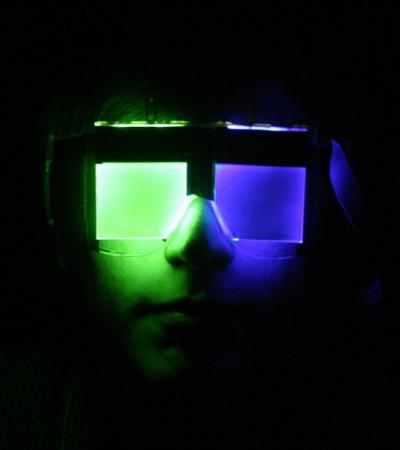




A new study in Neuroscience Letters says that short-wavelength light, including natural light from a blue sky, is highly effective at stimulating the circadian system while exposure to other wavelengths — and thus colors — of light may necessitate longer exposure times or require higher exposure levels to be as effective at stimulating our biological clocks.

In some instances, exposure to multiple wavelengths (colors) of light simultaneously can result in less total stimulation to the circadian system than would result if either color were viewed separately, a phenomenon known as "spectral opponency." The LRC scientists have shown that the circadian system shares neurons in the retina — which exhibit spectral opponency and form the foundation for our perception of color — with the visual system. Thus, in principle, the circadian system may be able to distinguish between lights of different colors.

More than meets the eye To demonstrate that the circadian system exhibited spectral opponency formed in the retina, the researchers exposed 10 subjects to three experimental conditions: one unit of blue light to the left eye plus one unit of green light to the right eye; one unit of blue light to the right eye plus one unit of green light to the left eye; and half a unit of blue light plus half a unit of green light to both eyes and then measured each individual's melatonin levels, a natural indicator of the circadian clock.

SAN FRANCISCO, California, June 6 /PRNewswire/ --

- "ADVANCE Results go Beyond Existing Evidence"

New results from the world's largest ever study of diabetes treatments show that intensive blood glucose (sugar) control using modified release gliclazide and other drugs as required, protects patients against serious complications of the disease. In particular, intensive treatment reduces the risk of kidney disease by one-fifth. Presented today at the American Diabetes Association and published in the New England Journal of Medicine, the results of ADVANCE (Action in Diabetes and Vascular Disease) show that this intensive treatment strategy has the potential to benefit millions of diabetic patients worldwide.

TORONTO, Canada, June 6 /PRNewswire/ -- Archimed, the woundcare division of Insense Ltd., today announced it has received approval from Health Canada for the use of its revolutionary Oxyzyme product in the treatment of difficult and chronic wounds. Oxyzyme was first trialed in Toronto by Dr. Gary Sibbald, one of the world's leading wound care specialists, in 2004 by his team at the Toronto Wound Healing Centres. The announcement was made at the 3rd Congress of the World Union of Wound Healing Societies taking place from June 4-8, 2008 at the Metro Toronto Convention Center.

CHARLOTTE, North Carolina, June 6 /PRNewswire/ --

Effective July 1, 2008, or as allowed by contract, BASF will increase prices on all kaolin products that are manufactured at the BASF middle Georgia, USA, kaolin operation and exported to Asia and the Middle East.

This action is necessary primarily due to the dramatic escalation of ocean freight costs. Several other cost factors, such as energy, chemicals, and mining costs, continue to impact the overall business. The existing energy surcharge program remains in effect.

Kaolin customers can determine the precise impact on their purchases by contacting their local BASF sales representative.

BERLIN, June 6 /PRNewswire/ -- The German parliament (Bundestag) has agreed to new laws that strengthen conditions for renewable energies investments. The laws are part of the government's "Climate Package," the goals of which are saving 250 million metric tons of CO2 by 2020, with renewable energies contributing to 30% of electricity production by the same year. These legal changes strengthen Germany as an investment location for renewable energies and energy efficiency technologies.

LONDON, June 6 /PRNewswire/ -- A famous name in car manuals has taken a diversion to give male carers of people with multiple sclerosis (MS) a guide to help them deal with the everyday challenges of their role.

To coincide with Carers Week (9 June to 15 June), the MS Society has teamed up with the renowned publisher Haynes to produce MS Carers - The man's guide to caring for someone with multiple sclerosis.

The new manual is written in an accessible and familiar style and discusses everyday issues such as relationships, financial help and gives tips to help the carer to also look after their own health and wellbeing.

A few days ago I had the opportunity of moderating a conversation with philosopher Daniel Dennett, hosted by the New York Society for Ethical Culture as part of their presentation of two of the “Atheists Tapes” produced by Alive Mind. It was a pleasant and intellectually stimulating afternoon, which reminded me both of why I admire Dennett, and also of the points of disagreement we have on substantial issues in philosophy and humanism.

For instance, we certainly agree that religion is, as Dennett puts it in his book, a natural phenomenon. How exactly it came about, and what the relative contribution of biological and cultural evolution was to its shaping remains a matter of debate and a fertile field of inquiry, but religion in that respect is no different from other peculiar human habits, such as producing music, or engaging in team sports (or war, for that matter).

Was Judgment Day at hand? At noon, it was black as night, there was lunch by candle light, the night birds came out to sing while flowers folded their petals and the animals behaved strangely. They called it 'New England's Dark Day' and it's been a mystery for almost 230 years.

The mystery has been solved, according to researchers at the University of Missouri, who say evidence from tree rings reveals massive wildfires as the likely cause, one of several theories proposed after the event but previously dismissed as 'simple and absurd.'

Limited ability for long-distance communication prevented colonists from knowing the cause of the darkness.

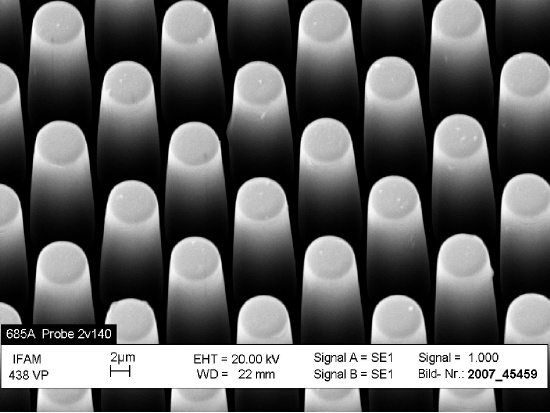
Researchers at the Fraunhofer Institute have taken a page from sports physiology and developed a low-cost optical sensor to measure the force with which tiny, migrating somatic cells push themselves away from an underlying surface. Force analysis devices like these could help to identify specific cell types more reliably than using a microscope or other conventional methods.

The sensor consists of a smooth surface that is studded with 250,000 tiny plastic columns measuring only five microns in diameter, rather like a fakir’s bed of nails. These columns are made of elastic polyurethane plastic. When a cell glides across them, it bends them very slightly sideways. This deflection is registered by a digital camera and analyzed by a special software program.

The researchers working with project manager Dr. Norbert Danz of the Fraunhofer Institute for Applied Optics and Precision Engineering IOF in Jena have already shown that their ‘Cellforce’ sensor works. It will be the task of initial biological tests to show how different cell types behave.

HANOI, Vietnam, June 6 /PRNewswire/ -- QIAGEN was featured this week for its efforts to eliminate cervical cancer at the 14th annual Global Summit of Women in Hanoi, Vietnam. CEO Peer Schatz came to this prominent international platform to issue a call to other leaders in business, NGOs and governments to join him and campaign to create a cervical-cancer-free world.

